4 listings
Filters

 APMEX
APMEX



Prices are fetched automatically and may not reflect current merchant prices. Currency conversions and tax treatment are approximate. Rankings are based solely on price. We are not a dealer and accept no responsibility for transactions with listed merchants. Past performance is not indicative of future results. This site does not provide investment advice. Full disclaimer
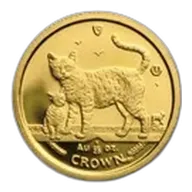
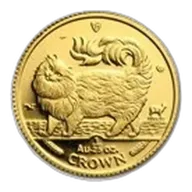
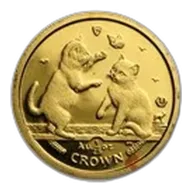
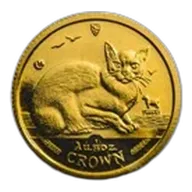
About the 1/25 oz Cat Coin Gold Coin
The 1/25 oz Isle of Man Cat Gold Coin
The Isle of Man Cat is a long-running annual legal tender series that features a different domestic cat breed each year, with each design used once and then permanently retired. The 1/25 oz coin is the smallest of the five gold sizes in the programme, containing 1.244 grams of fine gold with a 1/25 Crown denomination guaranteed by the Isle of Man government. The series ranks among the most fractional-friendly gold programmes available, running from 1 oz down to this tiny denomination, and very few major bullion lines go this small; the Austrian Philharmonic and Somali Elephant are the only two major annual programmes using the 1/25 oz weight.
The buying case is split between two audiences. As entry-level gold, a 1/25 oz coin costs roughly what a few grams of silver would, making physical gold accessible on a small budget or as a gift. As a collectible, the Cat series has unusual crossover appeal: it won "Most Popular Coin of the Year" from an international jury and is reportedly owned by over two million collectors worldwide, drawing cat enthusiasts as well as bullion buyers. The one-year-one-breed format means each date is a closed design.
The honest caveat applies to all coins at this weight: premiums on 1/25 oz gold are the highest of any standard bullion denomination, because die work, quality control, and packaging cost nearly the same as for a full ounce while the gold content is a twenty-fifth of the value. Buyers accumulating gold by weight are better served by 1/10 oz gold coins or larger. Buyers who want the smallest real gold coin with a genuinely distinctive design are exactly who this piece is for.
Isle of Man Cat Gold Sizes and Dimensions
This page covers the 1/25 oz coin; the gold Cat has been issued in five sizes, each carrying a Crown denomination proportional to its weight.
| Size | Weight | Diameter | Denomination |
|---|---|---|---|
| 1 oz | 31.103 g | ~32.7 mm | 1 Crown |
| 1/2 oz | 15.552 g | ~27 mm | 1/2 Crown |
| 1/5 oz | 6.221 g | 21 mm | 1/5 Crown |
| 1/10 oz | 3.110 g | 17-18 mm | 1/10 Crown |
| 1/25 oz | 1.244 g | 13-14 mm | 1/25 Crown |
Purity depends on the year: coins dated 1988 to 1996 are .999 fine gold, while coins dated 1997 onwards are .9999 fine. The series was originally struck by Pobjoy Mint of Surrey, England, with production since transferred to Tower Mint. Production quality is a selling point: the Pobjoy Proof finish strikes each coin four times, producing frosted relief against a mirror-brilliant background, and individual proof coins come boxed with a certificate of authenticity. At around 13 mm across, the 1/25 oz coin is physically tiny and easy to lose, so keeping it in its capsule or original packaging is both a preservation and a resale consideration.
Isle of Man Cat Gold Tax Treatment by Country
- UK: The primary market. Gold investment coins are VAT-free, and the post-1997 .9999 issues comfortably meet the investment gold standard. CGT treatment needs care: the Isle of Man is a Crown Dependency, not part of the UK, so its coins are not automatically CGT-exempt the way Britannias and Sovereigns are. UK investment coins must appear on HMRC's approved list, and individual years of the Cat series should be verified against the current list before assuming exemption.
- US: No federal sales tax and most states exempt bullion. Gold coins of .999+ purity are generally IRA-eligible, and the fractional sizes give low-cost entry points. Long-term gains are taxed at the collectibles rate of up to 28%.
- Canada: Gold refined to 99.5% purity or better in coin form is zero-rated for GST/HST, which the .9999 issues meet.
- Australia and New Zealand: Both exempt investment-grade gold at 99.5%+ purity from GST; the post-1997 coins qualify. New Zealand has no formal capital gains tax.
- EU: Investment gold is VAT-exempt under the EU directive for legal tender gold coins of 900+ thousandths purity priced near melt value; heavily collector-priced examples could fall outside that pricing test.
- Singapore and Hong Kong: No capital gains tax in either; qualifying gold coins are GST-exempt in Singapore and Hong Kong levies no sales tax.
One series-specific wrinkle: where exemptions require pricing near metal value, low-mintage collector years trading well above melt may be treated differently from bullion-priced examples.
One Cat Breed a Year Since 1988
The series launched in 1988 with the Manx cat, the Isle of Man's famously tailless native breed, a deliberate link between the coin programme and the island's identity. The Isle of Man is a self-governing British Crown Dependency in the Irish Sea with its own currency at parity with the pound, and its coins were struck by Pobjoy Mint, a Surrey producer that has made coins for over 30 countries and specialises in Crown Dependency and overseas territory issues. Production later transferred to Tower Mint.
From there the series settled into its defining rhythm: a different domestic cat breed every year, used once and retired. The early decades ran from the Persian (1989) and the unusual choice of the New York Alley Cat (1990), a common street cat among pedigree breeds, through the Siamese, Maine Coon, Scottish Fold, Bengal, Ragdoll, and dozens more, with over 30 breeds featured across more than 35 years of production. The Manx is the single exception to the one-appearance rule, returning in 2012. The obverse carried Ian Rank-Broadley's portrait of Queen Elizabeth II until her death, updating to King Charles III after 2022.
Gold purity stepped up from .999 to .9999 with the 1997 issues, and the gold range expanded across five sizes down to this 1/25 oz denomination. Coloured versions have appeared through the years, while the 1 oz silver proof, struck four times for the Pobjoy Proof finish and typically capped at 10,000 pieces, has been the one constant product. The combination of annual retired designs and modest mintages is what pushed the series toward collector status rather than commodity bullion.
Cat Coin vs Philharmonic, Other IoM Series, and Mainstream Bullion
At this exact weight the practical alternative is the 1/25 oz Austrian Philharmonic, introduced in 2014 as an entry-level gold coin and one of only two major annual bullion programmes at this denomination, alongside the Somali Elephant with its annually changing design. The Philharmonic is the commodity choice: a major mint's flagship with wide dealer availability and a static design. The Cat is the collector choice: retired annual designs and a smaller market. Both are .9999 fine in current production.
Against mainstream bullion series like the gold Britannia or Maple Leaf, the documented difference is orientation: the Cat series is more collector-focused with lower mintages, while the big sovereign coins run much higher mintages at lower premiums with far deeper liquidity. UK buyers should also weigh the tax gap, since Britannias and Sovereigns carry automatic CGT exemption that Isle of Man issues do not.
Within the Isle of Man's own coinage, the island also issues the gold Angel series and the platinum Noble, but the Cat is its most popular and widely collected programme. The closest thematic parallels elsewhere are annual-design animal programmes like the Perth Mint Lunar series, which rotates Chinese zodiac animals rather than cat breeds. For a buyer deciding at this weight, the question is simple: lowest cost per gram of gold points to the Philharmonic or a larger fractional coin, while design scarcity and the series' devoted collector base are what justify the Cat's premium.