67 listings
Filters
| Product | /oz | Premium | Price | |
|---|---|---|---|---|
|
AN
 Pacific Precious Metals
|
$4,465.82 | +1.31% | $4,465.82 | View Deal |
 Camino Coin Company
|
$4,471.89 | +1.45% | $4,471.89 | View Deal |
 Bullion Standard
|
$4,482.24 | +1.68% | $4,482.24 | View Deal |
 NYC Bullion
|
$4,483.80 | +1.72% | $4,483.80 | View Deal |
|
1
 Universal Gold
|
$4,438.78 | +2.11% |
$4,438.70
CA$6,216
|
View Deal |
| $4,482.95 | +2.78% |
$4,483.04
£3,347
|
View Deal | |
 Golden Eagle Coins
|
$4,539.38 | +2.98% | $4,539.38 | View Deal |
 Bullion Standard
|
$4,555.49 | +3.34% | $4,555.49 | View Deal |
 PMR Bullion
|
$4,558.50 | +3.41% | $4,558.50 | View Deal |
|
20
Pacific Precious Metals
|
$4,562.51 | +3.50% | $4,562.51 | View Deal |
 IDC Coin and Bullion
|
$4,564.10 | +3.54% | $4,564.10 | View Deal |
 IDC Coin and Bullion
|
$4,568.20 | +3.63% | $4,568.20 | View Deal |
 The Bullion Bank
|
$4,569.71 | +3.67% | $4,569.71 | View Deal |
 Veldt Gold
|
$4,571.75 | +3.71% | $4,571.75 | View Deal |

 Sharps Pixley
|
$4,528.67 | +3.83% |
$4,528.77
£3,381
|
View Deal |
 Camino Coin Company
|
$4,581.11 | +3.92% | $4,581.11 | View Deal |
 Golden Eagle Coins
|
$4,604.85 | +4.46% | $4,604.85 | View Deal |

 StoneX Bullion
|
$4,561.33 | +4.68% |
$4,561.21
€3,970
|
View Deal |
 StoneX Bullion
|
$4,562.57 | +4.71% |
$4,562.62
€3,971
|
View Deal |
 Veldt Gold
|
$4,621.00 | +4.83% | $4,621.00 | View Deal |
 Atkinsons Bullion
|
$4,585.59 | +5.13% |
$4,585.47
£3,423
|
View Deal |
 GoldCore UK
|
$4,593.36 | +5.31% |
$4,593.46
£3,429
|
View Deal |

 GoldCore
|
$4,594.61 | +5.45% |
$4,594.64
€3,999
|
View Deal |
| $4,619.80 | +5.91% |
$4,619.67
£3,449
|
View Deal | |
 First National Bullion
|
$4,669.15 | +5.92% | $4,669.15 | View Deal |
| $4,678.44 | +6.13% | $4,678.44 | View Deal | |
|
1O
Gold Bank
|
$4,638.15 | +6.34% |
$4,638.05
£3,463
|
View Deal |
 Golden Eagle Coins
|
$4,689.90 | +6.39% | $4,689.90 | View Deal |
 Penny Pincher Coins
|
$4,691.58 | +6.43% | $4,691.58 | View Deal |
 Gold Stock Canada
|
$4,634.42 | +6.61% |
$4,634.54
CA$6,490
|
View Deal |




Prices are fetched automatically and may not reflect current merchant prices. Currency conversions and tax treatment are approximate. Rankings are based solely on price. We are not a dealer and accept no responsibility for transactions with listed merchants. Past performance is not indicative of future results. This site does not provide investment advice. Full disclaimer
About the 1 oz American Eagle Gold Coin
The American Eagle: A 22-Karat Gold Standard
The 1 oz American Eagle is the US Mint's flagship gold bullion coin, struck continuously since 1986 and authorised by the Gold Bullion Coin Act of 1985. It is one of only two major sovereign bullion coins still made in 22-karat (.9167 fine) gold, the other being the South African Krugerrand. The 22-karat alloy (91.67% gold, 3% silver, 5.33% copper) is "crown gold," an English standard for gold coinage dating back to 1526. The copper-silver alloy makes the coin harder and more scratch-resistant than 24-karat alternatives, which matters for a coin likely to be handled.
Each 1 oz Eagle contains exactly one troy ounce of pure gold, but the total coin weight is 33.931g (1.0909 troy ounces) because the alloy metals add mass on top of the gold content. This is a persistent point of confusion: buyers sometimes mistake the total weight for the gold weight. The extra 2.8g is copper and silver with negligible monetary value. The $50 face value is purely symbolic.
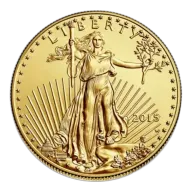
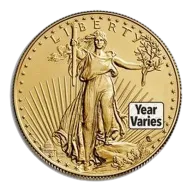
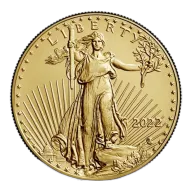
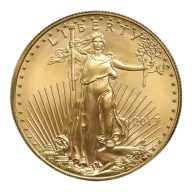
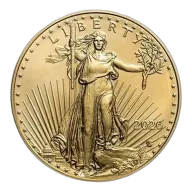
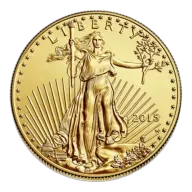
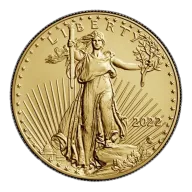
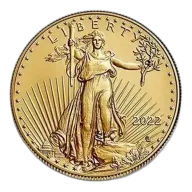
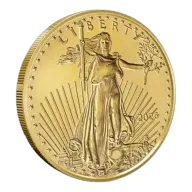
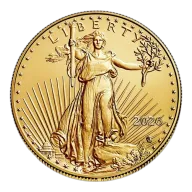
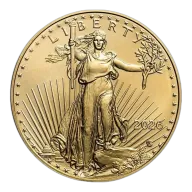
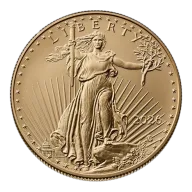
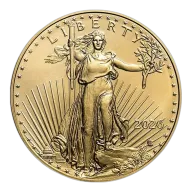
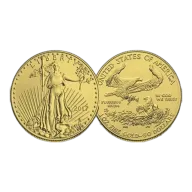
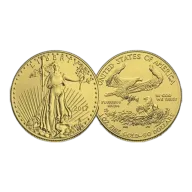
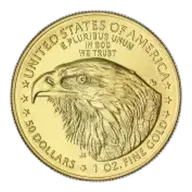
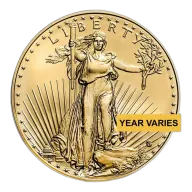
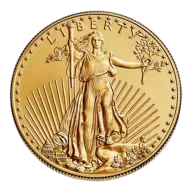
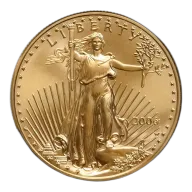
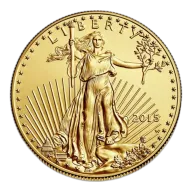
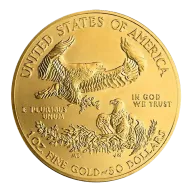
The obverse carries Augustus Saint-Gaudens' Lady Liberty, adapted from his celebrated 1907 $20 Double Eagle, routinely called the most beautiful American coin design. The reverse was updated in 2021 from Miley Busiek Frost's "Family of Eagles" (Type I, 1986-2021) to Jennie Norris' close-up eagle portrait (Type II, 2021-present). Both Type I and Type II were minted during 2021, making it the only transition year and a collector focal point. The Type II introduced a reeded edge anti-counterfeiting feature with an intentionally omitted reed whose position changes annually.
The Gold Eagle's IRA eligibility is unusual. Despite its 22-karat purity falling below the standard IRS minimum of .995 for gold, the coin is explicitly named in IRC Section 408(m)(3), granting it a statutory exemption. This makes it one of only two 22-karat coins permitted in US retirement accounts (the other being pre-1933 Double Eagles, which are technically not bullion coins).
American Eagle Gold Denominations
The American Gold Eagle is produced in four sizes. All contain their stated weight of pure gold; the total coin weight is higher due to the copper-silver alloy.
| Size | Pure gold | Total weight | Diameter | Thickness | Face value |
|---|---|---|---|---|---|
| 1 oz | 31.108 g | 33.931 g | 32.70 mm | 2.87 mm | $50 |
| 1/2 oz | 15.554 g | 16.965 g | 27.00 mm | 2.24 mm | $25 |
| 1/4 oz | 7.777 g | 8.483 g | 22.00 mm | 1.83 mm | $10 |
| 1/10 oz | 3.111 g | 3.393 g | 16.50 mm | 1.19 mm | $5 |
Alloy composition: 91.67% gold, 3% silver, 5.33% copper. Edge: reeded (Type II adds anti-counterfeiting reed variation from 2021).
By law, the gold must come from sources in the United States. Three production varieties exist: standard bullion (sold through authorised purchasers), proof (West Point Mint, "W" mint mark), and uncirculated/burnished (sold directly to the public through the US Mint).
Gold Eagle Tax Treatment and IRA Eligibility
The American Gold Eagle has a unique position in US tax law. Its IRA eligibility, sales tax treatment, and capital gains classification are all worth understanding in detail:
- US (IRA): Eligible by specific statutory provision. The Gold Eagle is explicitly named in IRC Section 408(m)(3), bypassing the normal .995 purity requirement for IRA gold. This exemption exists because the coin was created partly as a retirement savings vehicle. Both Traditional and Roth IRAs can hold Gold Eagles. The coin must be stored at an IRS-approved depository, not held personally.
- US (capital gains): Taxed as a collectible at up to 28% federal rate (not the lower 15/20% for equities). Short-term gains (held under one year) are taxed as ordinary income. The 3.8% Net Investment Income Tax may apply. Dealers must file IRS Form 1099-B for sales of 25 or more 1 oz Gold Eagles in a single transaction.
- US (sales tax): No federal sales tax. Over 35 states exempt bullion. Partial exemptions with thresholds apply in California ($2,000), Florida ($500), Louisiana ($1,000), Massachusetts ($1,000), and New York ($1,000).
- UK: VAT-exempt as investment gold. Not UK legal tender, so subject to CGT. The Britannia series offers CGT exemption that the Eagle cannot match for UK buyers.
- EU: Gold Eagles appear on the EU's annual list of recognised investment gold coins. VAT-exempt across all member states.
- Canada: GST/HST-exempt as investment gold. Not eligible for RRSP (not issued by a Canadian mint).
- Australia: The 22-karat purity (.9167) falls below Australia's 99.5% GST-exemption threshold for gold. Gold Eagles may attract 10% GST in Australia, unlike .9999 coins from Perth Mint, the Royal Mint, or the Royal Canadian Mint. Buyers should confirm with the ATO.
- New Zealand: The .9167 purity also falls below New Zealand's 99.5% threshold. Gold Eagles attract 15% GST in New Zealand. Buyers in NZ should prefer .9999 coins such as the 1oz Gold Kangaroo or the Maple Leaf.
- Singapore: The Investment Precious Metals scheme requires 99.5%+ purity for gold. The Gold Eagle does not qualify; 9% GST applies.
- Hong Kong: No sales tax, no import duty, no capital gains tax. Purity irrelevant for tax purposes.
- South Africa: Gold bullion is VAT-exempt.
The Australian, New Zealand, and Singapore GST exposure is the Gold Eagle's biggest international disadvantage. In those markets, 24-karat coins are strictly more tax-efficient.
From Saint-Gaudens to Type II: The Eagle's Design Evolution
The American Gold Eagle inherits one of the most celebrated lineages in US coinage. The obverse adapts Augustus Saint-Gaudens' full-length Lady Liberty from the 1907 $20 gold piece, a coin commissioned by President Theodore Roosevelt and routinely described as the most beautiful American coin ever struck. Saint-Gaudens (1848-1907) was America's foremost sculptor, whose other works include the Sherman Monument in New York. The Liberty design shows her striding forward with a torch in her right hand and an olive branch in her left, with the Capitol building in the background.
The original reverse (Type I, 1986-2021) was Miley Busiek Frost's "Family of Eagles": a male eagle carrying an olive branch, flying above a nest containing a female eagle and hatchlings. Frost described it as "a tribute to the American family, senior citizens and young people." This design appeared on every Gold Eagle for 35 years.
The 2021 redesign (Type II) replaced the eagle family with a close-up portrait of a bald eagle's head by Jennie Norris, sculpted by Renata Gordon. Norris' entry was her first-ever coin design submission to the US Mint's Artistic Infusion Program, making her debut one of the most prestigious coin design commissions in the world. The Type II also introduced an anti-counterfeiting reeded edge variation, with an intentionally omitted reed whose position changes annually. Both Type I and Type II were produced during 2021, creating a supply pinch that drove secondary market premiums sharply higher for both types.
Mintage has been highly volatile. The 1 oz bullion peaked at over 1.5 million in 1999, crashed to 108,000 in 2019 (one of the lowest years in series history), surged to 747,500 in 2020 during COVID-driven demand, and has declined again since. In 2009, the financial crisis drove such extreme demand that the US Mint suspended proof and uncirculated versions entirely to redirect capacity to bullion production.
Gold Eagle vs Gold Buffalo: Same Mint, Different Philosophy
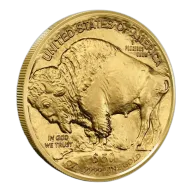
The 1 oz Gold Eagle and the 1oz Gold Buffalo are both US Mint products at the same $50 face value, but they serve different buyer priorities. The Eagle is 22-karat (.9167), harder, more scratch-resistant, and available in four sizes. The Buffalo is 24-karat (.9999), softer, more prone to contact marks, and limited to 1 oz. Both contain exactly one troy ounce of gold, but the Eagle weighs more due to its alloy. Both are IRA-eligible, though through different legal mechanisms (the Eagle by statutory name, the Buffalo on purity merit).
For buyers who want fractional sizes from the US Mint, the Eagle is the only option. For buyers who prioritise purity, the Buffalo matches the Canadian Maple Leaf and Gold Britannia at .9999. The Eagle has deeper secondary market liquidity thanks to its 20-year head start.
Gold Eagle vs the Krugerrand
The 1oz Gold Krugerrand is the Gold Eagle's closest international analogue: both are 22-karat, both contain exactly one troy ounce of gold in a heavier alloyed coin, and both were designed as practical investment coins where durability matters. The Krugerrand uses a pure copper alloy (no silver), giving it a warmer, more orange-gold colour than the Eagle's slightly cooler tone. The Krugerrand has no face value (legal tender at gold value in South Africa), while the Eagle carries a $50 symbolic face value. The Krugerrand typically trades at lower premiums due to its massive cumulative production (over 60 million coins since 1967), but the Eagle commands higher premiums in the American market.
Gold Eagle vs the Britannia
The 1oz Gold Britannia is .9999 fine, CGT-exempt in the UK, and carries four layers of visual security features (latent image, surface animation, micro-text, tincture lines). The Gold Eagle has none of these. For UK buyers, the Britannia is categorically superior on tax efficiency. For US buyers, the Eagle's IRA eligibility and domestic brand recognition offset the purity and security gaps. The Britannia's design changes annually; the Eagle's reverse has changed only once, in 2021.
1 oz American Eagle Gold Coin: frequently asked questions
-
The cheapest 1 oz American Gold Eagle we track is $4,465.82 from Pacific Precious Metals, carrying a premium of around 1.3% over spot. The Gold Eagle typically commands a modest premium reflecting its US Mint guarantee, legal tender status, and IRA eligibility.
-
The American Gold Eagle is 916.7 fine (22 karat), alloyed with small amounts of silver and copper for durability rather than struck in pure 24k gold. Despite the alloy, each 1 oz coin contains exactly one troy ounce of pure gold. The total coin weight is 33.931g, heavier than the stated gold content, because the alloy metals add mass on top of the gold.
-
Precious metals use the troy ounce, not the everyday (avoirdupois) ounce. One troy ounce equals 31.1035 grams, while the avoirdupois ounce used for groceries and postal weights is 28.35 grams. The troy system has been the standard for gold and silver for centuries, so all bullion weights, prices, and purity calculations are expressed in troy ounces rather than the familiar kitchen measure.