1 product · 19 deals
Filters
| Product | /oz | Premium | Price | |
|---|---|---|---|---|

19 deals
|
$4,501.61 | +3.60% |
$4,341.90
£3,254
|
Compare |
Prices are fetched automatically and may not reflect current merchant prices. Currency conversions and tax treatment are approximate. Rankings are based solely on price. We are not a dealer and accept no responsibility for transactions with listed merchants. Past performance is not indicative of future results. This site does not provide investment advice. Full disclaimer
About 30g Gold Coins
30 Gram Gold Coins: The Chinese Panda's Metric Standard
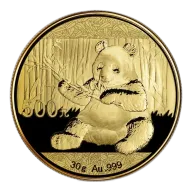
The 30 gram gold coin weight exists almost entirely because of the Chinese Gold Panda. In 2016, the People's Bank of China converted the entire Panda series from troy ounces to metric grams, replacing the traditional 1 oz denomination with 30 grams. The change aligned the series with China's domestic gold market, where prices are quoted in grams rather than troy ounces. At 30 grams (0.9645 troy ounces), the coin contains approximately 3.6% less gold than a standard 1 oz bullion coin, a difference of about 1.1 grams.
The metric conversion was the most significant weight system change in modern bullion history. Before 2016, Panda gold coins used the same troy ounce denominations as every other major series: 1 oz, 1/2 oz, 1/4 oz, 1/10 oz, and 1/20 oz. The post-2016 denominations are 30g, 15g, 8g, 3g, and 1g. Physical dimensions (diameter, thickness) remained unchanged, so the coins look identical but contain slightly different amounts of gold. Critics noted that pricing remained comparable to full-ounce competitors, making the conversion an effective premium increase.
The 30g Gold Panda is the only major annual bullion product at this weight. No other sovereign mint has adopted metric gram denominations for bullion coins, so the 30g category is effectively a single-product weight class. Some private refiners produce 30g gold bars, but these are uncommon and lack the sovereign mint backing that drives liquidity.
Market Position and Liquidity
The Panda is counted among the "Big Five" gold coin series alongside the American Gold Eagle, Maple Leaf, Krugerrand, and Philharmonic. Major dealers worldwide buy and sell Pandas readily, so liquidity is good despite the non-standard weight. Some dealers quote buyback prices at a slight discount to true 1 oz coins, reflecting the 3.6% lower gold content.
The annually changing reverse design (a different panda scene each year, with only the 2001-2002 exception of a shared design) creates numismatic demand that can push premiums higher for specific years. Low-mintage years and early metric-era coins (2016-2017) may trade above standard bullion pricing. Counterfeiting risk is higher for Pandas than for most Western mint products, making purchases from established dealers or NGC/PCGS-certified coins the recommended approach.
Premium Economics of 30g Gold Coins
Premiums on the 30g Panda typically fall in the 3% to 7% range over spot, comparable to other sovereign-mint gold coins at the approximate 1 oz weight class. The effective premium per gram of actual gold is marginally higher than for a full 1 oz coin, because the 30g coin contains 3.6% less gold while trading at a broadly similar price point to competitors like the 1 oz Maple Leaf or 1 oz Krugerrand.
The purity difference also matters for direct comparison. The Panda is .999 fine (three nines), while the Maple Leaf, Philharmonic, and Britannia are all .9999 (four nines). In practice, the difference between 99.9% and 99.99% purity on a 30g coin is negligible in terms of actual gold content, but it is a specification point that some buyers weigh when comparing premiums across series.
Specific years with popular designs or lower mintages can command collector premiums significantly above the standard bullion spread. The annual design change, unique among the Big Five, means that the Panda market has a numismatic dimension that pure bullion coins like the Maple Leaf or Britannia lack. For buyers focused strictly on gold content per dollar, the 30g Panda's combination of metric weight and .999 purity means they receive less fine gold for a comparable price. For buyers who value the collector aspect and the Panda's cultural significance, the premium carries additional justification.
Major 30g Gold Products
The Chinese Gold Panda 30g dominates this weight class. Issued by the People's Bank of China and struck by the China Gold Coin Corporation (CGCC) across multiple facilities in Beijing, Shanghai, Shenyang, and Shenzhen, the coin features the Hall of Prayer for Abundant Harvests at the Temple of Heaven on every obverse and a new panda design each year on the reverse. The face value is 500 yuan. Coins are sold sealed in individual plastic capsules from the mint.
The Panda was introduced in 1982 (as a 1 oz coin) and is one of the oldest continuously produced government bullion series. The 2016 metric conversion changed the weight but maintained the design philosophy and production continuity. The pre-2016 1 oz Panda and the post-2016 30g Panda are considered part of the same series by dealers and collectors.
Beyond the Panda, there are few options at exactly 30 grams. Some private refiners produce 30g gold bars, but these are not standard catalogue items at most major dealers. The weight has not been adopted by any other sovereign mint for a recurring bullion coin. Buyers specifically seeking a coin-format gold holding close to one troy ounce from a non-Chinese source would look to the standard 1 oz gold coins rather than trying to find 30g alternatives.
Resale, Storage, and Handling of 30g Gold Coins
Liquidity for the 30g Gold Panda is strong at established bullion dealers. APMEX, JM Bullion, SD Bullion, and specialist Panda dealers in Europe and Asia all maintain active buy and sell inventories. The market understands the 30g weight as the Panda's post-2016 standard, and pricing is quoted accordingly. Some dealers apply a modest discount on buyback compared to true 1 oz products, reflecting the 1.1 gram shortfall, but the discount is typically smaller than the premium charged on purchase.
The 30g Panda is physically similar in size to a standard 1 oz gold coin (32 mm diameter, 2.7 mm thickness). It fits standard coin capsules and storage solutions designed for 1 oz gold coins. Year-specific collecting is a significant part of the Panda market, creating demand for organised storage in albums or boxes arranged by year of issue.
Counterfeiting is a more significant concern for Pandas than for most competing series. The combination of high premiums, annually changing designs (which make comparison harder), and historically less sophisticated security features has made Pandas a disproportionate target. The CGCC does not offer a digital authentication system comparable to the Royal Canadian Mint's Bullion DNA or the Royal Mint's security suite. NGC and PCGS grading provides third-party authentication that can improve resale confidence, particularly for higher-premium years.
For buyers in the UK and Europe, the 30g weight is unremarkable in metric-system countries where gold is commonly quoted in grams. In markets that use troy ounces as the primary reference (US, UK, Canada, Australia), the 30g denomination requires an extra step in price comparison. The practical effect is that the Panda trades on its own terms rather than being directly slotted into per-ounce comparison tables.