1 product · 20 deals
Filters
| Product | /oz | Premium | Price | |
|---|---|---|---|---|

20 deals
|
$4,850.80 | +11.64% |
$1,247.65
£935
|
Compare |
Prices are fetched automatically and may not reflect current merchant prices. Currency conversions and tax treatment are approximate. Rankings are based solely on price. We are not a dealer and accept no responsibility for transactions with listed merchants. Past performance is not indicative of future results. This site does not provide investment advice. Full disclaimer
About 8g Gold Coins
The 8 Gram Gold Coin: China's Metric Denomination
The 8 gram weight class exists almost exclusively because of the Chinese Gold Panda. When China's mint converted from imperial troy ounce denominations to metric weights in 2016, it chose 8 grams as the replacement for the old 1/4 oz (7.776g) Panda. The choice was not arbitrary. The number 8 is the most auspicious in Chinese culture, its pronunciation in Mandarin and Cantonese closely resembling the words for "prosper" and "wealth." An 8g gold coin carries cultural symbolism that a 7.5g rounding would not.
This makes 8g an unusual weight in global bullion markets. It is not a standard metric denomination (like 5g, 10g, 50g) nor a traditional troy fraction (like 1/4 oz). Outside the Panda series and Indian gold coins from domestic jewellers, very few products are struck at this weight. For Western buyers, the 8g Panda is effectively the only internationally traded bullion coin at this denomination.
The practical difference from 1/4 oz is minimal: 8g contains 0.224g more gold than the pre-2016 quarter-ounce Panda. At current prices, that extra metal adds roughly $20 in intrinsic value. The premium economics are similar to other fractional sizes, sitting between the 5g gold coin tier and the more liquid 10g gold coin class.
For buyers outside China and India, the 8g weight is primarily a vehicle for owning the Panda series at an accessible price point rather than a weight class chosen for its investment efficiency.
Premium Dynamics at 8 Grams
The 8g Chinese Gold Panda typically trades at 5-10% over spot, placing it in the middle of the fractional premium spectrum. The smaller 3g Panda can exceed 15% over spot, while the larger 30g Panda runs 3-7%. This progression reflects the fixed manufacturing and distribution costs being spread over more metal as the denomination increases.
Annual design changes on the Panda create year-specific collector premiums. Unlike the 1oz Krugerrand, which has used the same reverse since 1967, each year's Panda carries unique artwork. Popular years can trade above their cohort. The 2016 8g Panda, as the first metric-weight issue, holds particular interest for collectors marking the series' transition.
Indian 8g gold coins from domestic jewellers (Malabar Gold, GRT Jewels, Tanishq) carry premiums that incorporate making charges, typically 3-10% above the domestic gold rate. These are priced for the Indian retail market and are not directly comparable to the Panda's international dealer premiums.
The cost of an 8g Panda ($500-$600 at current gold prices) is similar to a 1/10 oz gold coin from a sovereign mint. The 8g coin contains more gold (0.2572 troy oz vs 0.1 troy oz), so on a per-gram basis the Panda offers better value than the smallest sovereign mint fractionals. Against a 30g Gold Panda, the 8g version costs less than a third but carries roughly double the percentage premium.
Major 8g Gold Coins
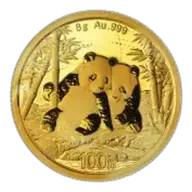
The product landscape at 8 grams is dominated by a single series. The 8g Chinese Gold Panda is the primary internationally traded bullion coin at this weight. Produced by the China Gold Coin Corporation and distributed through CGSE-approved dealers worldwide, it is struck in .999 fine gold with a 22mm diameter and carries a face value of 100 yuan. Available from 2016 onward (the metric-conversion year), each annual issue features a different panda design on the reverse.
The Panda's signature characteristic is its annually rotating artwork. No two consecutive years share a reverse design, making it both a bullion product and a collectible series. Authentication is important: counterfeits exist in the secondary market, and buying from established dealers is the standard advice. The NGC and PCGS grading services both authenticate and encapsulate Pandas, with MS70 (perfect uncirculated) grades commanding premium prices.
Indian 8g Gold Coins
India's domestic jewellery market produces 8g gold coins in both 22 karat (916 purity) and 24 karat (999 purity). Major producers include Malabar Gold and Diamonds, GRT Jewels, Tanishq (Tata group), PC Jeweller, and Bangalore Refinery. These coins feature culturally significant imagery: Lakshmi (goddess of wealth), Lord Ganesh, or other auspicious symbols. They serve a dual purpose as gifts (particularly for Diwali, Akshaya Tritiya, and weddings) and as household savings instruments.
Indian 8g coins are highly liquid within India through jewellers and bullion dealers. International recognition is limited unless the coin carries BIS (Bureau of Indian Standards) hallmarking from a well-known refiner. For buyers outside India, the Chinese Panda is the practical choice at this weight.
Resale and Recognition at 8 Grams
The 8g weight occupies an unusual position in global bullion markets. It is not a standard denomination in Western trading systems, where quarter-ounce (7.776g), 10g, and 5g dominate the fractional space. This means recognition at UK, US, and European coin shops varies depending on whether the dealer carries Chinese Panda inventory specifically.
Major international bullion dealers (APMEX, JM Bullion, SD Bullion, BullionStar) buy and sell 8g Pandas readily. The coin's strong brand recognition in collecting circles ensures a secondary market. However, a local coin shop unfamiliar with the Panda series might offer a less favourable buyback price than they would for a universally recognised product like a 1/4 oz Gold Eagle or a 1/4oz Britannia.
In Asia, liquidity is excellent. The Panda trades actively in China, Singapore, Hong Kong, and across Southeast Asian markets where the number 8 carries the same cultural weight. The Chinese diaspora worldwide provides a secondary demand base that other fractional weights do not enjoy at this specific gram count.
Storage Considerations
At 22mm diameter, the 8g Panda is compact enough for capsule storage in home safes or safety deposit boxes. The coin's relatively high per-unit value ($500-600) means even a modest collection represents meaningful capital in minimal space. Pandas are sold in individual capsules and can be purchased in sheets of 15 from mint-sealed boxes, though the 8g denomination is more commonly bought as individual coins rather than in bulk tube format.