

Prices are fetched automatically and may not reflect current merchant prices. Currency conversions and tax treatment are approximate. Rankings are based solely on price. We are not a dealer and accept no responsibility for transactions with listed merchants. Past performance is not indicative of future results. This site does not provide investment advice. Full disclaimer
About Double Sovereign Gold Coins
The Double Sovereign: Twice the Gold, Same Tax Benefits
The Double Sovereign contains exactly twice the fine gold of a standard Full Sovereign: 14.645 grams (0.4708 troy ounces) of gold at 916.7 millesimal fineness (22 carat). With a face value of two pounds sterling, it carries the same dual tax exemption that makes the sovereign family distinctive in the UK market: no VAT on purchase and no Capital Gains Tax on disposal, regardless of profit.
The denomination traces back to Tudor England, where Henry VII's mint struck double-weight presentation pieces. The modern version entered regular production under George IV in 1823, but it has never been a high-volume circulating coin. Most double sovereigns are proof or commemorative issues with mintages in the low thousands, and this limited production is reflected in their premiums.
Compared to buying two full sovereigns, a single double sovereign typically costs more per gram of gold. The lower mintages and proof-oriented production drive premiums of 15-30% over melt for new issues, versus 5-10% for bullion-grade full sovereigns. Pre-owned double sovereigns from the secondary market offer better value, typically trading at 8-15% over melt, but they remain more expensive per gram than their single-sovereign equivalent.
The double sovereign appeals to buyers who want more gold per coin while retaining CGT exemption, or who are building a collection across the sovereign denomination range. For pure investment efficiency, two full sovereigns bought on the secondary market will contain the same gold at a lower total premium. For collectors valuing low mintages and the Royal Mint's proof finishing, the double sovereign delivers both investment gold and numismatic interest in one piece.
Double Sovereign Specifications
| Attribute | Value |
|---|---|
| Face value | £2 (Two Pounds Sterling) |
| Total weight | 15.976 grams |
| Fine gold content | 14.645 grams (0.4708 troy oz) |
| Purity | 916.7 (22 carat / crown gold) |
| Alloy | 91.67% gold, 8.33% copper |
| Diameter | 28.40 mm |
| Thickness | ~1.9 mm |
| Edge | Milled (reeded) |
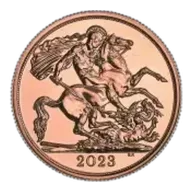
| Reverse | Pistrucci's St George and the Dragon |
| Obverse | Reigning monarch (Charles III from 2022) |
| Manufacturer | The Royal Mint |
Sovereign Family Comparison
| Denomination | Face Value | Total Weight | Fine Gold | Diameter |
|---|---|---|---|---|
| Quarter Sovereign | £0.25 | 1.997g | 1.831g | 13.50 mm |
| Half Sovereign | £0.50 | 3.994g | 3.661g | 19.30 mm |
| Full Sovereign | £1.00 | 7.988g | 7.322g | 22.05 mm |
| Double Sovereign | £2.00 | 15.976g | 14.645g | 28.40 mm |
| Quintuple Sovereign | £5.00 | 39.940g | 36.612g | 36.02 mm |
Each denomination is a precise weight multiple of the full sovereign. The 22-carat crown gold alloy has been consistent across the family since Henry VIII established the standard in 1526. The copper content gives all sovereign-family coins their distinctive warm reddish-gold hue and provides greater hardness than pure gold, reducing wear from handling. This alloy choice dates from an era when gold coins actually circulated as currency and needed to withstand daily use.
Notable historic mintages for double sovereigns include 1887-1893 (Victoria Jubilee Head), with limited production runs. Modern issues are predominantly proofs, with Elizabeth II-era scarcities including 1991 (620 coins), 1993 (414 coins), and 2016 (925 coins). These low-mintage years command substantial premiums above melt value in the collector market.
Double Sovereign Tax Treatment
The double sovereign's tax position is identical to all other sovereign-family coins. As UK legal tender with a £2 face value, it benefits from two separate exemptions that together make it one of the most tax-efficient gold products available to UK residents.
Capital Gains Tax
Under TCGA 1992, Section 21(1)(b), UK legal tender coins are wholly exempt from Capital Gains Tax. There is no monetary limit on this exemption; a gain of any size on any number of double sovereigns is entirely free of CGT. No reporting obligation exists. This applies to all sovereign denominations (quarter through quintuple) and to coins from any year, whether modern bullion strikes or Victorian-era pieces.
VAT
As investment gold exceeding 900/1000 fineness, double sovereigns are VAT-exempt in the UK under regulations derived from the EU Investment Gold Directive. This also applies throughout the EU, where sovereigns appear on the official annual list of qualifying investment coins.
Comparison with Non-Legal-Tender Gold
Gold bars and non-UK coins (including the 1oz Krugerrand) are VAT-exempt but subject to CGT at the holder's rate (18% basic, 24% higher). The annual CGT-free allowance (currently £3,000) applies, but gains above that threshold are taxable. For UK investors anticipating significant gold price appreciation, the sovereign family's CGT exemption can represent thousands of pounds in tax savings compared to bars of equivalent gold content.
Other Jurisdictions
- EU: VAT-exempt as recognised investment gold coin. CGT varies by country; Germany exempts gains after one year of holding.
- US: No special tax status. Purity of 916.7 is below the 995 threshold for IRA eligibility, and sovereigns do not have the special exemption granted to American Eagles.
- Canada: Not RRSP-eligible.
- Australia: The 916.7 purity is below Australia's 99.5% threshold for GST-exempt investment gold. Treatment depends on ATO interpretation of the foreign legal tender exception.
Double Sovereign vs Alternative Half-Ounce Gold
The double sovereign's 14.645g of fine gold (0.4708 troy oz) places it close to the half-ounce category, where several competing products exist. Each offers different trade-offs between premium, tax treatment, purity, and liquidity.
vs 1/2 oz Britannia
The 1/2oz Gold Britannia contains 15.55g of fine gold at 999.9 purity, slightly more metal than the double sovereign's 14.645g. Both are UK legal tender and CGT-exempt. The Britannia typically has tighter buyback spreads due to higher annual production volumes and stronger international recognition as a modern bullion coin. The double sovereign offers historical prestige and collector appeal from its limited mintages. For pure investment purposes, the Britannia usually represents better value per gram.
vs Two Full Sovereigns
Two full sovereigns contain 14.644g of fine gold, virtually identical to one double sovereign. The cost difference comes down to premiums: two secondary-market sovereigns typically cost less in aggregate premium than one double sovereign, because full sovereigns are produced in vastly higher quantities. The double sovereign's advantage is simplicity (one coin instead of two) and the potential for numismatic appreciation on low-mintage proof issues.
vs 1/2 oz Krugerrand
The half-ounce Krugerrand contains 15.55g of fine gold at the same 916.7 purity as the double sovereign. It holds slightly more gold and generally trades at lower premiums due to higher production volumes. The critical difference for UK buyers is tax: the Krugerrand is not UK legal tender and is therefore subject to CGT, while the double sovereign is exempt. This single distinction can make the double sovereign the better long-term choice despite its higher purchase premium.