1 product · 3 deals
Filters
| Product | /oz | Premium | Price | |
|---|---|---|---|---|

3 deals
|
$4,580.44 | +5.41% |
$4,580.45
£3,433
|
Compare |
Prices are fetched automatically and may not reflect current merchant prices. Currency conversions and tax treatment are approximate. Rankings are based solely on price. We are not a dealer and accept no responsibility for transactions with listed merchants. Past performance is not indicative of future results. This site does not provide investment advice. Full disclaimer
About the Noble Gold
Isle of Man Gold from the Mint That Pioneered Platinum
The Noble is an investment coin series issued by the Isle of Man Government, a Crown Dependency of the British Crown. The series is best known for its platinum version, launched in November 1983 as the world's first platinum bullion coin created for investors, predating the Canadian Platinum Maple Leaf by five years and the American Platinum Eagle by fourteen. The gold Noble appeared from 1994 onwards, struck in .9999 fine gold.
Three different private mints have produced Nobles over the decades: Pobjoy Mint (1983 to 2016), Coin Investment Trust (2017), and Tower Mint (2018). Production has been irregular rather than annual, and no new Nobles have been struck since 2018. The series appears dormant, giving surviving examples a degree of scarcity that continuously minted competitors cannot match.
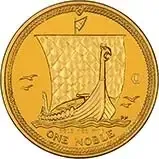
The design features a Viking longship with four birds on the reverse, reflecting the Isle of Man's Norse heritage, with elaborate Viking knotwork forming the border. The obverse carries a portrait of Queen Elizabeth II, with four different versions used across the decades of production. Unusually for a bullion coin, the Noble has no fixed face value. Like the Gold Krugerrand and the Mexican Libertad, its legal tender value floats with the metal price. The coin is stamped "ONE NOBLE" rather than a currency amount.
For buyers looking for a .9999 gold coin with historical significance and genuine scarcity, the Noble offers something that mass-produced bullion cannot. Liquidity is narrower than for continuously minted series, and premiums reflect the coin's collector appeal alongside its gold content.
Gold Noble Specifications
| Attribute | Value |
|---|---|
| Metal | .9999 fine gold (24 karat) |
| Legal Tender | Isle of Man (no fixed face value) |
| Issuer | Isle of Man Government |
| Minters | Pobjoy Mint (1983-2016), Coin Investment Trust (2017), Tower Mint (2018) |
Platinum Noble Denominations (Historical Reference)
| Denomination | Weight | Diameter | Thickness | Purity |
|---|---|---|---|---|
| 1 oz | 31.10 g | 32.7 mm | 2.38 mm | 99.95% |
| 1/2 oz | 15.55 g | 25.1 mm | n/a | 99.95% |
| 1/4 oz | 7.78 g | 22.0 mm | n/a | 99.95% |
| 1/10 oz | 3.11 g | 17.0 mm | n/a | 99.95% |
| 1/20 oz | 1.56 g | 14.0 mm | n/a | 99.95% |
The platinum specifications above are included because the Noble series is most closely associated with its platinum origins. The gold Noble uses the same .9999 purity standard as the Gold Maple Leaf and Gold Britannia. Rare 5 oz and 10 oz platinum proof Nobles were also struck, with mintages of just 26 and 15 pieces respectively (1986 and 1988), placing them among the rarest modern platinum coins.
The series also included bimetallic editions: a 1995 coin with a gold ring and platinum centre, and a 2009 coin with a silver ring and gold centre. A palladium Noble was issued in 2012 as a one-off.
Noble Gold Coin Tax Treatment
The Noble's tax treatment requires careful attention because the Isle of Man is a Crown Dependency, not part of the United Kingdom, and its coins are not UK Royal Mint legal tender.
United Kingdom: Investment gold is VAT-exempt in the UK. The gold Noble's .9999 purity and post-1800 legal tender status should qualify it for VAT exemption under HMRC's investment gold criteria, provided it trades within the 80% premium threshold. The more significant question is Capital Gains Tax. UK CGT exemption applies only to coins that are UK legal tender. The Noble is Isle of Man legal tender, not UK legal tender, so it is not automatically CGT-exempt. Some dealers list certain Isle of Man gold coins as CGT-exempt when they meet specific criteria, but buyers should verify this with a tax adviser rather than assuming exemption. The CGT-exempt status of the Gold Britannia and Gold Sovereign is clear-cut; the Noble's position is not.
European Union: The gold Noble qualifies for EU investment gold VAT exemption: post-1800, purity above 900, and legal tender. No CGT harmonisation exists across the EU.
United States: The .9999 purity exceeds the 99.5% IRA minimum. Gold Nobles are IRA-eligible. No federal sales tax; state sales tax varies by state. Capital gains at the collectibles rate of up to 28%.
Isle of Man: The Isle of Man has no capital gains tax. Residents holding Nobles face no CGT on disposal. This is a notable advantage for Isle of Man residents, though the island's small population limits the practical significance.
Canada: GST/HST-exempt as gold of 99.5% purity or higher. Standard capital gains inclusion rates apply.
Australia: GST-exempt as investment-grade gold. Standard CGT rules with 50% discount for holdings over 12 months.
The Coin That Created the Platinum Investment Market
The Noble's historical significance rests on a single fact: it was the world's first platinum bullion coin. When the Isle of Man Government issued the 1 oz platinum Noble in November 1983 through Pobjoy Mint, no sovereign or semi-sovereign entity had previously struck platinum specifically for investors. The coin effectively created the platinum investment coin market.
The platinum Noble ran for just six years, from 1983 to 1989. Production was modest by bullion standards. The 1985 vintage had the highest bullion mintage at 99,000 pieces. In 1986 and 1988, the Mint also produced 5 oz and 10 oz proof Nobles with mintages of 26 and 15 pieces respectively, making these among the rarest modern platinum coins in existence.
By the late 1980s, other mints had followed the Noble's lead. The Canadian Platinum Maple Leaf appeared in 1988, and the Australian Platinum Koala the same year. Both offered .9995 purity (matching the Noble) with continuous annual production and government mint backing. The Noble's first-mover advantage eroded as these competitors established themselves, and platinum Noble production ceased after 1989.
Gold and silver Nobles continued from 1994, struck by Pobjoy Mint through 2016. The 1996 Noble claimed another first: the world's first holographic coin, featuring a holographic sail on the Viking ship. Coin Investment Trust took over production in 2017, and Tower Mint struck the 2018 edition, after which no further Nobles have appeared.
The Noble is named after the medieval Noble, a 14th-century English gold coin. The Viking longship reverse design reflects the Isle of Man's Norse heritage. The Isle of Man was a Norse kingdom from the 9th to 13th centuries, and the triskelion (three-legged coat of arms) that appears on the coin remains the island's national symbol.
Pobjoy Mint, the primary producer for most of the series' history, is a family-owned private mint based in Surrey, England. It holds the contract to produce coins for several British Crown Dependencies and Overseas Territories, including the Falkland Islands, Gibraltar, and Ascension Island, alongside the Isle of Man.
Noble vs Britannia, Maple Leaf, and Other Gold Coins
The Gold Britannia is the most relevant comparison for UK-based buyers. Both are .9999 fine gold coins from jurisdictions connected to the British Crown. The Britannia's clear advantages are its CGT exemption in the UK, continuous annual production, unlimited mintage, and the backing of the Royal Mint. The Noble lacks CGT certainty, has irregular production, and uses private rather than government mints. For UK buyers focused on tax efficiency and liquidity, the Britannia is the better choice. The Noble appeals to a different motivation: historical interest and scarcity.
Against the Gold Maple Leaf, both share .9999 purity and legal tender status. The Maple Leaf's advantages are its global liquidity, Royal Canadian Mint backing, and MicroEngraved security features. The Noble cannot match any of these on a practical level. The Maple Leaf is available from virtually every bullion dealer worldwide; the Noble requires specialist sourcing.
The comparison with the Gold Krugerrand highlights a purity difference (22-karat vs 24-karat) but the Krugerrand's unmatched brand recognition and deep secondary market make it the easier coin to buy and sell. The Noble's floating face value is a feature it shares with the Krugerrand, but the Krugerrand benefits from decades of continuous production and billions of dollars in cumulative circulation.
The Noble's true peers are other discontinued or limited-production gold coins with historical interest. Collectors value the series for its pioneering role in platinum investment, its irregular production history across three different mints, and the Viking longship design that connects to the Isle of Man's Norse past. Buyers should approach it as a numismatic collectible with gold content rather than as a mainstream bullion investment.