1 product · 1 deal
Filters
| Product | /oz | Premium | Price | |
|---|---|---|---|---|
| $5,236.38 | +20.51% |
$5,236.38
£3,924
|
View Deal |

Prices are fetched automatically and may not reflect current merchant prices. Currency conversions and tax treatment are approximate. Rankings are based solely on price. We are not a dealer and accept no responsibility for transactions with listed merchants. Past performance is not indicative of future results. This site does not provide investment advice. Full disclaimer
About the Robin Hood Gold
The Royal Mint Robin Hood Gold Coin
The Robin Hood gold coin is part of The Royal Mint's Myths and Legends series, a collection celebrating Britain's folklore through bullion and proof coinage. The 1 oz gold version is struck from 999.9 fine gold with a face value of £100, making it UK legal tender and therefore exempt from Capital Gains Tax for British taxpayers. That CGT exemption, combined with VAT-free purchasing as investment gold, gives the Robin Hood gold coin the same double tax advantage that the Gold Britannia enjoys.
Robin Hood is the second chapter in the Myths and Legends series, following the Arthurian legend chapter (Morgan le Fay). The chapter includes three coin designs: Robin Hood (2021), Maid Marian (2022), and Little John (2022), all designed by Jody Clark. Clark is the Royal Mint engraver responsible for the most recent Queen Elizabeth II coinage portrait used across the Commonwealth, and his work on these coins demonstrates a level of artistic coherence between obverse and reverse that few bullion issues achieve.
The Robin Hood design depicts the outlaw perched on a tree branch in Sherwood Forest, bow drawn and ready, framed by dense oak foliage. The coin was first struck in 2021 with the Jody Clark portrait of Queen Elizabeth II on the obverse, then re-released in 2024 with the Martin Jennings portrait of King Charles III. The 2024 re-release also introduced new formats: 2 oz silver proofs (extremely limited at 510 mintage) and £5 BU cupro-nickel collector coins.
For UK buyers, the Robin Hood gold coin offers themed design appeal with no tax compromise. It carries the same CGT exemption as the Britannia, the same VAT-free status, and the same Royal Mint provenance. The themed design adds collector interest that the more utilitarian Britannia does not provide, though the Britannia has significantly higher secondary market liquidity due to its much larger production volumes and longer history.
Robin Hood Gold Coin Specifications
| Attribute | 1 oz Gold Bullion |
|---|---|
| Weight | 1 troy ounce (31.21 g) |
| Purity | 999.9 fine gold |
| Diameter | 32.69 mm |
| Face value | £100 GBP |
| Finish | Bullion (BU) |
| Edge | Milled |
| Designer | Jody Clark |
| Security | Micro-dot table texture |
| Legal tender | United Kingdom |
Full Myths and Legends Robin Hood Chapter
| Design | Year | 1 oz Gold | 1 oz Silver | 10 oz Silver | 2 oz Silver Proof |
|---|---|---|---|---|---|
| Robin Hood | 2021 | Yes | Yes | Yes | Yes (2024, mintage 510) |
| Maid Marian | 2022 | Yes | Yes | Yes | Yes (2024, mintage 506) |
| Little John | 2022 | Yes | Yes | Yes | No |
The coin incorporates a micro-dot table texture as a security feature, visible under magnification. This is a Royal Mint anti-counterfeiting measure that creates a textured surface pattern difficult to replicate. The 999.9 purity itself serves as an authentication marker, as four-nine fineness is technically demanding to counterfeit accurately. Bullion mintage figures for the Robin Hood gold coin are not publicly declared by the Royal Mint, though they are believed to be substantially smaller than the Britannia's production runs.
Robin Hood Gold Coin Tax Treatment by Country
As UK legal tender struck from 999.9 fine gold, the Robin Hood coin benefits from the strongest tax position available to any gold coin in the British market.
United Kingdom
The Robin Hood gold coin is both VAT-free and CGT-exempt. Gold coins qualifying as investment gold (post-1800, legal tender, purity above 900 fine) are exempt from 20% VAT. As British legal tender with a £100 face value, gains on disposal are exempt from Capital Gains Tax regardless of profit size. This double exemption is the primary reason Royal Mint legal tender gold coins carry premiums above equivalent foreign coins. The silver versions are subject to 20% VAT (margin scheme may apply through some dealers) but, as UK legal tender, are CGT-exempt on disposal.
United States
No federal sales tax. Over 35 states exempt investment-grade bullion from state sales tax. The 999.9 purity and sovereign mint origin make the coin IRA-eligible under IRS Section 408(m). CGT exemption does not apply in the US; long-term gains on bullion are taxed at the 28% collectible rate.
Canada
Gold at 99.5% purity or higher is GST/HST-exempt. The Robin Hood coin qualifies at 999.9 purity. Capital gains are taxed at the 50% inclusion rate.
European Union
The Royal Mint's gold coins appear on the EU's annual list of qualifying investment gold coins, making them VAT-exempt across all member states. Silver versions attract local VAT rates (17-27% depending on the country).
Australia and New Zealand
In Australia, the 999.9 purity qualifies for GST-free treatment. In New Zealand, fine gold at 99.5% or higher is GST-exempt. Both countries apply capital gains tax on disposal (with Australia offering a 50% discount for holdings over 12 months; New Zealand has no formal CGT).
Singapore and Hong Kong
Singapore: qualifies as IPM (Investment Precious Metals) and is GST-exempt. No capital gains tax. Hong Kong: no sales tax, import duty, or capital gains tax on any gold.
Sherwood Forest on a Sovereign Mint Coin
The Robin Hood legend dates back approximately 800 years, with the earliest known literary reference appearing in William Langland's Piers Plowman (c. 1377). The outlaw of Sherwood Forest, who robbed from the rich to give to the poor, has become one of the most enduring figures in English folklore, adapted into ballads, plays, novels, and films across centuries. Sherwood Forest itself is a real ancient woodland in Nottinghamshire, where the Major Oak (estimated at 800-1,000 years old) is traditionally said to have sheltered Robin Hood and his band.
Jody Clark's design for the 2021 coin captures Robin Hood in a moment of tension, perched on an oak branch with bow drawn, surrounded by the dense foliage of Sherwood. Clark is best known as the designer of the fifth and most recent Queen Elizabeth II coinage portrait (introduced 2015), used on British and Commonwealth coins until her death in 2022. Having the same artist design both the obverse monarch portrait and the reverse folklore scene gives the Robin Hood coin an unusual artistic unity.
The Myths and Legends series represents a deliberate strategy by The Royal Mint to create themed bullion with collector appeal beyond the flagship Britannia range. The Queen's Beasts series (2016-2021) demonstrated that themed Royal Mint bullion could command premiums and attract buyers who might not otherwise collect bullion coins. Robin Hood followed this model, and The Tudor Beasts series (2023 onward) has continued it.
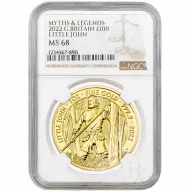
The Maid Marian coin (2022) is notable for its portrayal of the character. The Royal Mint describes her as "a leading figure amongst the Merry Men," shown standing alert among the trees with bow and quiver of arrows, a deliberate departure from the traditional damsel-in-distress characterisation. Little John (also 2022) completes the chapter with his iconic quarterstaff.
The 2024 re-releases brought the designs back with King Charles III on the obverse and added new formats. The 2 oz silver proof versions are particularly scarce: 510 Robin Hood coins and 506 Maid Marian coins, making them genuine rarities by Royal Mint standards. Whether the Robin Hood chapter will see further new formats or years remains unconfirmed.
Robin Hood vs Britannia and Other Royal Mint Gold
The Robin Hood gold coin shares its core tax and quality specifications with the 1 oz Gold Britannia: 999.9 purity, UK legal tender status, VAT-free purchasing, and CGT exemption. The decision between them is about liquidity versus design character.
The Britannia is the Royal Mint's flagship bullion coin, produced in large quantities since 1987 with annual design variations. Its secondary market is deep: every bullion dealer in the UK (and most internationally) buys and sells Britannias at tight spreads. The Robin Hood coin has a substantially smaller production run and a thinner resale market. A buyer selling a Britannia back to a dealer can expect competitive prices and fast transactions. Selling a Robin Hood may take slightly longer and involve modestly wider spreads, though major UK dealers do stock and buy back the Myths and Legends range.
Against the Tudor Beasts series (2023 onward), the Robin Hood shares the same format: 1 oz gold, 1 oz silver, and 10 oz silver from The Royal Mint, with the same CGT-exempt status. The Tudor Beasts feature heraldic creatures; the Myths and Legends coins feature folklore characters. Both are designed to attract collectors into the bullion market. The choice is purely aesthetic.
Compared to the Queen's Beasts series (2016-2021, now complete), the Robin Hood is a natural successor for collectors who assembled that series. Queen's Beasts coins have appreciated on the secondary market as a completed set, and some collectors anticipate a similar trajectory for Myths and Legends once it concludes.
For non-UK buyers, the Robin Hood's CGT exemption is irrelevant, and the comparison shifts to the coin's design appeal and sovereign mint credibility against globally traded alternatives like the 1 oz Gold Maple Leaf or 1 oz Gold Philharmonic. Those coins trade at lower premiums and tighter spreads. The Robin Hood gold coin is primarily a UK-market product, where its tax advantages and thematic appeal combine to justify the premium over more liquid alternatives.