
 AU Capital Management

 Best Bullion
Prices are fetched automatically and may not reflect current merchant prices. Currency conversions and tax treatment are approximate. Rankings are based solely on price. We are not a dealer and accept no responsibility for transactions with listed merchants. Past performance is not indicative of future results. This site does not provide investment advice. Full disclaimer
About the 1 oz Gold Kiwi Gold Round
New Zealand's Heritage Gold Bullion Coin
The 1 oz Gold Kiwi is the flagship bullion product from the New Zealand Mint, containing 31.1035 grams of 999.9 fine gold. The series has been in production since 1944, predating the Krugerrand (1967), the Maple Leaf (1979), and the American Eagle (1986). This makes it one of the oldest continuously produced bullion coin designs in the world.
The New Zealand Mint is a private company based in Auckland, not a government mint. New Zealand's Reserve Bank does not operate a coin-minting facility; the country's circulation coins are struck overseas under contract. The NZ Mint partners with the Government of Niue, a self-governing territory in free association with New Zealand, to issue Gold Kiwi coins as Niue legal tender denominated in New Zealand dollars. This arrangement gives the coins governmental backing and legal tender status, distinguishing them from purely private mint rounds.
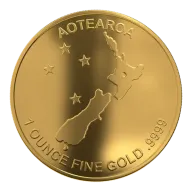
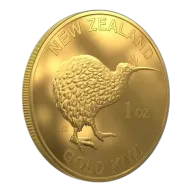
The reverse features a design by artist Rick Lewis depicting the kiwi bird with its head held high. The kiwi, a nocturnal, flightless bird roughly the size of a chicken, is New Zealand's national symbol and the source of the country's colloquial name for its people. The obverse carries the word "Aotearoa" (the Maori name for New Zealand, meaning "land of the long white cloud") alongside the Southern Cross constellation and Niue's legal tender elements.
The NZ Mint was among the first mints globally to adopt 999.9 (four nines) purity as standard for gold bullion, at a time when 900 or 916.7 (22 carat) was the norm. The Gold Kiwi matches the purity of the Canadian Maple Leaf, the benchmark 999.9 gold coin. Each coin ships in a tamper-proof Certi Card, a serial-numbered assay card that must be broken to remove the coin, providing both authentication and tamper evidence.
1 oz Gold Kiwi Specifications
| Specification | Value |
|---|---|
| Fine gold content | 31.1035 g (1 troy oz) |
| Purity | 999.9 fine gold (24 carat) |
| Diameter | 32 mm |
| Thickness | 2.8 mm |
| Edge | Reeded |
| Face value | Niue legal tender (NZD-denominated) |
| Designer | Rick Lewis |
| Manufacturer | New Zealand Mint, Auckland |
| Series in production since | 1944 |
| Authentication | Tamper-proof Certi Card (serial numbered) |
The Gold Kiwi is also produced in fractional sizes. The 1/4 oz Gold Kiwi has been issued since 2022, and 1/2 oz, 2 oz, and 5 oz versions are also listed in the NZ Mint's product range. A silver Kiwi series exists alongside the gold range.
The 999.9 purity meets the highest investment gold classification in all jurisdictions, ensuring broad tax exemption eligibility. This purity places the Gold Kiwi alongside the Canadian Maple Leaf and the Britannia (post-2013) as a four-nines gold product. The 32 mm diameter is slightly smaller than the Maple Leaf (30 mm) and Britannia (32.69 mm), making it a compact coin for its weight class.
Each Gold Kiwi ships sealed in a tamper-proof Certi Card. The card is serial-numbered and certifies the coin's weight, purity, and authenticity. Breaking the card to remove the coin provides clear tamper evidence, discouraging resale of repackaged counterfeits. This system differs from the micro-laser engraving used by the Royal Canadian Mint (Bullion DNA) or the Royal Mint (tincture lines), but serves a similar purpose of supply-chain authentication.
Tax Treatment of the Gold Kiwi
The Gold Kiwi's 999.9 purity qualifies it for investment gold exemptions in all major markets. Its status as Niue legal tender provides additional regulatory standing in some jurisdictions.
New Zealand
GST-exempt as investment-grade fine metal. Gold at 99.5%+ purity in coin form is exempt from New Zealand's 15% GST. The NZ Mint operates as a domestic retailer from Auckland. This is a significant advantage, as NZ buyers purchasing 22-carat coins (such as the Krugerrand or Sovereign, both at 916.7 fineness) face 15% GST because the purity falls below the 99.5% threshold. The Gold Kiwi avoids this entirely.
Australia
GST-free as investment-grade gold at 99.5%+ purity. Available through Australian bullion dealers. The Gold Kiwi competes directly with the Perth Mint Kangaroo in the Australasian market.
United Kingdom
VAT-exempt as investment gold (purity exceeds 995 millesimal). Not CGT-exempt, as the coin is not UK legal tender. UK buyers seeking CGT-free gold should consider the 1oz Britannia.
European Union
VAT-exempt as investment gold under EU Directive 98/80/EC.
United States
No federal sales tax. State sales tax varies. Capital gains taxed at the collectibles rate of up to 28%. Available through major US dealers including JM Bullion and APMEX.
Singapore and Hong Kong
Singapore: GST-exempt as investment precious metal at 99.5%+ purity from a qualifying source. No capital gains tax. Hong Kong: no sales tax, no import duty, no capital gains tax.
Gold Kiwi vs Perth Mint Kangaroo and Canadian Maple Leaf
The Gold Kiwi's most direct regional competitor is the Perth Mint Kangaroo. Both are 999.9 fine gold from the Australasian region, and both are legal tender (Kangaroo as Australian currency, Gold Kiwi as Niue currency). The Kangaroo has substantially higher global liquidity, broader dealer availability, and stronger brand recognition. The Perth Mint is a government mint backed by the Government of Western Australia, while the NZ Mint is a private company. The Kangaroo also features annually rotating reverse designs, adding mild collectible appeal.
Against the Canadian Maple Leaf, the Gold Kiwi matches on purity (both 999.9) but falls behind on global liquidity and security features. The Maple Leaf's Bullion DNA micro-laser engraving, introduced in 2014, provides a level of anti-counterfeiting technology that the Gold Kiwi's Certi Card system does not match. The Maple Leaf is available from virtually every bullion dealer worldwide, while Gold Kiwi availability is strongest in New Zealand, Australia, and through a limited number of US and international dealers.
The Gold Kiwi's unique position is its heritage. With production dating to 1944, it predates every major modern bullion programme. For New Zealand buyers specifically, it is the home-market product with the additional advantage of avoiding the 15% GST that 22-carat coins attract. The combination of local availability, GST exemption, and national symbolism makes it the default gold bullion choice in New Zealand, even if its international profile is more modest than the established global programmes.
1 oz Gold Kiwi Gold Round: frequently asked questions
-
The Gold Kiwi is a 1 oz (999.9 fine gold) bullion round produced by New Zealand Mint, a private company based in Auckland. It is not government-issued New Zealand legal tender; the coins carry Niue legal tender status. The reverse features New Zealand's kiwi bird, designed by artist Rick Lewis, with the Southern Cross constellation and the word "Aotearoa" on the obverse.
-
Investment-grade gold is VAT-free in the UK and GST-exempt in New Zealand when it meets the relevant purity threshold (the Gold Kiwi's .9999 purity qualifies in both countries). On gains, UK investors pay CGT at 18% or 24% above the annual exempt amount; US investors pay up to 28% on long-term gold gains. Tax treatment varies by country, so check the rules for where you are based.