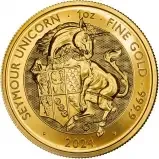

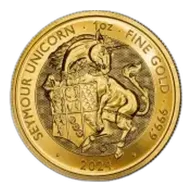

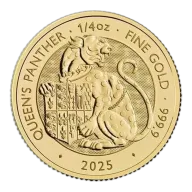

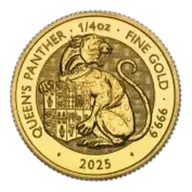
Prices are fetched automatically and may not reflect current merchant prices. Currency conversions and tax treatment are approximate. Rankings are based solely on price. We are not a dealer and accept no responsibility for transactions with listed merchants. Past performance is not indicative of future results. This site does not provide investment advice. Full disclaimer
About the Tudor Beasts Gold
The Gold Tudor Beasts: Royal Mint's Tudor-Era Collector Series
The Tudor Beasts series is a ten-coin collection released by The Royal Mint between 2022 and 2026, with two designs issued per year. Each coin features a heraldic beast from the stone statues on the Moat Bridge of Hampton Court Palace, originally placed there by Henry VIII. The beasts represent dynastic connections to the Tudor line, from Jane Seymour's panther to the Lion of England from the royal arms. All reverses were designed by David Lawrence, who brought a detailed and dynamic style to the heraldic subjects.
For buyers weighing this against the established Gold Britannia, the Tudor Beasts occupy a different niche. The Britannia is a permanent annual issue targeting core bullion demand; the Tudor Beasts are a fixed ten-coin programme designed for the collector-investor crossover. Once the final design is struck in 2026, no new Tudor Beasts will be added. This finite supply window is the series' central appeal, and it follows the same playbook that made the predecessor Queen's Beasts series a strong performer on the secondary market.
The gold bullion version is struck in 999.9 fine gold at both 1 oz and 1/4 oz sizes, with a face value of GBP 100 and GBP 25 respectively. Both carry UK legal tender status, which is the source of the tax advantages discussed below. A platinum version exists alongside the gold, and the silver range extends from 1 oz through to 1 kg.
The series straddles a historically significant transition: coins issued in 2022 carry the Jody Clark portrait of Queen Elizabeth II, and from 2023 onward they bear the Martin Jennings portrait of King Charles III. Some collectors specifically seek matched pairs of both portrait variants for each beast, adding another dimension of collectibility.
Tudor Beasts Gold Bullion Denominations
| Size | Weight | Diameter | Purity | Face Value |
|---|---|---|---|---|
| 1 oz | 31.21 g | 32.69 mm | 999.9 | GBP 100 |
| 1/4 oz | 7.80 g | 22.00 mm | 999.9 | GBP 25 |
Edge type is milled on both denominations. The 999.9 gold purity (four nines, 24 karat) matches the current Britannia standard and the Queen's Beasts before it. This is the highest purity that The Royal Mint strikes for bullion, and it meets IRS fineness requirements for US precious metals IRAs (which require 99.5% or higher for gold).
The Ten Beasts
| Beast | Year | Dynastic Connection |
|---|---|---|
| Seymour Panther | 2022 | Jane Seymour (Henry VIII's third wife) |
| Lion of England | 2022 | Royal arms of England |
| Yale of Beaufort | 2023 | Lady Margaret Beaufort (Henry VII's mother) |
| Bull of Clarence | 2023 | House of York |
| Seymour Unicorn | 2024 | Jane Seymour |
| Tudor Dragon | 2024 | Henry VII / Welsh Tudor origins |
| Queen's Panther | 2025 | Jane Seymour via the Queen |
| Greyhound of Richmond | 2025 | Henry VII |
| Queen's Lion | 2026 | TBC |
| 10th beast (TBC) | 2026 | TBC |
Each beast holds a shield bearing Tudor heraldic arms. The designs are derived from the stone statues on the Moat Bridge at Hampton Court Palace. The current statues are 20th-century replicas carved by Joseph Cribb in the 1930s, as the originals placed by Henry VIII had deteriorated over the centuries. The guilloche patterned background on all bullion reverses serves as both an aesthetic feature and a counterfeiting deterrent, distinguishing the bullion versions from the plain-field proof editions.
Tudor Beasts Tax Treatment: CGT Exemption on Gold and Silver
All Tudor Beasts coins carry UK legal tender status, which grants them a significant tax advantage: exemption from Capital Gains Tax for UK residents. This applies across all three metals (gold, silver, and platinum), because sterling-denominated legal tender is not a chargeable asset for CGT purposes. The annual CGT allowance in the UK is currently GBP 3,000, so the exemption matters most for larger positions or assets that have appreciated substantially.
On the purchase side, gold Tudor Beasts are VAT-free under the investment gold directive (coins of 900+ fineness, post-1800, that are or were legal tender). Silver and platinum Tudor Beasts attract 20% VAT at the standard UK rate. This creates an asymmetry: the gold versions are tax-efficient on both purchase and sale, making them the strongest proposition from a pure tax perspective. Silver Tudor Beasts benefit from CGT exemption on sale but carry a 20% VAT headwind on acquisition.
Other Countries
- United States: Tudor Beasts are not IRA-eligible (they are not specifically listed by the IRS and there is no general exemption for foreign legal tender coins outside the purity provision). Gains are taxed as collectibles at up to 28% federal rate.
- European Union: Gold Tudor Beasts qualify as investment gold under the EU directive (VAT-exempt). Silver versions are subject to local VAT rates, though the margin scheme may apply on the secondary market in countries like Germany and the Netherlands.
- Australia: Gold coins at 999.9 purity meet the investment-grade threshold for GST exemption (99.5% or higher). Silver at 999.9 also meets the 99.9% threshold. Subject to CGT on disposal, with a 50% discount for holdings over 12 months.
- Canada: Gold and silver at 999.9 purity exceed the 99.5% GST/HST exemption threshold. No special CGT treatment. Not eligible for RRSP or TFSA accounts.
- Singapore: Investment-grade gold and silver meeting purity thresholds are GST-exempt as Investment Precious Metals (IPM). No capital gains tax.
- Hong Kong: No sales tax, no import duty, no CGT on precious metals.
From Hampton Court to Bullion: The Tudor Beasts' Origins
The source material for this series is the Moat Bridge at Hampton Court Palace, built from 1514 by Cardinal Thomas Wolsey and later seized by Henry VIII. Ten heraldic beast statues stood along the bridge, each representing a family or dynastic connection to the Tudor line. The beasts were not merely decorative; they were political statements, asserting the legitimacy and power of the Tudor dynasty through the language of heraldry that medieval and early modern audiences would have read fluently.
The originals deteriorated over the centuries, and the statues visible today are 20th-century replicas carved by Joseph Cribb in the 1930s. The Royal Mint's series therefore draws on both the historical originals and the Cribb interpretations, filtered through David Lawrence's contemporary numismatic design sensibility. Lawrence, a sculptor and illustrator with over 30 years of experience, designed all ten reverses. His style is more dynamic and detailed than the cleaner heraldic approach used by Jody Clark for the Queen's Beasts series (2016-2021).
The series is structured deliberately: two beasts per year, five years total. The Seymour Panther, representing Jane Seymour (mother of Edward VI and Henry VIII's third wife), opened the series in 2022. Jane Seymour features prominently because the Tudor claim to the throne ran through both the paternal Tudor line and the maternal Seymour connection. The Lion of England, the most recognisable of the heraldic beasts, appeared alongside the Panther in the debut year.
The 2024 releases introduced the Tudor Dragon, a beast with particular significance. The dragon references the Welsh origins of the Tudor dynasty, specifically Henry VII's claim to descent from Cadwaladr, the last ancient king of the Britons. Henry VII carried a red dragon standard at the Battle of Bosworth Field in 1485, and the Tudor Dragon embodies that foundational moment of the dynasty.
A question that collectors frequently raise is whether a "Completer Coin" will follow the tenth design in 2026. The Queen's Beasts precedent strongly suggests one is likely, as that series concluded with a design incorporating all ten beasts, and it was one of the most sought-after issues in the entire programme.
Tudor Beasts vs Queen's Beasts, Britannia, and Lunar
The most direct comparison is the Queen's Beasts series (2016-2021), which the Tudor Beasts directly succeed. Both are ten-coin Royal Mint series with heraldic themes, annual releases, CGT exemption, and collector-investor crossover appeal. The Queen's Beasts traced ancestry across all British dynasties from the 14th century onward; the Tudor Beasts narrow the focus to Henry VIII's era. Silver purity is identical at 999.9 (four nines) for both series, and both use 999.9 gold. The key practical difference is size: the Queen's Beasts' signature silver format was the 2 oz coin, giving it a different collector base from the Tudor Beasts' 1 oz and 2 oz options. On the secondary market, completed Queen's Beasts sets and individual low-mintage years have performed well, which underpins collector interest in the Tudor Beasts as a replicable model.
Against the Gold Britannia, the distinction is between a permanent programme and a time-limited one. The Britannia is The Royal Mint's flagship bullion coin with unlimited mintage, four advanced security features (latent image, surface animation, micro-text, and tincture lines from 2021), and the deepest secondary market of any UK bullion coin. The Tudor Beasts have a guilloche background as their anti-counterfeiting measure, which is effective but less sophisticated. For pure bullion accumulation, the Britannia is the more liquid choice. For buyers who value design variety and a collectible dimension alongside their bullion holding, the Tudor Beasts fill a gap that the Britannia's fixed-design format does not.
The Perth Mint Lunar series shares the annual-design-change format but follows a 12-year Chinese zodiac cycle that repeats indefinitely across Series I, II, and III. This makes it a perpetual programme rather than a finite one. The Lunar is 999.9 gold at the same purity, but it carries Australian dollar legal tender status (no UK CGT benefit). Dragon years consistently sell at higher premiums than other zodiac animals, a pattern that has no direct parallel in the Tudor Beasts where demand is driven by the particular beast's historical significance rather than cultural symbolism.
Tudor Beasts Gold: frequently asked questions
-
The Tudor Beasts series comprises ten coins released over five years (2022 to 2026), with two designs issued each year. Coins released so far include the Seymour Panther, Lion of England, Yale of Beaufort, Bull of Clarence, Seymour Unicorn, Tudor Dragon, Queen's Panther, and Greyhound of Richmond. The Queen's Lion and a tenth beast are scheduled for 2026. All are produced by The Royal Mint.
-
The series concludes in 2026 with two final coins: the Queen's Lion and a tenth beast. The Royal Mint has followed a consistent two-coin-per-year pattern throughout the series. Once all ten designs are issued, the series will be complete, following the precedent set by the Queen's Beasts programme.
-
Tudor Beasts is The Royal Mint's ten-coin successor to the Queen's Beasts series, running from 2022 to 2026. The designs are drawn from stone beast statues on the Moat Bridge at Hampton Court Palace, each representing a noble house connected to the Tudor dynasty. The series is available in gold (999.9 fine), silver (999.9 fine), and platinum (999.5 fine), with all reverses designed by David Lawrence.
-
Tudor Beasts coins trade at a premium above the live $4,408.10 spot price, reflecting their annual-design collector format. The page currently tracks 83 listings from 15 dealers, so you can compare premiums across the series. Premiums vary by coin, weight, and metal; silver Tudor Beasts typically carry a higher premium per ounce than gold.
-
In the UK, Tudor Beasts coins are UK legal tender, and legal-tender coins issued by The Royal Mint are exempt from Capital Gains Tax for UK residents. This applies to the gold, silver, and platinum versions. US investors pay up to 28% on long-term gains from bullion coins. In Canada, 50% of any capital gain is included in taxable income at your marginal rate.