1 listing
Filters
| Product | /oz | Premium | Price | |
|---|---|---|---|---|

 Essential Bullion
|
$1,848.79 |
+10.37%
+32% inc.VAT
|
$594.37
£539 inc.VAT
|
View Deal |
Prices are fetched automatically and may not reflect current merchant prices. Currency conversions and tax treatment are approximate. Rankings are based solely on price. We are not a dealer and accept no responsibility for transactions with listed merchants. Past performance is not indicative of future results. This site does not provide investment advice. Full disclaimer
About the 10g Classic Platinum Bar
The 10g Argor-Heraeus Classic Platinum Bar
The Classic is Argor-Heraeus's standard investment bar range, the company's foundational line of cast and minted ingots that predates its Kinebar, Lunar Calendar, Origin Traced and Small Craft specialty products. In platinum, every Classic format is a minted ingot, and the 10g size sits in the lower-middle of a range that runs from 1g up to 1kg. Each bar is struck in 999.5 fine platinum, carries an individual serial number, and is certified by an Argor-Heraeus sworn assayer. Minted Classic bars ship in a numbered tamper-evident assay card, which matters for resale: sealed bars in assay cards from recognised refiners command better prices on the secondary market than loose or generic bars.
The refiner credentials behind the bar are the main reason to pick it. Argor-Heraeus SA holds LPPM Good Delivery accreditation for platinum and is one of only seven global LBMA Referees, the panel of refiners that audits other refiners' Good Delivery compliance. Its Mendrisio facility refines approximately 400 tonnes of gold annually, placing it in the same tier as PAMP and Valcambi within the Swiss Ticino refining cluster. That brand recognition supports liquidity in a platinum bar market that is much smaller than its gold or silver equivalents, where not all dealers stock platinum and inventory is often limited.
On cost, 10g is a workable compromise within platinum bars. Research on platinum bar premiums puts 10g bars at roughly 10 to 20% over spot, against 20 to 40% for 1g bars, while 1oz bars run around 5 to 10% and 100g bars around 4 to 8%. The smallest gram weights function more as gifts or novelties than cost-efficient investments; the 10g format gets you a recognised Swiss platinum bar at a fraction of the outlay of a 1oz bar without the steepest small-bar premium penalty. Buyers prioritising premium efficiency over entry price should still look at the 1oz size, which is the most commonly traded retail platinum bar and has the best resale liquidity of any bar weight.
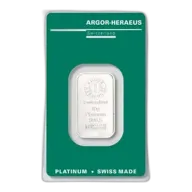
The design is deliberately minimal. The obverse carries the Argor-Heraeus logo, a stylised AH monogram within a double circle with Switzerland below, followed by the weight, metal type and purity, plus the serial number and assayer mark. There are no allegorical figures or decorative motifs; the plainness keeps production costs down and the authentication marks legible.
10g Argor-Heraeus Classic Platinum Bar Specifications
| Specification | Detail |
|---|---|
| Refiner | Argor-Heraeus SA, Mendrisio, Switzerland |
| Product line | Classic (standard investment range) |
| Metal | Platinum |
| Purity | 999.5 fine |
| Weight | 10 grams (0.321 troy oz) |
| Format | Minted ingot |
| Serial number | Yes, individual to each bar |
| Packaging | Numbered tamper-evident assay card |
| Face value | None (not legal tender) |
| Accreditation | LPPM Good Delivery (platinum) |
The obverse carries the Argor-Heraeus AH monogram logo within a double circle, the word Switzerland, and the weight, metal and purity in vertical arrangement, together with the serial number and the mark of a sworn assayer. The reverse of minted Classic bars is left blank, though some platinum bars in the line carry a simplified repeating logo pattern instead. A year of manufacture stamp has appeared on all Argor-Heraeus bars since 1988.
The platinum Classic range as a whole spans 1g, 5g, 10g, 20g, 50g, 100g, 500g and 1kg, all minted. For scale, the 5g platinum bar in the same line measures 23.0mm x 14.0mm x 0.9mm with a smooth edge; Argor-Heraeus does not publish comparable structured dimensions for the 10g platinum bar in the sources we hold. Platinum's density of 21.45 g/cm3 is itself an authentication aid, since no common cheap metal is dense enough to substitute convincingly, and tungsten at 19.25 g/cm3 would be detectably light in a bar of correct dimensions.
Tax Treatment of the 10g Platinum Classic Bar by Country
Platinum bars do not benefit from the investment-gold exemptions that apply to gold bullion in the UK and EU, so the tax picture varies sharply by country.
- UK: 20% VAT on purchase. As a bar with no legal tender status, it is also liable to capital gains tax on disposal, making platinum bars the least tax-efficient platinum form for UK investors. The annual CGT allowance (currently £3,000) applies.
- EU: Full standard VAT at local rates, typically 17 to 27% depending on the member state. There is no EU investment exemption for platinum.
- US: No federal sales tax; state treatment varies from fully exempt to taxed, with some states applying thresholds. Gains are taxed at the IRS collectibles rate of up to 28% for holdings over one year. IRA eligibility requires platinum of at least 99.95% purity; at 999.5 fine, the Classic bar meets that threshold exactly.
- Canada: 0% GST/HST, since the bar's 99.5%+ purity satisfies the federal exemption for refined platinum in bar form.
- Australia: GST-free as investment-grade platinum, which requires at least 99% purity in a tradeable form.
- New Zealand: GST-exempt, with platinum needing only 99% purity to qualify as fine bullion. No formal capital gains tax.
- Singapore: 0% GST under the Investment Precious Metals scheme, which covers platinum of at least 99% purity in bar form. No capital gains tax.
- Hong Kong: No sales tax, no import duty, no capital gains tax.
For buyers in VAT jurisdictions, bars remain the best premium efficiency available within the platinum market, which partially offsets the VAT charge relative to higher-premium platinum coins.
Argor-Heraeus: From Chiasso Workshop to LBMA Referee
The company behind the Classic bar was founded in 1951 as Argor SA in Chiasso, in the Swiss canton of Ticino. Union Bank of Switzerland took full ownership in 1973, and the firm gained LBMA Good Delivery status for gold as early as 1961, with COMEX accreditation following in 1974 and TOCOM in 1982. The 1986 joint venture with Heraeus Holding GmbH of Hanau, Germany created the Argor-Heraeus name, and in 1988 the refinery moved to a purpose-built facility in Mendrisio, Ticino, where it operates today. UBS exited the shareholding in 1999, and after intervening periods involving Commerzbank, the Austrian Mint and company management, Heraeus completed its full acquisition on 13 July 2017, making Argor-Heraeus a wholly owned Heraeus subsidiary.
The Classic line represents the company's foundational bar output, the core minted and cast ingots that preceded the Kinebar with its kinegram holographic security (launched 1994) and all later specialty lines. The Classic name exists largely to distinguish these standard bars from those later products in catalogues and secondary-market listings. Continuity is part of the appeal: the serial-numbering scheme for the company's 400oz Good Delivery cast gold bars has run unchanged since 1952, and silver Good Delivery status was added in 1992 alongside LPPM accreditation for platinum and palladium. Since the LBMA Referee panel was constituted in 2003, Argor-Heraeus has served as one of its seven members, auditing other refiners' Good Delivery compliance while producing its own bars.
Argor-Heraeus Classic vs PAMP, Valcambi and Heraeus Platinum Bars
The 10g Classic competes directly with platinum bars from the other major LBMA-accredited refiners. The 10g PAMP Suisse platinum bar comes from a fellow Ticino refiner of comparable standing; PAMP's platinum bars run from 1g to 100g and ship sealed in assay cards, the same presentation as the Classic. Valcambi, the third major Swiss name, offers platinum in multiple sizes including its divisible CombiBar format. Heraeus of Germany, the Classic's own parent company since 2017, produces a separate platinum bar line that is popular in the European market. All four refiners carry full accreditation, so the choice between them at 10g usually comes down to dealer availability and price on the day rather than any quality difference; the platinum product range from every refiner is narrower than for gold or silver, and not all sizes are consistently in stock.
Against other weights in the same line, the trade-off is premium versus outlay. Platinum bar premiums fall from roughly 10 to 20% at 10g to around 5 to 10% for 1oz minted bars and 4 to 8% at 100g, and the 1oz size has the best resale liquidity of any platinum bar weight. The 10g format makes sense as a lower-cost entry point; buyers who can stretch to the larger sizes get materially better premium efficiency. Going smaller is hard to justify, since 1g platinum bars carry premiums of 20 to 40% and the smallest gram weights function more as gifts than investments.
The other comparison is bars versus coins. Platinum bars carry lower premiums than platinum coins, and the gap is wider than the equivalent gap in gold, which makes the bar saving more meaningful. The exception is the UK, where a Platinum Britannia coin shares the 20% VAT but is CGT-exempt as legal tender, while the Classic bar is CGT-liable on sale. For UK investors the Britannia is generally the better choice unless the bar's premium saving is large enough to offset the CGT exposure; elsewhere, the bar's lower premium usually wins.
10g Classic Platinum Bar: frequently asked questions
-
The cheapest 10g Argor-Heraeus Classic platinum bar on this page is $594.37, with a premium of 10.4% over the $1,680.00 platinum spot price. Essential Bullion lists it at that price. Because 10g platinum bars carry a higher per-gram premium than larger sizes, comparing dealer prices in the table above is worthwhile.
-
The bar weighs 10g and is 999.5 fine platinum (99.95% pure), the standard investment-grade fineness for platinum. It is a minted ingot produced by Argor-Heraeus in Mendrisio, Switzerland, and comes with a numbered tamper-evident assay card bearing the individual serial number and a sworn assayer's certification.
-
Platinum has a smaller secondary market than gold or silver. Fewer dealers buy and sell it, coin and bar formats are less standardised, and retail recognition is lower. Platinum's price is also driven heavily by industrial demand (particularly from the automotive sector), making it more volatile and less familiar to general investors. These factors mean bid-offer spreads can be wider and finding a buyer may take longer than for gold.
-
Each Argor-Heraeus Classic platinum bar ships in a numbered tamper-evident assay card (blistercard) sealed by the refinery, with a sworn assayer's certification and an individual serial number. Argor-Heraeus is an LPPM Good Delivery-approved refiner for platinum. A precision weight check against the bar's published specifications provides a practical authenticity cross-check, alongside verifying the serial number on the assay card.