1 listing
Filters
| Product | /oz | Premium | Price | |
|---|---|---|---|---|

 Essential Bullion
|
$2,430.43 |
+45.10%
+74% inc.VAT
|
$78.14
£71 inc.VAT
|
View Deal |
Prices are fetched automatically and may not reflect current merchant prices. Currency conversions and tax treatment are approximate. Rankings are based solely on price. We are not a dealer and accept no responsibility for transactions with listed merchants. Past performance is not indicative of future results. This site does not provide investment advice. Full disclaimer
About the 1g Classic Platinum Bar
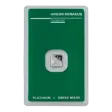
The 1g Argor-Heraeus Classic Platinum Bar
The 1g Argor-Heraeus Classic platinum bar is the smallest platinum format in the Classic range, the Swiss refiner's standard investment bar line. Classic is the no-frills tier in the Argor-Heraeus catalogue, distinct from the Kinebar with its kinegram holographic security and from the Lunar Calendar, Origin Traced, and Small Craft specialty lines. The design philosophy is deliberately minimal: no allegorical figures, no decorative motifs, which keeps production cost down and the authentication marks legible.
Argor-Heraeus credentials are the main reason to choose this bar over a generic gram bar. The refiner holds LPPM Good Delivery status for platinum, is LBMA Good Delivery for gold (since 1961) and silver (since 1992), and has served as one of seven global LBMA Referees since the panel was constituted in 2003, meaning the same entity that strikes this bar also audits other refiners' Good Delivery compliance. Every Classic bar carries an individual serial number certified by a sworn assayer and ships in a numbered tamper-evident assay card.
Be clear-eyed about the format itself: gram-weight platinum bars carry very high premiums, around 20 to 40 percent over spot, against 5 to 10 percent for a 1 oz platinum bar. A 1g bar is an entry point, gift, or curiosity rather than an efficient accumulation vehicle.
Classic Platinum Bar Specifications
The bar contains 1 gram (0.032 troy oz) of 999.5 fine platinum, the standard purity across the entire Classic platinum line, which is produced exclusively as minted ingots.
| Attribute | Detail |
|---|---|
| Weight | 1 g (0.032 troy oz) |
| Purity | 999.5 fine platinum |
| Format | Minted ingot |
| Serial number | Individual, certified by sworn assayer |
| Packaging | Numbered tamper-evident assay card |
| Face value | None (not legal tender) |
| Classic platinum sizes | 1g, 5g, 10g, 20g, 50g, 100g, 500g, 1kg |
The obverse carries the Argor-Heraeus logo, a stylised AH monogram within a double circle with "Argor-Heraeus SA" around the ring and "Switzerland" below, followed by the weight, metal, and purity in vertical arrangement. The reverse is blank or carries a simplified repeating logo pattern on some platinum bars. A year-of-manufacture stamp has appeared on all Argor-Heraeus bars since 1988. Platinum's density (21.45 g/cm3) is itself an authentication asset; no common cheap metal is dense enough to substitute convincingly, and counterfeit platinum bars are accordingly rare.
Tax Treatment of Platinum Bars by Country
Platinum gets none of the VAT exemptions that investment gold enjoys in Europe, which changes the buying calculus by country.
- United Kingdom: 20% VAT on purchase, and as a bar with no legal tender status it is also CGT-liable on sale. This is the least tax-efficient platinum form for UK buyers.
- European Union: Standard local VAT applies (17 to 27 percent depending on member state). There is no EU investment exemption for platinum.
- United States: Sales tax depends on the buyer's state; most states exempt bullion. Gains are taxed at the 28 percent collectibles rate. The IRA purity threshold for platinum is 99.95 percent, which this bar's 999.5 fineness meets exactly.
- Canada: GST/HST exempt, since 999.5 fineness clears the 99.5 percent purity requirement.
- Australia: GST-free as investment-grade platinum (99 percent purity threshold).
- New Zealand: GST-exempt; platinum requires only 99 percent purity to qualify.
- Singapore and Hong Kong: No GST under Singapore's IPM scheme, no tax of any kind in Hong Kong, and no capital gains tax in either.
Argor-Heraeus from Chiasso to Mendrisio
Argor SA was founded in 1951 in Chiasso, in the Swiss canton of Ticino. Union Bank of Switzerland took full ownership in 1973, and the 1986 joint venture with Heraeus Holding GmbH of Hanau, Germany gave the company its current name. The refinery relocated to a purpose-built facility in Mendrisio, Ticino in 1988. UBS exited in 1999, and in the years that followed the shareholding passed through Heraeus, Commerzbank, the Austrian Mint, and company management before Heraeus completed full acquisition on 13 July 2017, making Argor-Heraeus a wholly owned subsidiary.
The Classic line is the company's foundational bar output, the core minted and cast ingots that preceded the Kinebar (launched 1994) and all later specialty ranges; the Classic name exists mainly to distinguish these standard bars in catalogues and secondary-market listings. The company's accreditation record runs deep: LBMA Good Delivery for gold since 1961, COMEX since 1974, TOCOM since 1982, DMCC since 2005, and LPPM Good Delivery for platinum and palladium. Annual gold refining capacity at Mendrisio is approximately 400 tonnes, placing Argor-Heraeus in the same tier as PAMP and Valcambi within the Ticino refining cluster. The serial-numbering scheme for its 400 oz Good Delivery bars has run continuously and unchanged since 1952.
Argor-Heraeus Classic vs PAMP, Valcambi, and Heraeus at 1g
The 1g platinum bar market is small and the competing products come from the same Swiss and German refining cluster. PAMP Suisse sells platinum bars from 1g to 100g sealed in assay cards, Valcambi offers multiple sizes including its CombiBar format, and Heraeus, the German parent of Argor-Heraeus, is popular in the European market. All are LBMA-accredited names, so at this weight the practical differences are design, card packaging, and whatever each dealer charges on the day rather than any quality gap.
The more consequential comparison is across formats and sizes. Within platinum, gram bars at 20 to 40 percent over spot are far less efficient than the 1 oz bar at 5 to 10 percent; the 1 oz size is also the most liquid platinum bar at resale. Buyers in VAT jurisdictions should also weigh platinum coins: in the UK a platinum Britannia carries the same 20 percent VAT but escapes CGT as legal tender, an advantage no bar can match. Against the 1g Classic gold bar from the same line, the platinum version is the cheaper metal per gram but sits in a much thinner market with wider buy-sell spreads, so the exit matters as much as the entry price.
1g Classic Platinum Bar: frequently asked questions
-
The cheapest Argor-Heraeus 1g Classic platinum bar tracked here is $78.14, at 45.1% over the $1,680.00 platinum spot price per gram. Essential Bullion lists it at that price. Small bars carry significantly higher per-gram premiums than larger sizes due to fixed production costs spread across less metal.
-
The Argor-Heraeus Classic platinum bar is 999.5 fine, meaning it contains 99.95% pure platinum. This is the standard investment-grade fineness for platinum bars and meets the purity requirements for inclusion in platinum-eligible retirement accounts in markets such as the US.
-
Annual platinum mine production is far smaller than gold's, with supply concentrated in a small number of regions, primarily South Africa and Russia. Unlike gold, which is accumulated globally as a monetary asset, platinum's above-ground stocks are limited. This scarcity, combined with significant industrial demand, means platinum's price can behave differently from gold's even when supply is constrained.