51 products · 164 deals Prices & premiums exclude tax to compare across countries
Filters
| Product | /oz | Premium | Price (ex. tax) | |
|---|---|---|---|---|

5 deals
|
$1,790.68 |
-0.68%
+7% inc.VAT
|
$17,906.82
€16,891 inc.VAT
|
Compare |

2 deals
|
$1,889.39 | +4.62% | $18,893.90 | Compare |
| $1,891.84 | +4.75% | $1,216.48 | View Deal | |
| $1,885.75 |
+4.76%
+26% inc.VAT
|
$60,628.14
£54,521 inc.VAT
|
View Deal | |

2 deals
|
$1,912.37 | +5.89% | $6,148.42 | Compare |

2 deals
|
$1,911.54 | +6.20% |
$61,457.51
£46,056
|
Compare |

2 deals
|
$1,920.54 |
+6.70%
+28% inc.VAT
|
$30,873.26
£27,763 inc.VAT
|
Compare |
| $1,921.84 |
+6.77%
+28% inc.VAT
|
$9,607.24
£8,639 inc.VAT
|
View Deal | |

4 deals
|
$1,929.72 | +6.85% | $1,929.72 | Compare |

4 deals
|
$1,930.98 | +6.92% | $1,930.98 | Compare |
| $1,939.44 | +7.75% |
$31,177.13
£23,364
|
View Deal | |
| $1,948.10 | +7.87% |
$62,632.76
S$80,070
|
View Deal | |
| $1,956.13 | +8.31% |
$31,445.47
S$40,200
|
View Deal | |
| $1,964.20 | +8.76% |
$6,315.03
S$8,073
|
View Deal | |

24 deals
|
$1,958.98 |
+8.83%
+31% inc.VAT
|
$1,958.98
£1,762 inc.VAT
|
Compare |

4 deals
|
$1,966.50 | +8.89% | $1,966.50 | Compare |
| $1,968.13 |
+9.34%
+31% inc.VAT
|
$6,327.69
£5,690 inc.VAT
|
View Deal | |
| $1,982.97 | +9.80% | $1,275.08 | View Deal | |

6 deals
|
$1,985.87 |
+10.15%
+31% inc.VAT
|
$1,276.94
€1,326 inc.VAT
|
Compare |

2 deals
|
$1,989.19 |
+10.51%
+33% inc.VAT
|
$3,197.69
£2,876 inc.VAT
|
Compare |
| $1,989.42 | +10.52% |
$19,894.18
£14,909
|
View Deal | |

2 deals
|
$1,990.07 | +10.56% |
$31,991.11
£23,974
|
Compare |

3 deals
|
$1,997.03 | +10.58% | $642.06 | Compare |
| $2,010.86 | +11.34% |
$3,232.53
S$4,132
|
View Deal | |

4 deals
|
$2,008.23 | +11.57% |
$6,456.62
£4,839
|
Compare |

5 deals
|
$2,019.99 | +11.85% | $649.44 | Compare |

2 deals
|
$2,030.69 | +12.47% |
$2,030.69
A$2,852
|
Compare |

6 deals
|
$2,045.43 | +13.63% |
$3,288.10
£2,464
|
Compare |
| $2,064.27 |
+14.68%
+38% inc.VAT
|
$1,032.13
£928 inc.VAT
|
View Deal | |

5 deals
|
$2,067.46 |
+14.86%
+38% inc.VAT
|
$2,067.45
£1,859 inc.VAT
|
Compare |








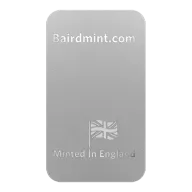

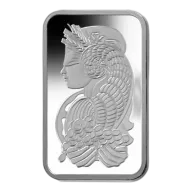
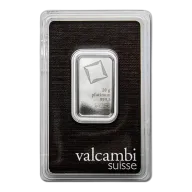
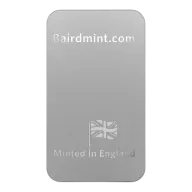



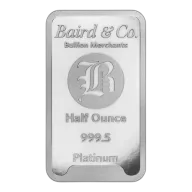
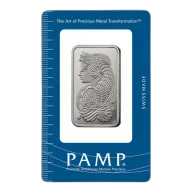
Prices are fetched automatically and may not reflect current merchant prices. Currency conversions and tax treatment are approximate. Rankings are based solely on price. We are not a dealer and accept no responsibility for transactions with listed merchants. Past performance is not indicative of future results. This site does not provide investment advice. Full disclaimer
About Platinum Bars
Platinum Bars: Lower Premiums in a High-Premium Market
Platinum bars are the most cost-efficient way to buy physical platinum. In a market where premiums are structurally higher than for gold or silver, bars typically carry 5-10% over spot for a 1 oz minted piece, compared to 8-15% for platinum coins. That gap is wider than the equivalent bar-versus-coin spread in the gold market, making the premium savings on platinum bars more meaningful.
The platinum bar market is small. Dealer inventory is limited, not all bullion dealers stock platinum bars, and the range of available sizes is narrower than for gold. Common retail sizes are 1g, 5g, 10g, 1 oz, 50g, 100g, and 1 kg. Larger sizes (10 oz, 100 oz) exist but are uncommon in retail channels. The 1 oz bar is the most commonly traded size and offers the best balance of premium efficiency and resale liquidity.
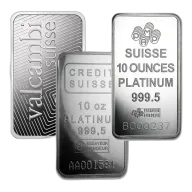
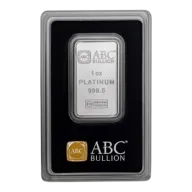
Bars are produced by the same LBMA-accredited refiners that dominate the gold and silver bar markets: PAMP Suisse, Valcambi, Heraeus, Argor-Heraeus, and Perth Mint. Standard purity is 999.5 fine (99.95%), matching the LPPM Good Delivery minimum and the purity of all major platinum coins. Minted bars come sealed in tamper-evident assay cards with serial numbers and refiner hallmarks.
The trade-off for lower premiums is reduced liquidity. Platinum bars have a thinner secondary market than gold bars. The 1 oz size from recognised refiners sells reasonably well through established dealers, but larger platinum bars (100g and above) have a very limited retail buyer pool. Buy-sell spreads are wider than for gold bars in both absolute and percentage terms, and not all local dealers handle platinum inventory. For resale ease, sealed bars from PAMP, Valcambi, or Heraeus in original assay cards command the best prices.
Platinum bars share gold's storage advantages: high density (21.45 g/cm3, even denser than gold), no tarnishing, no corrosion, and minimal space requirements per unit of value. Platinum is also harder than gold (3.5 versus 2.5 on the Mohs scale), making bars more resistant to surface scratches. The primary storage concern is the same as for gold: physical security.
Platinum Bar Tax Treatment by Country
Platinum bars receive less favourable purchase tax treatment than gold bars in the UK and EU, where investment gold has specific VAT exemptions that do not extend to platinum. In countries with purity-based exemptions, platinum bars typically qualify at a lower purity threshold than gold or silver.
United Kingdom
Platinum bars are subject to 20% VAT on purchase. There is no investment platinum exemption. On disposal, bars are subject to CGT at 18-24%, with the GBP 3,000 annual allowance. Bars do not qualify for the CGT exemption that applies to the Platinum Britannia coin (UK legal tender). This makes platinum bars the least tax-efficient platinum form for UK investors: 20% VAT in, CGT on exit. VAT-free vault storage is the main cost mitigation.
United States
Most states exempt platinum bars from sales tax. Capital gains are taxed at the 28% collectibles rate. IRA-eligible platinum bars must be 99.95%+ purity from accredited refiners. Most major LBMA-accredited refiner bars (PAMP, Valcambi, Heraeus, Perth Mint) qualify. Bars' lower premiums make them attractive for IRA accounts where liquidity at resale is less immediate a concern.
Canada
GST/HST exempt for platinum bars at 99.5%+ purity. No form-based distinction between bars and coins.
Australia
GST-free for investment-grade platinum bars at 99%+ purity. This is a lower threshold than for gold (99.5%) and silver (99.9%). All standard platinum bars exceed it comfortably.
New Zealand
GST-exempt at 99%+ purity. No capital gains tax. Favourable for platinum bars.
Singapore
GST-exempt for platinum bars at 99%+ purity from LPPM-accredited refiners. No capital gains tax. Singapore and Hong Kong are the most cost-efficient jurisdictions for platinum bars: no purchase tax, no sale tax, and the bar premium is the entire cost consideration.
Hong Kong
No VAT, no import duty, no capital gains tax.
South Africa
Platinum bars are subject to 15% VAT. South Africa does not produce a platinum Krugerrand in regular bullion quantities, so there is no legal tender coin to provide a VAT-exempt alternative as exists for gold.
European Union
Standard VAT applies at national rates (17-27%). No investment platinum exemption equivalent to the Investment Gold Directive. In Germany, gains on platinum bars held longer than one year are tax-free, partially offsetting the upfront VAT.
Platinum Bar Premiums by Size
Platinum bar premiums are higher than gold bar premiums at every size, reflecting lower production volumes, a smaller dealer network, fewer competing refiners, and platinum's higher melting point (1,768 degrees C versus gold's 1,064 degrees C), which increases fabrication costs.
| Size | Typical premium over spot | Notes |
|---|---|---|
| 1g | 20-40% | Gift/novelty; not cost-efficient |
| 5g | 15-25% | Very high premium; entry point only |
| 10g | 10-20% | Still elevated; moderate efficiency |
| 1 oz (31.1g) | 5-10% | Most practical investment size |
| 50g | 5-8% | Less common; limited availability |
| 100g | 4-8% | Narrower retail buyer pool |
| 1 kg | 3-6% | Significant capital commitment; thin secondary market |
The largest premium drop occurs between the gram-weight bars and the 1 oz threshold, where premiums fall from double digits to single digits. Above 1 oz, each step up saves less. The marginal improvement from 1 oz to 100g is typically 1-3 percentage points, meaningful but not transformative.
Small gram-weight platinum bars (1g to 5g) carry premiums of 20-40% and function more as gifts or collectibles than cost-efficient investments. The 1 oz bar is the minimum practical investment size.
In VAT jurisdictions (UK at 20%, EU at 17-27%), the effective cost above spot for a delivered 1 oz platinum bar reaches 25-30%. The bar must appreciate by this amount before the position breaks even after accounting for the buy-sell spread. Larger bars reduce the premium component but the VAT is fixed. This is the core economic challenge for platinum investment in the UK and EU.
The premium gap between platinum bars and platinum coins is wider than the equivalent gap in gold: typically 3-5 percentage points versus 2-3 for gold bars versus coins. This makes the bar option relatively more attractive in the platinum market than in the gold market.
Major Platinum Bar Producers
The range of platinum bar products is narrower than for gold or silver. Fewer refiners produce platinum bars, not all sizes are consistently in stock, and some refiners offer only a limited range. Buying from an LBMA/LPPM-accredited refiner is important for resale liquidity.
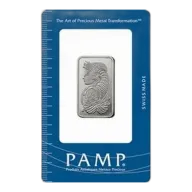
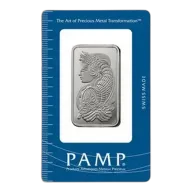
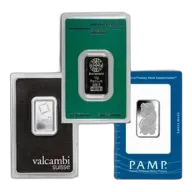
PAMP Suisse (Switzerland) produces platinum bars from 1g to 100g, sealed in assay cards with VeriScan authentication. PAMP is one of the most widely recognised refiner brands globally. Their platinum bars carry the same assay card packaging and branding as their gold products.
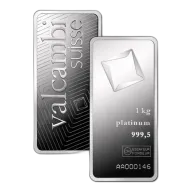
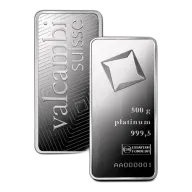
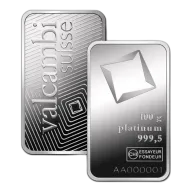
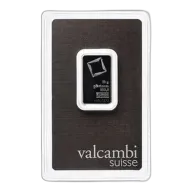
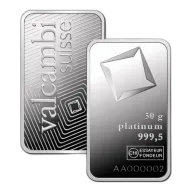
Valcambi (Switzerland) offers platinum bars in multiple sizes, including CombiBars (scored, divisible bars). LBMA-accredited with clean, minimalist design.
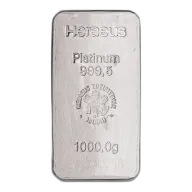
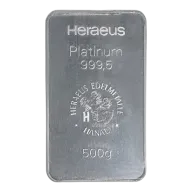
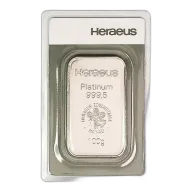
Heraeus (Germany) produces platinum bars popular in the European market. LBMA-accredited. A major presence in continental European dealer networks.
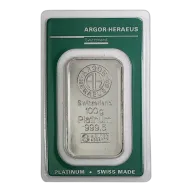
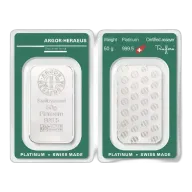
Argor-Heraeus (Switzerland) uses Kinebar holographic security on their platinum bars. LBMA-accredited since 1961. The holographic element provides visual authentication without specialised equipment.
Perth Mint (Australia) is government-backed (Western Australian Government) and produces platinum bars featuring the kangaroo design. The sovereign backing adds an additional layer of institutional assurance beyond private refiner branding.
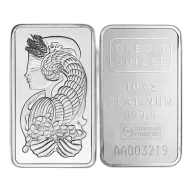
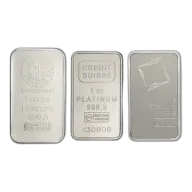
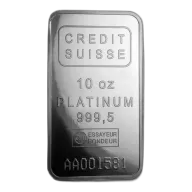
Credit Suisse platinum bars are no longer produced (Credit Suisse sold its bullion operations), but secondary market bars still trade. They carry the legacy brand recognition and are accepted by dealers.
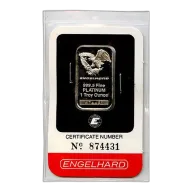
The Johnson Matthey name also appears on older platinum bars. Johnson Matthey's refining operations were acquired by Asahi in 2015. Legacy JM bars are liquid and recognised, particularly in North America.
A notable absence: unlike in gold, where government mints (Royal Canadian Mint, Perth Mint) produce branded bars that compete with private refiners, government mint platinum bars are less common. The Perth Mint is the primary exception. The platinum bar market is dominated by Swiss and German private refiners.
Authenticating Platinum Bars
Platinum has a natural advantage in authentication that gold lacks. At a density of 21.45 g/cm3, platinum is denser than any common inexpensive metal. The tungsten-core risk that affects gold bars does not apply to platinum: tungsten (19.25 g/cm3) is substantially lighter than platinum and would produce a bar that is detectably underweight or oversized. The only metals denser than platinum (osmium at 22.56 g/cm3 and iridium at 22.59 g/cm3) are rarer and more expensive than platinum itself, making them non-viable for counterfeiting.
This density advantage means that a simple weight-and-dimension check is a particularly strong authentication test for platinum bars. A bar of the correct weight and correct dimensions is almost certainly genuine platinum, because no affordable substitute can match both properties simultaneously.
Testing Methods
XRF (X-ray fluorescence) reads surface composition and is effective for confirming platinum content. The surface penetration depth (10-50 microns) is less of a concern for platinum than gold, since there is no viable core substitution material.
Sigma Metalytics Precious Metal Verifier uses electromagnetic conductivity measurement. Effective for bars up to 100g and widely available at dealers.
Ultrasonic testing can verify the internal composition of larger bars, though the absence of a credible core-substitution threat makes this less critical for platinum than for gold.
Specific gravity (water displacement) is accurate and definitive but requires removing the bar from its assay card.
Provenance and Packaging
As with gold, the primary defence is purchasing from authorised dealers. Sealed assay cards from major refiners (PAMP with VeriScan, Argor-Heraeus with Kinebar, Valcambi with serial numbers) provide chain-of-custody assurance. Breaking the seal may require re-assaying for resale. Counterfeit platinum bars are rare in practice, making the authentication concern lower than for equivalent gold products.
Platinum Bars: frequently asked questions
-
The live platinum spot price is $1,806.00 per troy ounce. Investment bars are priced by multiplying the bar's troy ounce weight by spot and adding a fabrication and dealer premium. Larger bars generally carry a smaller per-ounce premium than fractional sizes.
-
Investment platinum bars are typically 999.5 fine (99.95% pure platinum), the standard used by LBMA Good Delivery-accredited refiners. This is distinct from jewellery grades such as 850, 900, or 950, which are alloys used for durability. Bullion bars are stamped Pt999.5 or Pt9995 to confirm the investment-grade purity.
-
We currently track 36 dealers offering 188 platinum bar listings. Use the comparison table on this page to sort by premium over spot and filter by bar weight to find the most competitively priced option for your budget.
-
In the UK, platinum bars are subject to Capital Gains Tax; gains above the £3,000 annual allowance are taxed at 18% or 24%. Bars do not carry the CGT exemption available to certain UK legal-tender coins. US investors pay up to 28% on long-term gains. In Canada, 50% of any gain is included in taxable income. Check the tax tab on this page for your country's rules.
- 100g Argor-Heraeus Platinum Bar
- 100g Baird & Co. Platinum Bar
- 100g Britannia Platinum Bar
- 100g Credit Suisse Platinum Bar
- 100g Fortuna Platinum Bar
- 100g Heraeus Platinum Bar
- 100g PAMP Suisse Platinum Bar
- 100g Perth Mint Platinum Bar
- 100g Platinum Bar
- 100g Royal Canadian Mint Platinum Bar
- 100g Valcambi Platinum Bar
- 10g Argor-Heraeus Platinum Bar
- 10g Fortuna Platinum Bar
- 10g Multigram Platinum Bar
- 10g PAMP Suisse Platinum Bar
- 10g Platinum Bar
- 10g Valcambi Platinum Bar
- 10 oz Credit Suisse Platinum Bar
- 10 oz Fortuna Platinum Bar
- 10 oz PAMP Suisse Platinum Bar
- 10 oz Perth Mint Platinum Bar
- 10 oz Platinum Bar
- 10 oz Royal Canadian Mint Platinum Bar
- 10 oz Valcambi Platinum Bar
- 1/10 oz Baird & Co. Platinum Bar
- 1/10 oz Platinum Bar
- 1/2 oz Fortuna Platinum Bar
- 1/2 oz Intrinsic Tender Platinum Bar
- 1/2 oz PAMP Suisse Platinum Bar
- 1/2 oz Platinum Bar
- 1/4 oz Platinum Bar
- 1g APMEX Platinum Bar
- 1g Argor-Heraeus Platinum Bar
- 1g Credit Suisse Liberty Platinum Bar
- 1g Credit Suisse Platinum Bar
- 1g Fortuna Platinum Bar
- 1g PAMP Suisse Liberty Platinum Bar
- 1g PAMP Suisse Platinum Bar
- 1g Valcambi Platinum Bar
- 1 Kilo Argor-Heraeus Platinum Bar
- 1 Kilo Baird & Co. Platinum Bar
- 1 Kilo Fortuna Platinum Bar
- 1 Kilo Heraeus Platinum Bar
- 1 Kilo PAMP Suisse Platinum Bar
- 1 Kilo Platinum Bar
- 1 Kilo Valcambi Platinum Bar
- 1 oz ABC Refinery Platinum Bar
- 1 oz Ainslie Platinum Bar
- 1 oz Argor-Heraeus Platinum Bar
- 1 oz Baird & Co. Platinum Bar
- 1 oz Britannia Platinum Bar
- 1 oz Credit Suisse Platinum Bar
- 1 oz Engelhard Platinum Bar
- 1 oz Fortuna Platinum Bar
- 1 oz Geiger Original Platinum Bar
- 1 oz Heraeus Platinum Bar
- 1 oz Johnson Matthey Platinum Bar
- 1 oz PAMP Suisse Lunar Platinum Bar
- 1 oz PAMP Suisse Platinum Bar
- 1 oz Perth Mint Platinum Bar
- 1 oz Platinum Bar
- 1 oz Royal Canadian Mint Platinum Bar
- 1 oz Swiss Mint Platinum Bar
- 1 oz Valcambi Platinum Bar
- 20g Argor-Heraeus Platinum Bar
- 20g Fortuna Platinum Bar
- 20g PAMP Suisse Platinum Bar
- 20g Platinum Bar
- 20g Valcambi Platinum Bar
- 250g Baird & Co. Platinum Bar
- 250g Platinum Bar
- 25g Fortuna Platinum Bar
- 25g Multigram Platinum Bar
- 2.5g PAMP Suisse Platinum Bar
- 2.5g Platinum Bar
- 2.5g Valcambi Platinum Bar
- 2g Credit Suisse Platinum Bar
- 2g US Mint Liberty Platinum Bar
- 2 oz Platinum Bar
- 500g Asahi Refining Platinum Bar
- 500g Baird & Co. Platinum Bar
- 500g Fortuna Platinum Bar
- 500g Heraeus Platinum Bar
- 500g Platinum Bar
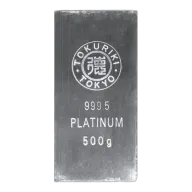
- 500g Tokuriki Honten Platinum Bar
- 500g Valcambi Platinum Bar
- 50g Argor-Heraeus Platinum Bar
- 50g CombiBar Platinum Bar
- 50g Fortuna Platinum Bar
- 50g Platinum Bar
- 50g Valcambi Platinum Bar
- 50 oz Argor-Heraeus Platinum Bar
- 5g Argor-Heraeus Platinum Bar
- 5g Credit Suisse Liberty Platinum Bar
- 5g Credit Suisse Platinum Bar
- 5g Fortuna Platinum Bar
- 5g PAMP Suisse Platinum Bar
- 5g Platinum Bar
- 5g Valcambi Platinum Bar
- 5 Kilo PAMP Suisse Platinum Bar
- 5 oz Fortuna Platinum Bar
- 5 oz PAMP Suisse Platinum Bar
- 5 oz Platinum Bar
- Pre-Owned 100g Platinum Bar
- Pre-Owned 100g The Royal Mint Platinum Bar
- Pre-Owned 10g Platinum Bar
- Pre-Owned 10 oz Credit Suisse Platinum Bar
- Pre-Owned 10 oz Engelhard Platinum Bar
- Pre-Owned 10 oz Platinum Bar
- Pre-Owned 1g Credit Suisse Platinum Bar
- Pre-Owned 1 oz Degussa Goldbars Platinum Bar
- Pre-Owned 1 oz Platinum Bar
- Pre-Owned 1 oz Valcambi Platinum Bar
- Pre-Owned 20g Platinum Bar
- Pre-Owned 50g Johnson Matthey Platinum Bar
- Pre-Owned 50g Platinum Bar
- Pre-Owned 5g Platinum Bar
- Pre-Owned 5g Valcambi Platinum Bar
- Pre-Owned 5 oz Platinum Bar