5 products · 10 deals Prices & premiums exclude tax to compare across countries
Filters





Prices are fetched automatically and may not reflect current merchant prices. Currency conversions and tax treatment are approximate. Rankings are based solely on price. We are not a dealer and accept no responsibility for transactions with listed merchants. Past performance is not indicative of future results. This site does not provide investment advice. Full disclaimer
About 5g Platinum Bars
The 5 Gram Platinum Bar as an Entry Point
Five grams of platinum sits at the boundary between novelty and investment. At roughly 0.16 troy ounces, a 5g bar costs a fraction of the standard 1 oz platinum bar, placing physical platinum within reach for buyers building a position gradually or seeking a compact, high-value store. The 5g size is the smallest platinum bar that major LBMA-accredited refiners produce as a standard catalogue item, which matters for resale: a Valcambi or PAMP Suisse Fortuna 5g bar in its original sealed assay card is globally recognised by dealers.
The tradeoff is premium. Manufacturing a minted platinum bar at this size involves nearly the same fixed costs as striking a 1 oz bar (assay packaging, individual serial numbering, quality control), but those costs are spread across far less metal. Typical premiums on 5g platinum bars run 15-25% above spot, compared to 5-10% on a 1 oz bar. This means the spot price must rise substantially before a 5g purchase breaks even on a round trip. For buyers focused purely on cost efficiency, stepping up to a 10g bar or saving toward 1 oz makes better economic sense.
Where the 5g size has genuine utility is as a metric-market entry point. In continental Europe, the Middle East, and parts of Asia, gram-denominated bars feel natural, and 5g represents the smallest size where the premium penalty becomes tolerable rather than punishing. It also works as a physical gift: the credit-card-sized assay card presents well and carries meaningful value without requiring five-figure expenditure.
Premium Structure for 5 Gram Platinum Bars
Premiums on 5g platinum bars are among the highest in the platinum bar market, reflecting the fixed manufacturing and certification costs divided across a small quantity of metal. The standard range sits between 15% and 25% over spot, with branded bars from premium refiners occasionally exceeding that. For context, a 1 oz platinum bar typically carries 5-10% over spot, and a 10g bar sits in the 10-20% range.
Within the 5g category, there is meaningful premium variation by brand. Generic bars from lesser-known refiners trade at the lower end. The 5g PAMP Fortuna commands the highest premiums, reflecting its Lady Fortuna design, VeriScan digital authentication, and strong secondary-market recognition. Valcambi 5g bars and Argor-Heraeus 5g bars sit in between, benefiting from LBMA accreditation without the design premium that PAMP carries.
Buyback spreads at this size are wide. Dealers typically offer 5-10% below spot on repurchase, which combined with the acquisition premium means a round-trip cost of 20-35%. This compares poorly to 1 oz bars where the round trip is closer to 10-15%. The economics improve somewhat for bars in sealed original packaging from recognised refiners, which command tighter spreads than loose or damaged-packaging bars.
Major 5 Gram Platinum Bars by Refiner
The 5g platinum bar market is dominated by Swiss LBMA-accredited refiners, with a few sovereign-mint entries. Each bar shares the standard 999.5 fineness (99.95% pure platinum) required for investment-grade status, but they differ in design, security features, and market recognition.
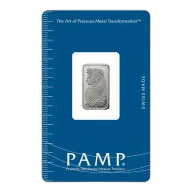
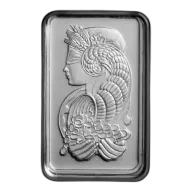
The 5g PAMP Suisse Fortuna is the most widely stocked option, available from the largest number of dealers. It features the iconic Lady Fortuna reverse design and PAMP's VeriScan digital authentication system, where each bar's microscopic surface topography is recorded in a database and verifiable via smartphone app. The bar ships in tamper-evident CertiPAMP assay packaging with a unique serial number.
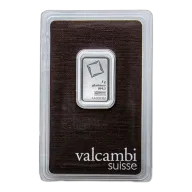
Valcambi 5g platinum bars match the Fortuna's dealer availability. Valcambi (based in Balerna, Switzerland) is an LBMA-accredited refiner that also manufactures bars for other brands including Credit Suisse. Their bars come in sealed assay cards but without the design flourishes or digital verification of PAMP products, which translates to slightly lower premiums.
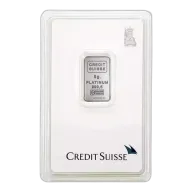
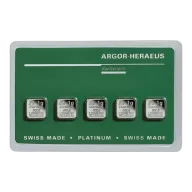
The 5g Credit Suisse Liberty features the Statue of Liberty on its reverse and is manufactured by Valcambi with the CHI Essayeur Fondeur hallmark. Following UBS's acquisition of Credit Suisse in 2023-2024, long-term production status is uncertain, but existing bars remain fully investment-grade. Argor-Heraeus 5g bars offer another Swiss option, produced by a subsidiary of the Heraeus Group with kinebar holographic security features on some products.
Less common entries include the 5g Casa de Moneda de Chile bar (from Chile's national mint) and the 5g Argentia bar from the Canadian private mint. Both meet the 999.5 purity standard but have narrower dealer networks and thinner secondary markets compared to the Swiss refiners.
Resale and Storage at 5 Grams
Liquidity for 5g platinum bars depends heavily on the refiner. Bars from PAMP Suisse, Valcambi, and Argor-Heraeus in their original sealed assay cards are accepted by virtually all major online dealers and will receive quoted buyback prices. Generic bars or those from lesser-known refiners may face wider spreads or require specialist buyers. The platinum market is already thinner than gold or silver at every size, and this illiquidity is amplified at fractional sizes where fewer buyers are active.
The practical resale hierarchy runs: PAMP Fortuna (strongest secondary demand, broadest dealer acceptance), Valcambi and Argor-Heraeus (strong acceptance at major dealers), Credit Suisse (still well-recognised on secondary market despite uncertain production future), and other brands (may require approaching specialist dealers or accepting wider spreads).
Storage is straightforward. A 5g platinum bar in its assay card measures roughly the size of a credit card and stores flat. Multiple bars stack efficiently in a safe, safety deposit box, or vault. Platinum does not tarnish, corrode, or require atmospheric precautions. The density of platinum (21.45 g/cm3) means these bars are compact relative to their value. The main storage consideration is preserving the sealed assay packaging intact, as broken seals reduce resale value and may require re-assaying.
For buyers accumulating 5g bars over time, the total position remains easy to store but harder to liquidate efficiently than an equivalent value held in fewer, larger bars. Selling ten 5g bars incurs transaction costs on each piece, whereas a single 50g bar would sell in one transaction with a lower percentage spread.
5g Platinum Bars: frequently asked questions
-
The indicative melt value of a 5g platinum bar is the live spot ($1,806.00 per troy ounce) divided by 31.1035, multiplied by 5g. Dealer prices run above melt; small bars carry higher percentage premiums than larger formats because fixed fabrication costs are spread over less metal. 7 dealers list 11 products in this size for comparison.
-
To find the platinum price per gram, divide the live spot ($1,806.00 per troy ounce) by 31.1035. This gives the raw metal value; the price you pay for a physical bar will include a fabrication and dealer premium on top.
-
Yes. Annual platinum mine production is significantly lower than gold production by weight, and usable platinum deposits are concentrated in a small number of regions. Its scarcity, combined with high industrial demand (primarily for catalytic converters), underpins its value as both an industrial and investment metal.
-
Investment-grade platinum bars are typically 999.5 fine (99.95% platinum), a widely recognised standard for bullion. Some refinery bars are marked 999 fine. Jewellery alloys such as 950 or 850 platinum contain other metals and are not considered bullion-grade.
-
VAT and GST treatment varies. Investment platinum at 99.5% or finer carries no VAT in the UK; it is also GST-free in Canada (0%), Australia (0%), and New Zealand (0%). In Germany, platinum bars attract 19% VAT. Capital gains on bars are generally taxable; see your country's rules on rates and exemptions.