10 products · 70 deals Prices & premiums exclude tax to compare across countries
Filters
| Product | /oz | Premium | Price (ex. tax) | |
|---|---|---|---|---|

4 deals
|
$1,929.72 | +6.85% | $1,929.72 | Compare |

4 deals
|
$1,930.98 | +6.92% | $1,930.98 | Compare |

24 deals
|
$1,958.98 |
+8.83%
+31% inc.VAT
|
$1,958.98
£1,762 inc.VAT
|
Compare |

4 deals
|
$1,966.50 | +8.89% | $1,966.50 | Compare |

2 deals
|
$2,030.69 | +12.47% |
$2,030.69
A$2,852
|
Compare |

5 deals
|
$2,067.46 |
+14.86%
+38% inc.VAT
|
$2,067.45
£1,859 inc.VAT
|
Compare |

5 deals
|
$2,078.32 |
+15.46%
+39% inc.VAT
|
$2,078.32
£1,869 inc.VAT
|
Compare |

18 deals
|
$2,082.39 | +15.69% |
$2,082.39
£1,561
|
Compare |

3 deals
|
$2,138.16 | +18.79% |
$2,138.17
£1,602
|
Compare |
| $2,271.50 | +25.78% | $2,271.50 | View Deal |

Prices are fetched automatically and may not reflect current merchant prices. Currency conversions and tax treatment are approximate. Rankings are based solely on price. We are not a dealer and accept no responsibility for transactions with listed merchants. Past performance is not indicative of future results. This site does not provide investment advice. Full disclaimer
About 1 oz Platinum Bars
The 1 oz Platinum Bar as the Standard Retail Size
One troy ounce is 31.1035 grams and serves as the standard unit for bullion worldwide, with premiums quoted relative to the spot price per troy ounce. Among platinum bars, which come in retail sizes from 1g up to 1 kg, the 1 oz bar is the most commonly traded size. Standard purity is .9995 fine platinum, and production sits with private refineries rather than sovereign mints, the same LBMA-accredited names that strike gold and silver bars.
The economic case for starting at 1 oz rather than smaller is straightforward. Gram-weight platinum bars at 1g to 5g carry premiums of 20-40% or more over spot, which makes them function more as gifts or novelties than cost-efficient investments. The 1 oz bar is the minimum practical investment size. Going larger cuts the premium further, but larger platinum bars trade in a very limited retail secondary market, so the 1 oz size balances cost against the ability to sell again later.
Buyers also weigh bars against 1 oz platinum coins. Bars carry lower premiums; coins offer sovereign mint branding, security features, and in the UK the CGT exemption on the Platinum Britannia. The premium gap between platinum bars and coins is wider than the equivalent gap in gold, so the bar saving is more meaningful here than it would be for a gold buyer making the same choice. In jurisdictions that charge VAT on platinum, bars offer the best premium efficiency within the platinum market, which partially offsets the VAT impact. UK buyers pay 20% VAT on new platinum bars and face CGT on sale, since bars have no legal tender status. In Canada, Australia, New Zealand, Singapore and Hong Kong, a .9995 fine platinum bar passes the local purity thresholds for sales tax exemption, and US buyers can place 99.95%+ bars from accredited refiners in an IRA.
One structural fact shapes everything about this market: platinum bullion is a fraction of the size of the gold market. Fewer buyers means fewer products, less competition between refiners, and higher premiums. Not all bullion dealers stock platinum bars at all, and inventory in any given size is thinner than a gold buyer would expect.
1 oz Platinum Bar Premiums and the Size Ladder
Minted 1 oz platinum bars typically trade at 5-10% over spot. That sits in the middle of the platinum bar size ladder:
| Bar size | Typical premium over spot |
|---|---|
| 1g | 20-40% |
| 10g | 10-20% |
| 1 oz | 5-10% |
| 100g | 4-8% |
| 1 kg | 3-6% |
The drop from 10g to 1 oz is the steepest useful step on the ladder. Moving beyond 1 oz to 100g platinum bars or a kilo bar shaves a few more points off the premium, but those sizes are uncommon in the retail market and their secondary market is thin, so the saving comes with a liquidity cost.
Platinum bar premiums run higher than gold bar premiums at equivalent sizes. The reasons are structural: lower production volumes, a smaller market, fewer competing refiners, and higher fabrication difficulty. Platinum melts at 1,768C against 1,064C for gold, which makes it harder to work. For comparison, 1 oz gold bars carry premiums of roughly 2-4%.
Against platinum coins, bars win on cost. Coins carry sovereign mint premiums on top of fabrication, and the bar-versus-coin premium gap in platinum is wider than the same gap in gold. In VAT jurisdictions this matters twice over: the UK and EU charge full VAT on new platinum (20% in the UK, 17-27% across the EU), so squeezing the premium through bar buying is the main cost lever a platinum buyer controls. US buyers building IRA positions also favour bars, since the lower premium matters more than liquidity inside a retirement account.
Major 1 oz Platinum Bars by Refiner
Platinum bars come from the same LBMA-accredited refiners that produce gold and silver bars, though each refiner's platinum range is narrower than its gold or silver range, and not all sizes are consistently in stock.
| Bar | Refiner | Country | Notable |
|---|---|---|---|
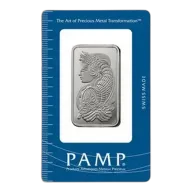
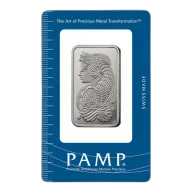
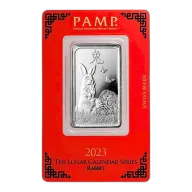
| PAMP Suisse platinum bar | PAMP Suisse | Switzerland | LBMA accredited; sizes from 1g to 100g; sealed in assay card |
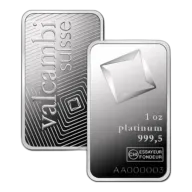
| Valcambi platinum bar | Valcambi | Switzerland | LBMA accredited; multiple sizes including CombiBars |
| Heraeus platinum bar | Heraeus | Germany | LBMA accredited; popular in the European market |
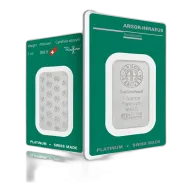
| Argor-Heraeus platinum bar | Argor-Heraeus | Switzerland | LBMA accredited; kinebar holographic security |
| Perth Mint platinum bar | Perth Mint | Australia | Government-backed; kangaroo design |
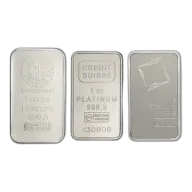
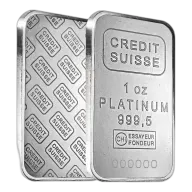
| Credit Suisse platinum bar | Credit Suisse | Switzerland | No longer produced since Credit Suisse sold its bullion operations; secondary market bars still trade |
The Swiss refiners dominate the list. A 1 oz PAMP Suisse platinum bar ships sealed in an assay card, and Argor-Heraeus adds kinebar holographic security to its bars. The Perth Mint is the exception to the private-refinery pattern, offering a government-backed bar with its kangaroo design. Credit Suisse bars are a secondary-market-only option now that production has ended.
For US buyers, IRA eligibility requires 99.95%+ purity from an accredited refiner, a bar every product in the table meets at the standard .9995 fineness. Buyers should expect limited dealer inventory regardless of brand: the platinum bar market is much smaller than gold or silver, and not all bullion dealers stock platinum bars at all.
Selling 1 oz Platinum Bars and Storing Them
The 1 oz size has the best resale liquidity among platinum bars. Bars from LBMA-accredited refiners are sellable, but the whole platinum market is thinner than gold or silver, and buy-sell spreads on platinum bars are wider than on gold bars in both absolute and percentage terms. The smaller the dealer network in a given country, the wider the spread; the US and UK have the most established platinum dealer networks. Larger bars at 100g and above have a very limited retail secondary market and may need to be sold to specialist dealers or refiners, which is a further argument for staying at 1 oz.
Presentation matters at buyback. Sealed bars in assay cards from recognised refiners such as PAMP, Valcambi and Heraeus command better resale prices than generic or loose bars, so the assay card should stay sealed. LBMA-branded assay cards with serial numbers also provide strong provenance, which feeds directly into authentication: platinum's density of 21.45 g/cm3 means no common cheap metal can substitute convincingly. Tungsten, at 19.25 g/cm3, would be detectably lighter in a bar of correct dimensions, and the only denser candidates, iridium and osmium, are rarer and more expensive than platinum itself. Counterfeit platinum bars are accordingly rare.
Storage is undemanding. Platinum does not tarnish or corrode, so no atmospheric precautions are needed, and at Mohs 3.5 hardness it resists scratches better than gold at 2.5. A 1 oz bar holds roughly USD 1,000+ of value in a very small package, minted bars in assay cards store flat and stack efficiently, and the value-to-space ratio in a vault is similar to gold. The practical routine is simple: keep the bar sealed in its card, keep the card flat, and sell through a dealer who handles platinum, since not all do.
1 oz Platinum Bars: frequently asked questions
-
The metal value of a 1 troy oz platinum bar is the live platinum spot price, currently $1,806.00. Retail prices from the 31 dealers tracked on this page will be higher, as each dealer adds a premium over spot to cover production and margin. Compare listings above to find the keenest price available.
-
Both prices move continuously. The live platinum spot is $1,806.00; you can compare that directly with the gold spot on the gold pages. Historically platinum often traded above gold, but in recent years it has typically sat below gold, reflecting slower growth in industrial demand and a smaller investor base relative to gold.
-
Investment-grade 1 oz platinum bars are typically refined to 99.95% purity (stamped 9995 fine). Some bars from major refiners reach 99.99% (.9999 fine). This distinguishes them from jewellery alloys such as 950 platinum, which contain only 95% platinum. Always check the assay certificate or stamp before purchase.
-
Platinum's price is shaped heavily by industrial demand, particularly from catalytic converters in diesel vehicles. The shift away from diesel and uncertainty around hydrogen fuel cell adoption have reduced the industrial demand outlook. Platinum also has a thinner investor market than gold and its supply is concentrated in a small number of producing regions, creating both volatility and liquidity constraints that can weigh on price relative to gold.
-
Platinum bars are not legal tender and carry no automatic CGT exemption. In the UK, gains above the £3,000 annual exempt amount are taxed at 18% or 24%. US investors pay up to 28% on long-term gains. In Canada, 50% of any capital gain is included in taxable income. Tax rules vary by country, so check the position in your jurisdiction.
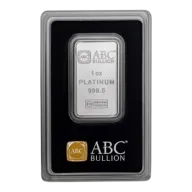
- 1 oz ABC Refinery Platinum Bar
- 1 oz Ainslie Platinum Bar
- 1 oz Argor-Heraeus Platinum Bar
- 1 oz Baird & Co. Platinum Bar
- 1 oz Britannia Platinum Bar
- 1 oz Credit Suisse Platinum Bar
- 1 oz Engelhard Platinum Bar
- 1 oz Fortuna Platinum Bar
- 1 oz Geiger Original Platinum Bar
- 1 oz Heraeus Platinum Bar
- 1 oz Johnson Matthey Platinum Bar
- 1 oz PAMP Suisse Lunar Platinum Bar
- 1 oz PAMP Suisse Platinum Bar
- 1 oz Perth Mint Platinum Bar
- 1 oz Platinum Bar
- 1 oz Royal Canadian Mint Platinum Bar
- 1 oz Swiss Mint Platinum Bar
- 1 oz Valcambi Platinum Bar
- Pre-Owned 1 oz Degussa Goldbars Platinum Bar
- Pre-Owned 1 oz Platinum Bar
- Pre-Owned 1 oz Valcambi Platinum Bar