3 products · 8 deals Prices & premiums exclude tax to compare across countries

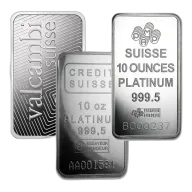

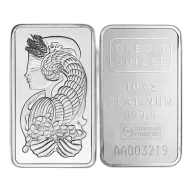

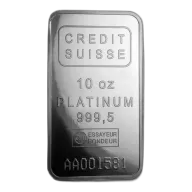
Prices are fetched automatically and may not reflect current merchant prices. Currency conversions and tax treatment are approximate. Rankings are based solely on price. We are not a dealer and accept no responsibility for transactions with listed merchants. Past performance is not indicative of future results. This site does not provide investment advice. Full disclaimer
About 10 oz Platinum Bars
The 10 oz Platinum Bar: A Large Format in a Small Market
A 10 oz platinum bar contains 311.035 grams of platinum at the standard bar purity of .9995 fine. It sits near the top of the retail platinum size range, well above the 1 oz bar that dominates retail trading. Platinum bars are produced primarily by private refineries rather than sovereign mints, and the common retail sizes run from 1g through 1 kg. Larger sizes such as 10 oz exist but are uncommon in the retail market, a consequence of the high per-unit cost and a thin secondary market.
The platinum bar market as a whole is much smaller than the gold or silver bar market. Dealer inventory is limited, and not all bullion dealers stock platinum bars at all, especially in the larger sizes. That shapes who buys at this weight: a 10 oz platinum bar concentrates a substantial outlay into a single piece, so it suits buyers building a large platinum position who are prioritising cost over flexibility. In the US, platinum bars at 99.95%+ purity from accredited refiners are IRA-eligible, and the research notes that lower premiums make bars attractive for IRA accounts where day-to-day liquidity matters less.
The tradeoff against smaller formats is the familiar one, sharpened by platinum's thin market. Ten separate 1 oz platinum bars can be sold one at a time; a 10 oz bar is a single all-or-nothing transaction. The 1 oz size also has the best resale liquidity among platinum bars, so moving up the scale trades away the easiest exit in the platinum market. Buyers who want sovereign branding or, in the UK, capital gains tax exemption have a separate decision between bars and platinum coins, where the premium gap is wider than it is for gold.
Where 10 oz Sits on the Platinum Premium Curve
Platinum bar premiums fall steadily as bar size increases. The approximate bands from the research run as follows: 1g bars at 20-40% over spot, 10g bars at 10-20%, 1 oz bars at 5-10%, 100g bars at 4-8%, and 1 kg bars at 3-6%. The research does not quote a band for the 10 oz size specifically, but it sits between the 100g and 1 kg formats on the weight scale, where per-unit fabrication cost is spread across more metal. The clear pattern is that gram-weight bars are not cost-efficient, the 1 oz bar is the minimum practical investment size, and larger bars buy progressively lower percentage premiums.
Platinum bar premiums are higher than gold bar premiums at equivalent sizes. The research attributes this to lower production volumes, a smaller market, fewer competing refiners, and higher fabrication difficulty: platinum melts at 1,768C against 1,064C for gold. Bars do carry lower premiums than platinum coins, and the premium gap between platinum bars and coins is wider than the equivalent gap for gold, which makes the bar saving more meaningful in this metal.
Tax treatment dominates the total cost in some markets. UK buyers pay 20% VAT on new platinum bars, and the bars are CGT-liable on sale, making them the least tax-efficient platinum form for UK investors. Across the EU, silver and platinum carry the full local VAT rate, which ranges from 17% to 27% depending on the country, with no investment exemption. By contrast, Canada applies no GST/HST at 99%+ purity, Australia is GST-free at 99%+ purity from accredited refiners, New Zealand and Singapore are GST-exempt at 99%+ purity, and Hong Kong has no VAT, duties, or capital gains tax. In the US, most states exempt bullion from sales tax, with gains taxed at the 28% collectibles rate. In VAT jurisdictions, bars offer the best premium efficiency within the platinum market, partially offsetting the VAT impact.
Who Makes Large Platinum Bars
Platinum bars come from the same LBMA-accredited refiners that produce gold and silver bars. The range of platinum products from each refiner is narrower than for gold or silver, and not all sizes are consistently in stock, which is felt most at the larger weights. The main names are:
- PAMP Suisse (Switzerland): LBMA accredited, platinum bars available from 1g to 100g, sealed in assay cards. A 1 oz PAMP Suisse platinum bar is the most commonly traded entry point in the range.
- Valcambi (Switzerland): LBMA accredited, multiple sizes including CombiBars.
- Heraeus (Germany): LBMA accredited, popular in the European market.
- Argor-Heraeus (Switzerland): LBMA accredited, known for kinebar holographic security features.
- Perth Mint (Australia): government-backed bars carrying the kangaroo design.
- Credit Suisse (Switzerland): no longer produced since Credit Suisse sold its bullion operations, but secondary-market bars still trade.
Because 10 oz platinum bars are uncommon in the retail market, availability at this weight is patchier than the refiner list suggests. Dealer inventory in platinum is limited generally, and the larger sizes are the first to be missing from stock lists. Buyers set on this format should expect a narrower choice of refiners at any given moment than they would find shopping for 1 oz platinum bars, where every major name competes.
Selling a 10 oz Platinum Bar
Platinum bars from LBMA-accredited refiners are sellable, but the market is thinner than for gold or silver, and that thinness compounds with size. The 1 oz bar has the best resale liquidity among platinum bars; the research notes that larger platinum bars in the 100g-and-up bracket have a very limited retail secondary market and may need to be sold to specialist dealers or refiners. A 10 oz bar, at over three times the 100g weight, sits firmly in that large-bar territory. It is also an all-or-nothing sale: there is no way to liquidate part of the position, where a stack of smaller bars can be sold piecemeal.
Buy-sell spreads on platinum bars are wider than on gold bars in both absolute and percentage terms, and the smaller the dealer network in a given country, the wider the spread. The US and UK have the most established platinum dealer networks, so sellers elsewhere should budget for worse pricing. Sealed bars in assay cards from recognised refiners such as PAMP, Valcambi, and Heraeus command better resale prices than generic or loose bars, so keeping original packaging intact matters at resale.
On the storage side, platinum is undemanding. It does not tarnish or corrode, needs no atmospheric precautions, and is harder than gold (Mohs 3.5 versus 2.5), so it resists scratches better. Authentication is a quiet strength of the metal: platinum's density of 21.45 g/cm3 means no common cheap metal can substitute convincingly. Tungsten, at 19.25 g/cm3, would be detectably lighter in a bar of correct dimensions, and the only denser candidates, iridium and osmium, are rarer and more expensive than platinum itself. Counterfeit platinum bars are accordingly rare, and LBMA-branded assay cards with serial numbers provide strong provenance for larger pieces like this one.
10 oz Platinum Bars: frequently asked questions
-
A 10 troy ounce platinum bar contains 10 oz of metal, so its melt value tracks directly with $1,806.00 per troy ounce. Retail prices include a dealer premium above that figure. We track 10 listings across 9 dealers, so you can compare current prices on this page.
-
A 10 troy ounce platinum bar weighs exactly 311.035 grams. Troy ounces are slightly heavier than the avoirdupois ounces used in everyday life (31.1035 g vs 28.35 g), so it is worth confirming which unit a seller is quoting when comparing weights.
-
Cast bars are produced by pouring molten platinum into a mould and letting it cool, resulting in a rougher surface finish. Minted bars are cut from a rolled platinum sheet and machine-stamped with fine detail. Minted bars typically carry a slightly higher premium due to the extra fabrication steps, while cast bars are often preferred by buyers focused on metal content at a lower markup.
-
Investment-grade platinum bars are typically refined to 999.5 fine (99.95% pure), which meets the standard for recognised bullion. This is distinct from the 950 and 990 alloys used in jewellery, which contain copper or other metals for hardness. When buying for investment, always check that the bar's assay certificate or hallmark confirms 999.5 purity.
-
Platinum bars are not legal-tender coins, so they do not benefit from coin-specific CGT exemptions. In the UK, gains are taxed at 18% or 24% depending on your income, with a £3,000 annual allowance. US investors pay up to 28% on long-term gains; in Canada 50% of any gain is included in taxable income.