4 products · 19 deals Prices & premiums exclude tax to compare across countries
Filters




Prices are fetched automatically and may not reflect current merchant prices. Currency conversions and tax treatment are approximate. Rankings are based solely on price. We are not a dealer and accept no responsibility for transactions with listed merchants. Past performance is not indicative of future results. This site does not provide investment advice. Full disclaimer
About 1g Platinum Bars
1 Gram Platinum Bars
The 1 gram platinum bar is the smallest standard weight available in the platinum bar market. At just 0.032 troy ounces of 999.5 fine platinum, these wafer-thin bars function primarily as gifts, collectible pieces, and ultra-low-budget entry points into physical platinum ownership rather than cost-efficient investment vehicles. The metal content is worth approximately $30-35 at current spot prices, making this the lowest-cost way to acquire physical platinum from a recognised refiner.
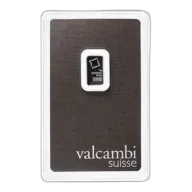
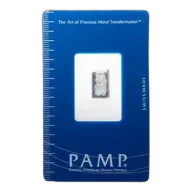
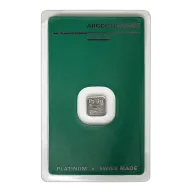
The gram-weight platinum bar market is dominated by Swiss LBMA-accredited refiners. The 1g Valcambi Platinum Bar and 1g Fortuna Platinum Bar from PAMP Suisse are the most widely available, followed by the 1g Argor-Heraeus Platinum Bar and 1g Credit Suisse Platinum Bar. Each arrives sealed in an assay card certifying weight, purity, and serial number, providing the authentication necessary for future resale.
Unlike 1g gold bars, which contain roughly $100 of metal, a 1g platinum bar holds substantially less value. This lower metal value makes the fabrication premium even more dominant as a proportion of the purchase price. Buyers choosing platinum at this weight are typically diversifying a small precious metals collection across multiple metals, purchasing specifically for the gifting market, or adding variety to a multi-metal holding strategy that already includes gold and silver at more cost-efficient weights.
Premium Structure for 1g Platinum Bars
Premiums on 1g platinum bars range from 20-40% over spot, making them the least cost-efficient way to accumulate platinum by weight. The manufacturing, assaying, packaging, and distribution costs for a single bar are roughly fixed regardless of metal content. Spread over just one gram of platinum, these costs dominate the total price. At current spot prices, a 1g platinum bar's fabrication premium typically exceeds the equivalent percentage markup on a 1g gold bar because the lower platinum spot price amplifies the fixed-cost proportion.
To illustrate the scale: purchasing 31 individual 1g bars to reach approximately one troy ounce would cost vastly more in cumulative premiums than a single 1 oz platinum bar at 5-10% over spot. The premium differential is even more pronounced than for gold at the same weight, because platinum's lower per-gram spot price makes the fixed fabrication cost a larger percentage of the total. A buyer spending $50 on a 1g platinum bar at 30% premium is paying roughly $11 in premiums; at the 1 oz size, the same $11 buys less than 1% premium on a $1,000+ bar.
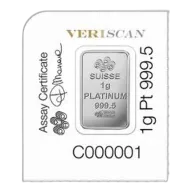
Among 1g offerings, branded bars from Swiss refiners carry the highest premiums but also the best resale prospects. The PAMP Fortuna design commands a brand premium above generic equivalents due to the Lady Fortuna design and VeriScan authentication. The Valcambi CombiBar format (a perforated sheet of 50 segments) reduces the per-gram premium compared to individually packaged bars by amortising the assay cost across the full sheet. The PAMP Multigram offers similar sheet-format economics with individual CertiPAMP certification for each segment.
Major 1g Platinum Bar Products
The 1g platinum bar market is smaller than the equivalent gold market but features several well-established products from recognised refiners. Selection is concentrated among Swiss manufacturers with LBMA/LPPM accreditation.
Valcambi Platinum Bar is the most widely stocked 1g platinum bar, available from 18 dealers. Valcambi is an LBMA-accredited Swiss refinery (founded 1961, based in Balerna) producing bars at 999.5 fineness sealed in assay cards. The plain Valcambi bar is the lowest-premium branded option at this weight, offering straightforward metal content without design premiums.
PAMP Suisse Fortuna carries the iconic Lady Fortuna design that PAMP introduced in 1979, making it the first artistic motif ever placed on a bullion bar. Available from 12 dealers, the 1g Fortuna comes with VeriScan digital authentication technology, allowing buyers to verify authenticity by scanning the bar's microscopic surface topography against PAMP's database via a free smartphone app.
PAMP Suisse (plain) is available from 9 dealers and provides the PAMP brand and CertiPAMP packaging without the Fortuna design premium. The 1g Credit Suisse Platinum Bar (6 dealers) shares the same Valcambi manufacturing provenance in a different branded package, with the Statue of Liberty design adding American-market appeal.
Argor-Heraeus produces a 1g platinum bar (4 dealers) with their distinctive Kinebar holographic security feature, an optically variable device embossed directly into the metal surface using the same technology found on government banknotes. This is the strongest tamper-proof authentication available on a 1g bar, as it survives even if the packaging is removed.
Generic 1g platinum bars (15 dealers) offer the lowest premiums for buyers who prioritise metal content over brand recognition, though resale values are correspondingly lower without assay certification from a named refiner. For buyers who want brand-level security at a lower per-gram cost, the sheet formats (CombiBar and Multigram) provide a middle ground.
Resale and Storage for 1g Platinum
Resale prospects for 1g platinum bars depend heavily on brand and condition. Sealed bars from PAMP Suisse, Valcambi, and Argor-Heraeus in their original assay cards are accepted by most established dealers, though buyback prices reflect the reality that these are high-premium items with thin secondary demand. Expect wider buy-sell spreads than for larger platinum bars. The spread on a 1g bar can approach 20-30% of the metal value, meaning a buyer purchasing at retail and immediately reselling would lose a substantial fraction of their outlay.
Unbranded or opened-assay 1g platinum bars have poor resale prospects through dealer channels. The cost to verify a tiny bar against counterfeits can approach or exceed the dealer's margin, making generic pieces uneconomic for most buyback programmes. Secondary market platforms (collector forums, peer-to-peer sales) may yield better results for non-branded pieces, particularly if the seller can demonstrate weight and purity through independent testing.
Storage is the one area where 1g bars genuinely excel. A 1g platinum bar in its assay card is roughly credit-card sized but extremely thin. Platinum does not tarnish or corrode under normal conditions, and its hardness (Mohs 3.5, versus 2.5 for gold) makes it resistant to scratches. The assay card itself needs more protection than the metal; bending or damaging the sealed packaging reduces resale value significantly. A small collection of 1g bars stores easily in a desk drawer, safe deposit box, or home safe without special arrangements or atmospheric precautions.
For those drawn to the 1g format for divisibility rather than budget constraints, the Valcambi CombiBar offers a more economical path. The 50-segment platinum CombiBar allows individual grams to be snapped off as needed while storing the entire sheet as a single compact unit approximately the size of a credit card. Each segment retains the Valcambi hallmark for dealer recognition, though the original assay covers only the intact sheet.
1g Platinum Bars: frequently asked questions
-
A 1g platinum bar contains roughly 0.032 troy ounces of metal, so its melt value is approximately $1,806.00 divided by 31.1. Retail prices sit above melt value to cover fabrication and dealer margin, which tends to be proportionally higher on small bars. We track 27 listings across 19 dealers on this page.
-
Platinum spot ($1,806.00) can be compared to gold spot on any metal page. Historically platinum traded at a premium to gold, driven by strong automotive and industrial demand, but the two metals have swapped positions at different points in time. Structural factors including the shift toward electric vehicles and a smaller investor base than gold have weighed on platinum's price relative to gold.
-
Investment-grade platinum bars are typically refined to 999.5 fine (99.95% pure), the standard required by recognised exchanges. This distinguishes them from 950 and 990 platinum alloys used in jewellery, which include other metals. Even small 1g bars from accredited refineries will carry a hallmark confirming 999.5 purity.
-
In the UK, investment platinum carries 20%, unlike investment gold which is VAT-free. In Canada, investment platinum is GST-free (0%). Australia also exempts investment platinum bullion from GST (0%). VAT and GST treatment varies by country, so check local rules before buying.