4 products · 8 deals Prices & premiums exclude tax to compare across countries
Filters




Prices are fetched automatically and may not reflect current merchant prices. Currency conversions and tax treatment are approximate. Rankings are based solely on price. We are not a dealer and accept no responsibility for transactions with listed merchants. Past performance is not indicative of future results. This site does not provide investment advice. Full disclaimer
About 100g Platinum Bars
100g Platinum Bars: The European Standard
The 100 gram platinum bar (3.2151 troy ounces) is one of the most popular metric denominations for European platinum investors. At roughly three times the weight of a 1 oz bar, the 100g format offers materially better premium efficiency while remaining accessible to individual buyers. The weight is natural for metric-system markets where Swiss and German refiners dominate the product landscape.
Premiums on 100g platinum bars typically run 4-8% over spot, positioned between 1 oz bars (5-10%) and kilo bars (3-6%). This makes them one of the more cost-efficient ways to accumulate physical platinum at the retail level without the capital commitment of a kilo bar. The premium drop from 1 oz to 100g is one of the steeper efficiency gains available in the platinum size range.
The product selection at 100g is strong by platinum standards. Valcambi, Argor-Heraeus, PAMP Suisse, Heraeus, Baird and Co., the Royal Canadian Mint, and ABC Refinery all produce bars at this weight. The availability from multiple competing refiners creates genuine price competition that benefits buyers, unlike smaller platinum denominations where fewer options exist.
Platinum's structural market characteristics bear on the 100g buyer's decision. Investment demand accounts for only 8.5% of total platinum consumption, with automotive catalytic converters (37.8%) and industrial uses (29.7%) absorbing the bulk of supply. The market has been in structural deficit since 2023, with above-ground stocks declining. These supply dynamics differ fundamentally from gold, where central bank and investment demand dominate, and provide a distinct risk-reward profile for platinum holders.
Premium Analysis for 100g Platinum Bars
The 100g denomination sits in the efficiency sweet spot for retail platinum. Premiums of 4-8% over spot represent a genuine saving over 1 oz bars (5-10%), while the absolute cost per bar (approximately USD 3,200-3,500 at current levels) remains accessible to most individual investors. The premium curve flattens above 100g, meaning the incremental saving from stepping up to 500g or 1 kilo is modest in percentage terms, though meaningful in absolute dollars on larger purchases.
Among 100g products, Valcambi typically offers the lowest acquisition premium from a major refiner. As the world's largest precious metals refinery by capacity, Valcambi's production efficiency and scale allow thinner margins than competitors. Argor-Heraeus bars, produced by the same parent company (Global Gold Refining), compete closely on price.
PAMP Suisse Fortuna 100g bars command the highest premiums in the category, typically 2-4 percentage points above Valcambi. The Lady Fortuna design, CertiPAMP packaging, and PAMP's brand positioning drive this markup. Whether the PAMP premium is recoverable at resale depends on the buyer's exit market; dealers generally offer better buyback rates for PAMP products, partially offsetting the higher acquisition cost.
Platinum premiums across all sizes remain structurally higher than gold equivalents. A 100g gold bar carries 2-4% over spot versus platinum's 4-8%. The gap reflects platinum's higher fabrication costs (melting point of 1,768 degrees versus 1,064 for gold), smaller production runs, and thinner dealer competition. Buyers comparing platinum bars to gold bars should account for this structural premium differential and wider buy-sell spreads in their return calculations.
Major 100g Platinum Bars
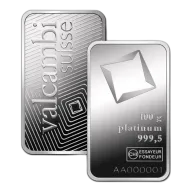
Valcambi 100g Platinum Bar is the most widely stocked product in this category, available from 21 dealers. Valcambi's Swiss provenance, LPPM accreditation, and competitive pricing make it the default choice for cost-focused platinum buyers. The bar features a simple design with the Valcambi hallmark, weight, purity (999.5), and serial number.
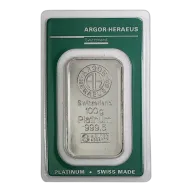
Argor-Heraeus 100g Platinum Bar is another strong Swiss contender, available from 13 dealers. Argor-Heraeus is known for its Kinebar holographic security feature (available on some product lines) and produces bars with clean, institutional aesthetics. Pricing typically sits close to Valcambi.
PAMP Suisse Fortuna 100g Platinum Bar carries the iconic Lady Fortuna design and PAMP's premium branding. Available from 7 dealers, it appeals to buyers who value design aesthetics and brand recognition at resale. The CertiPAMP tamper-evident packaging provides integrated authentication.
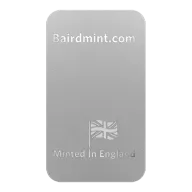
Baird and Co. 100g Platinum Bar is the British option, produced at the Beckton refinery in East London. LBMA-accredited since 2000, it is primarily stocked by UK dealers and has strong domestic recognition. Available from 4 dealers.
ABC Refinery 100g Platinum Bar is the Australian option, produced as a minted tablet format. LBMA-accredited and COMEX Good Delivery listed, ABC Refinery products are primarily distributed through Australian dealers. Available from 2 dealers (Guardian Gold and ABC Bullion).
Generic 100g platinum bars, where the specific refiner is not guaranteed at purchase, offer the lowest premiums in the category and account for 17 dealer listings. All carry 999.5 purity from LPPM-accredited sources.
Resale and Storage for 100g Platinum
Liquidity for 100g platinum bars from LPPM-accredited refiners is solid across major bullion markets. The 100g format is a recognised trading size in European markets where metric weights are standard, and major dealers in the US, UK, Australia, and Singapore actively buy back branded 100g platinum bars at competitive spreads. The broad dealer coverage at this weight (77 total active dealer listings across multiple brands) confirms healthy secondary market demand.
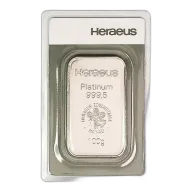
Within the 100g category, the liquidity hierarchy mirrors the brand hierarchy. Valcambi bars are the most universally accepted, followed by PAMP Suisse (strongest in Asia and the Middle East), Argor-Heraeus (strongest in continental Europe), and Heraeus (strongest in Germany and Austria). Bars from any LPPM-accredited refiner are accepted by specialist platinum dealers regardless of brand, but recognition speed and buyback spreads may vary for less common brands.
The partial-liquidation profile of 100g bars is favourable. At roughly USD 3,200-3,500 per unit, a seller can release a measured amount of capital without the all-or-nothing dynamics of kilo bar liquidation. Multiple 100g bars can be sold individually as needed, making this weight class practical for investors who may need to draw down their platinum position incrementally over time.
Storage is compact. A 100g platinum bar occupies minimal space due to platinum's density of 21.45 g/cm3 (the densest of the three main bullion metals). The metal does not tarnish, requires no atmospheric controls, and is harder than gold, making stored bars essentially maintenance-free. Sealed bars in assay cards from major refiners should be kept in their packaging for optimal resale value, as the assay card serves as both authentication documentation and physical protection.
100g Platinum Bars: frequently asked questions
-
A 100g platinum bar contains roughly 3.215 troy ounces of metal, so its melt value is approximately 3.215 times $1,806.00 per troy ounce. Retail prices will sit above that figure to cover fabrication and dealer margin. Use the listings on this page to see current prices across multiple dealers.
-
We currently track 10 listings from 8 dealers selling 100g platinum bars. Prices and availability vary between dealers, so comparing here before buying can save a meaningful amount, especially given the size of this investment.
-
One troy ounce equals exactly 31.1035 grams. This is the standard unit for quoting platinum spot prices worldwide, so when a dealer or exchange shows a price per ounce, that figure refers to the troy ounce. Dividing the spot price by 31.1035 gives the price per gram.
-
Investment-grade platinum bars are typically produced to 999.5 fine (99.95% purity), the standard recognised by major exchanges and refineries. This is higher than the 950 and 990 alloys used in jewellery. A reputable bar will carry a hallmark or assay certificate confirming its purity and the refiner's identity.
-
Platinum bars are not legal-tender coins, so they are not exempt from Capital Gains Tax in the UK the way British legal-tender coins are. UK gains are taxed at 18% or 24% above the £3,000 annual allowance. In Canada, 50% of any gain is included in taxable income; US investors pay up to 28% on long-term gains.
- 100g Argor-Heraeus Platinum Bar
- 100g Baird & Co. Platinum Bar
- 100g Britannia Platinum Bar
- 100g Credit Suisse Platinum Bar
- 100g Fortuna Platinum Bar
- 100g Heraeus Platinum Bar
- 100g PAMP Suisse Platinum Bar
- 100g Perth Mint Platinum Bar
- 100g Platinum Bar
- 100g Royal Canadian Mint Platinum Bar
- 100g Valcambi Platinum Bar
- Pre-Owned 100g Platinum Bar
- Pre-Owned 100g The Royal Mint Platinum Bar