3 products · 4 deals Prices & premiums exclude tax to compare across countries



Prices are fetched automatically and may not reflect current merchant prices. Currency conversions and tax treatment are approximate. Rankings are based solely on price. We are not a dealer and accept no responsibility for transactions with listed merchants. Past performance is not indicative of future results. This site does not provide investment advice. Full disclaimer
About 1 Kilo Platinum Bars
The 1kg Platinum Bar: Lowest Cost Per Gram in a Thin Market
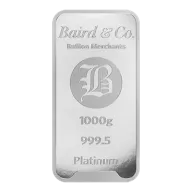
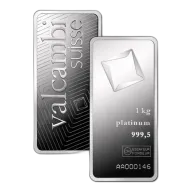
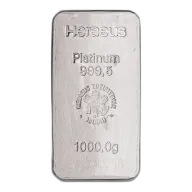
A kilogram is the standard metric bullion weight: 1,000 grams, or 32.1507 troy ounces. In platinum, the kilo bar sits at the top of the common retail size range, which runs from 1g and 5g novelty bars through 10g, 1 oz, 50g, 100g and 500g up to the full kilo. Standard purity for platinum bars is .9995 (99.95%) fine, and kilo bars come from the same LBMA-accredited refiners that produce gold and silver: PAMP Suisse, Valcambi, Heraeus and Argor-Heraeus among them.
The kilo buyer is optimising for the lowest cost per gram, not flexibility. At this size the premium falls to the lowest tier available in platinum bars, but the trade-off is significant. The platinum bar market is much smaller than the gold or silver bar market, dealer inventory is limited, and not all bullion dealers stock platinum bars at all, especially in larger sizes. Larger platinum bars also have a very limited retail secondary market compared with the 1oz platinum bar, which is the most commonly traded retail size and has the best resale liquidity.
Each kilo bar is also an all-or-nothing sale. Partial liquidation is not possible, so an investor who may need to raise smaller amounts of cash gives up the flexibility that holding the same metal in smaller units would provide. The kilo format suits buyers making a large, deliberate allocation who expect to exit in a single transaction, most likely through a specialist dealer.
Kilo Platinum Bar Premiums and the Size Ladder
Platinum bar premiums fall steadily as bar size increases. Approximate premiums over spot by size: 1g bars run 20-40%, 10g bars 10-20%, 1 oz bars 5-10%, 100g bars 4-8%, and 1 kg bars 3-6%. The kilo is the most premium-efficient size on the ladder, and the gap against gram-weight bars is dramatic: small 1g-5g platinum bars carry premiums so high that they function more as gifts or novelties than cost-efficient investments.
Platinum bar premiums are higher than gold bar premiums at equivalent sizes. The reasons are structural: lower production volumes, a smaller market, fewer competing refiners, and higher fabrication difficulty, since platinum melts at 1,768C against 1,064C for gold. Within the platinum market itself, bars carry lower premiums than platinum coins, and the premium gap between platinum bars and coins is wider than the equivalent gap for gold, making the bar savings more meaningful.
Tax treatment shapes the real cost more than the premium in several countries. In the UK, platinum bars carry 20% VAT on purchase and are CGT-liable on sale, making them the least tax-efficient platinum form for UK investors. In the EU, standard VAT of 17-27% applies with no investment exemption. In these VAT jurisdictions, bars still offer the best premium efficiency within the platinum market, partially offsetting the VAT impact. Elsewhere the picture is better: qualifying platinum bars are sales-tax exempt in Canada (99%+ purity), Australia (99%+ purity), New Zealand (99%+ purity) and Singapore (99%+ purity from LBMA-accredited refiners), while Hong Kong levies no VAT, duties or capital gains tax at all. In the US, most states exempt bullion from sales tax, gains are taxed at the 28% collectibles rate, and platinum bars of 99.95%+ purity from accredited refiners are IRA-eligible.
Who Makes Kilo Platinum Bars
Platinum bars are produced primarily by private refineries rather than sovereign mints, and the range of products from each refiner is narrower than for gold or silver. Not all sizes are consistently in stock, and the kilo sits at the thin end of dealer inventory. The names to look for are the LBMA-accredited refiners:
| Refiner | Country | Notable |
|---|---|---|
| PAMP Suisse | Switzerland | LBMA accredited; platinum range runs 1g to 100g, sealed in assay cards |
| Valcambi | Switzerland | LBMA accredited; multiple sizes including CombiBars |
| Heraeus | Germany | LBMA accredited; popular in the European market |
| Argor-Heraeus | Switzerland | LBMA accredited; kinebar holographic security |
| Perth Mint | Australia | Government-backed; kangaroo design |
| Credit Suisse | Switzerland | No longer produced, but secondary-market bars still trade |
The metric size family (100g, 250g, 500g, 1 kg) is standard for European refiners, which is why the major kilo bar producers are concentrated in Switzerland and Germany. At kilo weight, expect to shop around: the platinum bullion market is a fraction of the gold market, and fewer buyers means fewer products, less competition between sellers, and higher premiums than an equivalent 1kg gold bar would carry. Sealed bars with serial-numbered assay cards from recognised refiners provide the strongest provenance and resale position.
Selling a Kilo Platinum Bar, and Living With One
Liquidity is the kilo platinum bar's weakest attribute. Platinum bars from LBMA-accredited refiners are sellable, but the market is thinner than gold or silver, and larger platinum bars (100g and up) have a very limited retail secondary market. A kilo bar may need to be sold to a specialist dealer or refiner rather than a local coin shop. Buy-sell spreads are wider than for gold bars in both absolute and percentage terms, and the smaller the dealer network in a given country, the wider the spread; the US and UK have the most established platinum dealer networks. Within platinum, the 1oz bar has the best resale liquidity, so a kilo position trades premium savings against exit flexibility.
Sealed bars in assay cards from recognised refiners such as PAMP, Valcambi and Heraeus command better resale prices than generic or loose bars, and LBMA-branded assay cards with serial numbers provide strong provenance. Authentication is one area where platinum works in the buyer's favour: its density of 21.45 g/cm3 has no cheap convincing substitute. Tungsten, at 19.25 g/cm3, would be detectably lighter in a bar of correct dimensions, and the only denser candidates, iridium and osmium, are rarer and more expensive than platinum itself. Counterfeit platinum bars are accordingly rare.
Storage is straightforward. Platinum does not tarnish or corrode, so no atmospheric precautions are needed, and it is harder than gold (Mohs 3.5 against 2.5), making it more scratch-resistant. The metal is compact and high-value with a value-to-space ratio similar to gold, so a single kilo bar stores easily in a home safe or takes up minimal room in vault storage.
1 Kilo Platinum Bars: frequently asked questions
-
A 1 kg platinum bar contains 32.1507 troy ounces of platinum. Its melt value is 32.1507 multiplied by the live platinum spot price, currently $1,806.00 per troy ounce. Retail prices from the 3 dealers tracked across 4 listings will be higher, reflecting the premium over spot each dealer charges.
-
Platinum and gold have traded at varying ratios over time. Historically platinum commanded a premium over gold, driven by strong industrial demand from the automotive sector. In recent years platinum has traded below gold, reflecting shifts in industrial use and a thinner investor market. The relationship continues to fluctuate with supply and demand on both sides.
-
Investment-grade platinum bars are typically refined to 999.5 or 999.9 fineness (often stamped 9995 or 9999), meaning they are at least 99.95% pure platinum. 950 platinum is a jewellery alloy, containing 95% platinum mixed with other metals, and is not standard for investment bars. When buying a 1 kg bullion bar, look for the 9995 or .9999 fineness stamp.
-
Platinum has a notably smaller secondary market than gold or silver. A 1 kg bar represents a large capital commitment and the pool of buyers is limited. Dealers and refiners will typically buy back branded bars from recognised producers, but you may face a wider bid-ask spread than you would with gold of equivalent value. Fractional platinum sizes can be easier to liquidate quickly.
-
Platinum bars are not legal tender and carry no automatic CGT exemption. In the UK, gains above the £3,000 annual exempt amount are taxed at 18% or 24%. US investors pay up to 28% on long-term gains. In Canada, 50% of any capital gain is included in taxable income. Consult a tax adviser for your specific position.