1 listing
Filters
| Product | /oz | Premium | Price | |
|---|---|---|---|---|

 Best Bullion
Out of Stock
Best Bullion
Out of Stock
|
$1,889.85 | +7.69% |
$1,889.89
NZ$3,219
|
View Deal |
Prices are fetched automatically and may not reflect current merchant prices. Currency conversions and tax treatment are approximate. Rankings are based solely on price. We are not a dealer and accept no responsibility for transactions with listed merchants. Past performance is not indicative of future results. This site does not provide investment advice. Full disclaimer
About the 1 oz Intrinsic Tender Platinum Bar
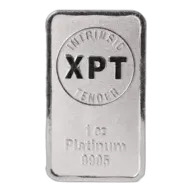
The 1 oz Intrinsic Tender Platinum Bar
The 1 oz Intrinsic Tender platinum bar is a .9995 fine platinum bar in the most commonly traded retail platinum size. One troy ounce (31.1035 g) is the benchmark unit for bullion worldwide, and within the platinum bar market it is the size with the best resale liquidity: larger bars of 100g and up have a very limited retail secondary market and may need to be sold to specialist dealers or refiners, while gram-weight platinum bars carry premiums of 20-40% that rule them out as cost-efficient investments.
The case for a platinum bar over a platinum coin is premium. Bars run lower premiums than coins, typically 5-10% over spot for 1 oz minted bars, and the premium gap between platinum bars and coins is wider than the equivalent gap for gold, so the bar saving is more meaningful in this metal. Platinum bar premiums are nonetheless higher than gold bar premiums at the same sizes, reflecting lower production volumes, a smaller market, fewer competing refiners, and the higher fabrication difficulty of a metal that melts at 1,768C against gold's 1,064C.
Platinum also brings practical advantages as a holding. It does not tarnish or corrode, needs no atmospheric precautions, and is harder than gold (Mohs 3.5 versus 2.5), so it resists scratches. A 1 oz bar concentrates four figures of value into a very small package, comparable to gold in value-to-space terms. The main caveat for any platinum bar is the thinner market: not all bullion dealers stock platinum, and buy-sell spreads are wider than for gold in both absolute and percentage terms.
Intrinsic Tender 1 oz Platinum Bar Specifications
| Attribute | Value |
|---|---|
| Weight | 1 troy oz (31.1035 g) |
| Purity | .9995 fine platinum |
| Form | Bar |
| Brand | Intrinsic Tender |
| Legal tender | No (private bar, no face value) |
The .9995 fineness is the standard purity for platinum bars and matters for two reasons. First, it clears the purity thresholds for tax exemption in every jurisdiction that offers one for platinum. Second, it meets the IRS requirement of 99.95% minimum purity for platinum held in a US precious metals IRA, provided the bar comes from an accredited refiner and is stored at an approved depository.
Authentication is a comparative strength of platinum. Its very high density of 21.45 g/cm3 means no common cheap metal can substitute convincingly: tungsten, the classic gold-bar counterfeiting material, is detectably lighter at 19.25 g/cm3, and the only denser candidates, iridium and osmium, are rarer and more expensive than platinum itself. Counterfeit platinum bars are accordingly rare. Standard checks (weight, dimensions, sigma testing) apply, and sealed assay-card packaging from the refiner supports resale value, since loose bars typically fetch less than sealed ones.
Tax Treatment of a 1 oz Platinum Bar
Platinum receives no equivalent of the investment gold exemption in Europe, which shapes the regional picture for this bar.
- United Kingdom: 20% VAT on purchase, and as a non-legal-tender bar there is no CGT exemption on sale. That combination makes platinum bars the least tax-efficient platinum form for UK buyers; the Platinum Britannia coin shares the VAT but avoids CGT.
- European Union: Full standard VAT applies at national rates (17-27% depending on country). No investment exemption exists for platinum.
- United States: No federal sales tax; most states exempt bullion, some with purchase thresholds. Long-term gains are taxed at the collectibles rate of up to 28%. At .9995 purity the bar meets the IRS 99.95% platinum threshold for IRAs.
- Canada: GST/HST exempt for platinum of at least 99.5% purity in bar form.
- Australia: GST-free as investment-grade platinum (99%+ purity).
- New Zealand: GST-exempt for platinum of at least 99% purity, with no capital gains tax.
- Singapore and Hong Kong: Singapore exempts qualifying investment platinum (99%+ purity) from GST; Hong Kong has no sales tax or import duty. Neither taxes capital gains, making them among the lowest-cost places to hold platinum.
Intrinsic Tender vs PAMP, Valcambi, and Platinum Coins
The established alternatives at this weight are bars from the LBMA-accredited refiners that dominate platinum fabrication: PAMP Suisse (sealed assay cards, sizes from 1g to 100g), Valcambi (multiple sizes including CombiBars), Heraeus, Argor-Heraeus (kinebar holographic security), and the government-backed Perth Mint with its kangaroo design. Discontinued Credit Suisse platinum bars still trade on the secondary market. Bars from recognised LBMA refiners in sealed assay cards command better resale prices, and in a market as thin as platinum, refiner recognition does more work than it would for gold or silver.
Against platinum coins, the bar trades sovereign branding for cost. Coins bring mint security features and, in the UK, the Platinum Britannia's CGT exemption, while bars deliver the lower premium, typically 5-10% over spot at 1 oz against the higher premiums coins carry. For US IRA accounts, where the metal sits with a custodian and day-to-day liquidity matters less, the bar's lower premium is the usual argument.
Within the bar weight range, 1 oz is the practical floor and the liquidity peak. Stepping up to 100g cuts the premium to roughly 4-8% and a kilo bar to 3-6%, but each step shrinks the pool of potential buyers; stepping down to 10g pushes premiums to 10-20%. For most buyers the 1 oz bar is where platinum's premium efficiency and saleability meet.
1 oz Intrinsic Tender Platinum Bar: frequently asked questions
-
The bar is 999.5 fine platinum, meaning 99.95% pure metal, and weighs one troy ounce (31.1035 grams). This purity meets the investment-grade threshold recognised in most major markets for platinum bullion bars.
-
Check for a clear hallmark showing purity (typically 999.5 or Pt999.5) and weight stamped on the bar's surface. Platinum is exceptionally dense at around 21.4 g/cm3, so a genuine one-ounce bar feels noticeably heavy for its size. Purchasing from an established, accredited dealer and retaining the assay card or certificate provides the strongest authenticity assurance.
-
Platinum's price history has been volatile, driven by shifts in industrial demand (particularly from the automotive sector) and supply conditions. No specific all-time high figure is confirmed in available sources; current and historical prices can be tracked on commodity data sites or bullion price charts.