1 product · 1 deal Prices & premiums exclude tax to compare across countries
Filters
| Product | /oz | Premium | Price (ex. tax) | |
|---|---|---|---|---|
| $1,921.84 |
+6.77%
+28% inc.VAT
|
$9,607.24
£8,639 inc.VAT
|
View Deal |

Prices are fetched automatically and may not reflect current merchant prices. Currency conversions and tax treatment are approximate. Rankings are based solely on price. We are not a dealer and accept no responsibility for transactions with listed merchants. Past performance is not indicative of future results. This site does not provide investment advice. Full disclaimer
About 5 oz Platinum Bars
Where 5 oz Sits in the Platinum Bar Range
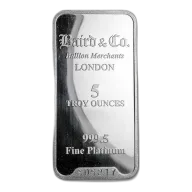
Five troy ounces is 155.517 grams, a mid-range weight that sits between the 1 oz and 10 oz formats. In platinum, it is an unusual size. The common retail platinum bar sizes run 1g, 5g, 10g, 1 oz, 50g, 100g, 500g and 1 kg, with the 1 oz bar the most commonly traded retail size. The 5 oz weight is also not a traditional bar weight in European or Asian markets, where metric weights such as 100g, 250g, 500g and 1 kg dominate. A 5 oz platinum bar therefore occupies a gap between the 100g and 500g metric formats rather than slotting into an established product line.
The platinum bar market itself is much smaller than the gold or silver bar market. Bars are produced primarily by private LBMA-accredited refineries rather than sovereign mints, dealer inventory is limited, and not all bullion dealers stock platinum bars at all, especially in larger sizes. Investment accounted for only 8.5% of platinum demand in 2024; the metal is overwhelmingly an automotive and industrial commodity with a small investment following. Buyers at this weight are committing a substantial sum in a thin product category, so the practical alternatives are stepping down to the widely traded 1 oz platinum bar or up to 100g and kilo sizes, where kilo bars ran roughly $30,000-35,000 at mid-2025 prices and are less liquid.
Physically, platinum suits larger bars well. It is the densest of the three main bullion metals at 21.45 g/cm3, denser than gold at 19.3 g/cm3, it does not tarnish or corrode under normal conditions, and it is harder than gold (Mohs 3.5 vs 2.5), making bars more resistant to scratches and wear. A 5 oz platinum bar is a compact, low-maintenance way to hold a five-figure-adjacent position in a single piece.
Premiums Above and Below the 5 oz Mark
Across bullion weights generally, 5 oz premiums sit between 1 oz and 10 oz: lower than 1 oz pieces but slightly higher per ounce than 10 oz. In platinum specifically, published premium bands by bar size show the same downward slope as weight increases:
| Bar size | Typical premium over spot |
|---|---|
| 1g | 20-40% |
| 10g | 10-20% |
| 1 oz | 5-10% |
| 100g | 4-8% |
| 1 kg | 3-6% |
At 155.5 grams, a 5 oz bar falls between the 100g and 1 kg sizes on this scale. The sources do not publish a dedicated band for the 5 oz size itself, which reflects how rarely it appears in platinum.
Platinum bar premiums are higher than gold bar premiums at equivalent sizes. The reasons are structural: lower production volumes, a smaller market, fewer competing refiners, and higher fabrication difficulty, since platinum melts at 1,768C against 1,064C for gold. Bars still carry lower premiums than platinum coins, typically 5-10% over spot for 1 oz minted bars, and in VAT jurisdictions bars offer the best premium efficiency within the platinum market, partially offsetting the VAT impact. UK buyers should note that platinum bars carry 20% VAT on purchase and are CGT-liable on sale, which makes bars the least tax-efficient platinum form there regardless of weight.
Who Makes Platinum Bars at and Around This Weight
No mainstream product line is built around the 5 oz platinum bar. Platinum bars come from the same LBMA-accredited refiners that produce gold and silver bars, but the range of platinum products from each refiner is narrower than for gold or silver, and not all sizes are consistently in stock. Common sizes cluster at 1 oz, 10 oz and 1 kg, with fewer options in between. Buyers hunting a 5 oz platinum bar are shopping the margins of an already thin market.
The major platinum bar producers are:
| Refiner | Country | Notable |
|---|---|---|
| PAMP Suisse | Switzerland | LBMA accredited; platinum bars available 1g to 100g, sealed in assay card |
| Valcambi | Switzerland | LBMA accredited; multiple sizes including CombiBars |
| Heraeus | Germany | LBMA accredited; popular in the European market |
| Argor-Heraeus | Switzerland | LBMA accredited; kinebar holographic security |
| Perth Mint | Australia | Government-backed; kangaroo design |
| Credit Suisse | Switzerland | No longer produced, but secondary market bars still trade |
For comparison, the 5 oz weight is better established elsewhere in bullion. In gold, 5 oz gold bars from PAMP Suisse, Valcambi and Perth Mint exist but remain niche due to high unit cost, and in silver the weight gained mainstream recognition through the America the Beautiful 5 oz coin series. Platinum never developed an equivalent following at this size; standard purity for platinum bars is .9995 fine, and virtually all platinum bullion sticks to that figure whatever the weight.
Reselling a Mid-Size Platinum Bar
Platinum is the thinnest of the three main bullion markets, and that shows most at non-standard weights. Bars from LBMA-accredited refiners are sellable, but the market is thinner than gold or silver, and the 1 oz size has the best resale liquidity among platinum bars. Larger platinum bars at 100g and above, which is where a 155.5g bar sits, have a very limited retail secondary market and may need to be sold to specialist dealers or refiners. While gold and silver trade at virtually every bullion dealer worldwide, some smaller or regional dealers do not handle platinum at all, particularly outside the US, UK and Singapore, which have the most established platinum dealer networks.
Spreads compound the issue. Buy-sell spreads on platinum bars are wider than on gold bars in both absolute and percentage terms, and the smaller the dealer network in a given country, the wider the spread. Sealed bars in assay cards from recognised refiners such as PAMP, Valcambi and Heraeus command better resale prices than generic or loose bars, so keeping the original packaging intact matters at resale time.
Storage is the easy part. Platinum does not tarnish or corrode, so no capsules, desiccants or atmospheric precautions are needed, and its 21.45 g/cm3 density means even a 5 oz bar is physically small. Minted bars in assay cards store flat and stack efficiently. Authentication is also a relative strength: no common cheap metal is dense enough to substitute convincingly for platinum, since the closest candidates, iridium and osmium, are rarer and more expensive than platinum itself, and tungsten would be detectably lighter in a bar of correct dimensions. Counterfeit platinum bars are rare as a result.