35 products · 220 deals Prices & premiums exclude tax to compare across countries
Filters
| Product | /oz | Premium | Price (ex. tax) | |
|---|---|---|---|---|

4 deals
|
$1,907.41 | +5.62% | $1,907.41 | Compare |

3 deals
|
$1,907.20 |
+5.96%
+27% inc.VAT
|
$1,907.20
£1,715 inc.VAT
|
Compare |

5 deals
|
$1,923.68 | +6.52% | $1,923.68 | Compare |
| $1,925.66 | +6.63% | $1,925.66 | Compare | |

2 deals
|
$1,928.78 | +6.80% | $1,928.78 | Compare |

2 deals
|
$1,928.78 | +6.80% | $1,928.78 | Compare |
| $1,943.34 | +7.60% | $1,943.34 | View Deal | |
| $1,945.57 | +7.73% | $1,945.57 | View Deal | |

4 deals
|
$1,946.50 | +7.78% | $1,946.50 | Compare |

2 deals
|
$1,952.70 | +8.12% | $1,952.70 | Compare |

2 deals
|
$1,959.09 |
+8.84%
+31% inc.VAT
|
$195.91
£176 inc.VAT
|
Compare |

16 deals
|
$1,972.97 |
+9.43%
+30% inc.VAT
|
$1,972.97
€2,049 inc.VAT
|
Compare |

12 deals
|
$1,975.45 |
+9.75%
+32% inc.VAT
|
$1,975.45
£1,776 inc.VAT
|
Compare |

20 deals
|
$1,977.29 |
+9.85%
+32% inc.VAT
|
$1,977.29
£1,778 inc.VAT
|
Compare |

9 deals
|
$1,977.29 |
+9.85%
+32% inc.VAT
|
$1,977.29
£1,778 inc.VAT
|
Compare |

8 deals
|
$1,977.29 |
+9.85%
+32% inc.VAT
|
$1,977.29
£1,778 inc.VAT
|
Compare |

12 deals
|
$1,977.29 |
+9.85%
+32% inc.VAT
|
$1,977.29
£1,778 inc.VAT
|
Compare |

18 deals
|
$2,044.06 | +13.56% |
$2,044.06
£1,532
|
Compare |

3 deals
|
$2,050.53 |
+13.92%
+37% inc.VAT
|
$1,025.26
£922 inc.VAT
|
Compare |

13 deals
|
$2,074.57 | +14.87% | $2,074.57 | Compare |

6 deals
|
$2,076.61 | +14.98% | $1,038.31 | Compare |

2 deals
|
$2,083.75 | +15.38% | $520.94 | Compare |
| $2,197.02 |
+22.06%
+46% inc.VAT
|
$219.70
£198 inc.VAT
|
View Deal | |

7 deals
|
$2,217.75 | +22.80% | $554.44 | Compare |

32 deals
|
$2,228.21 | +23.79% |
$2,228.21
£1,670
|
Compare |
| $2,235.69 | +23.79% | $1,117.85 | View Deal | |

2 deals
|
$2,312.59 | +28.05% | $2,312.59 | Compare |
| $2,334.62 | +29.70% |
$2,334.62
£1,750
|
View Deal | |

2 deals
|
$2,407.84 | +33.32% | $240.78 | Compare |

3 deals
|
$2,421.46 | +34.08% | $242.15 | Compare |









Prices are fetched automatically and may not reflect current merchant prices. Currency conversions and tax treatment are approximate. Rankings are based solely on price. We are not a dealer and accept no responsibility for transactions with listed merchants. Past performance is not indicative of future results. This site does not provide investment advice. Full disclaimer
About Platinum Coins
Platinum Coins: A Small Market With Strong Sovereign Options
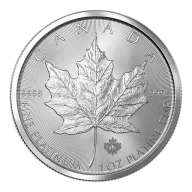
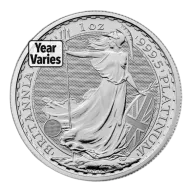
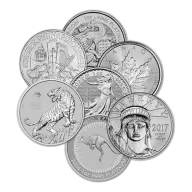
The platinum bullion coin market is far smaller than gold coins or silver coins. Fewer mints produce platinum coins, mintages are lower, dealer inventory is more limited, and the product range is narrower. Only four mints currently produce platinum coins for the regular bullion market: the US Mint (American Platinum Eagle), the Royal Canadian Mint (Platinum Maple Leaf), the Royal Mint (Platinum Britannia), and the Perth Mint (Platinum Kangaroo). The Austrian Mint, which produces gold and silver Philharmonics, has produced a Platinum Philharmonic since 2016.
All five coins are struck at 999.5 fine (99.95%), matching the LPPM Good Delivery bar standard. There is no purity variation in the platinum coin market comparable to gold's 22-carat/24-carat split. The standard weight is 1 oz. Fractional sizes (1/2 oz, 1/4 oz, 1/10 oz) are available from some mints but production is intermittent and less consistently available than gold fractionals.
Platinum coin premiums are substantially higher than gold coin premiums: typically 8-15% over spot for a 1 oz piece, compared to 3-7% for a 1 oz gold coin. This reflects lower production volumes, fewer competing products, a smaller dealer network, and less price competition in a thin market. The premium gap between coins and bars is also wider for platinum (3-5 percentage points) than for gold (2-3 points), making the cost difference between forms more consequential.
The argument for coins over bars in platinum is the same as for gold, but amplified in the UK: the Platinum Britannia is CGT-exempt as UK legal tender, avoiding the capital gains tax that applies to platinum bars. In VAT jurisdictions where both coins and bars attract 20% VAT, the Britannia's CGT exemption is the only tax differentiation available, and it is significant for holders expecting gains. Outside the UK, where there is no CGT distinction between forms, the choice between platinum coins and bars is a simpler trade-off between premium and liquidity.
Platinum is visually similar to silver; both are grey-white metals. The difference is density: a 1 oz platinum coin weighs 31.1g but is noticeably smaller than a 1 oz silver coin of the same weight, because platinum is roughly twice as dense (21.45 versus 10.49 g/cm3). This density difference is immediately apparent when handling the coins and serves as a basic authentication check.
Platinum Coin Tax Treatment by Country
Platinum coins follow a different tax path from gold coins in the UK and EU, where the Investment Gold Directive provides VAT exemptions that do not extend to platinum. In purity-based exemption countries, platinum coins qualify, often at a lower purity threshold than gold.
United Kingdom
Platinum coins are subject to 20% VAT on purchase. The Platinum Britannia is CGT-exempt as UK legal tender, the same exemption applied to gold and silver Britannias. All other platinum coins (Eagles, Maples, Kangaroos) are subject to both 20% VAT and CGT on disposal. The Britannia is the only platinum product with a CGT advantage in the UK. Combined with VAT-free vault storage, the Britannia is the most tax-efficient platinum option for UK investors.
United States
Most states exempt platinum coins from sales tax. Capital gains at the 28% collectibles rate. All four major sovereign platinum coins are IRA-eligible at 99.95% purity. The Platinum Eagle is the most widely available and dealer-supported option for US IRA investors.
Canada
GST/HST exempt for platinum coins at 99.5%+ purity. All sovereign platinum coins exceed this. The Platinum Maple Leaf qualifies for RRSP and TFSA accounts. Canada is one of the more favourable jurisdictions for platinum coins: no purchase tax, strong domestic product.
Australia
GST-free for platinum coins at 99%+ purity from accredited sources. Lower threshold than for gold (99.5%) and silver (99.9%). All standard platinum coins exceed it. CGT applies with the 50% discount for holdings over 12 months.
New Zealand
GST-exempt at 99%+ purity. No capital gains tax. Favourable jurisdiction for platinum, though the domestic platinum dealer market is small.
Singapore
GST-exempt as IPM at 99%+ purity for coins that are or were legal tender. No capital gains tax. Singapore is a competitive market for platinum coins with no tax friction.
Hong Kong
No sales tax, no VAT, no import duty, no capital gains tax. Fully tax-neutral.
European Union
Standard VAT applies (17-27% depending on country). No investment platinum exemption. In Germany, gains on platinum coins held longer than one year are tax-free, offering some offset to the upfront VAT.
Platinum Coin Premiums: Higher Than Gold, Wider Gap to Bars
Platinum coin premiums are the highest among the three bullion metals. A 1 oz sovereign platinum coin typically carries 8-15% over spot, compared to 3-7% for gold coins and 12-25% for silver coins (where the high percentage reflects silver's low unit price). During periods of tight supply or low demand, platinum coin premiums can spike higher still.
| Coin | Typical premium (1 oz) |
|---|---|
| Platinum Maple Leaf | 8-12% |
| American Platinum Eagle | 8-12% |
| Platinum Britannia | 8-15% |
| Platinum Kangaroo | 8-12% |
| Platinum Philharmonic | 8-12% |
Fractional platinum coins carry very high premiums: 15-25% for 1/4 oz and 1/10 oz pieces. These are rarely cost-efficient and are produced in small, inconsistent quantities. The 1 oz denomination is the practical minimum for cost-conscious buyers.
The premium gap between platinum coins and platinum bars (typically 3-5 percentage points) is wider than the equivalent gap in gold (2-3 points). This means the savings from choosing bars over coins are more significant in platinum. The question is whether the coin advantages (sovereign mint branding, security features, and CGT exemption for the UK Britannia) justify the extra cost.
In VAT jurisdictions (UK at 20%, EU at 17-27%), the effective cost of a delivered 1 oz platinum coin can reach 28-35% above spot when the premium and VAT are combined. The spot price must rise by this amount before the position breaks even, assuming the full buy-sell spread is paid on exit. This is the highest effective entry cost among the three bullion metals and forms.
Buy-sell spreads are wider than for gold coins: expect to lose 5-10% on a round-trip through a dealer. The combination of high premiums and wide spreads means platinum coins have the longest break-even period among standard bullion products.
Five Sovereign Platinum Coins
The platinum coin market is defined by five sovereign products. All are 999.5 fine. All are recent by bullion standards; the oldest is the Maple Leaf (1988) and the newest are the Britannia and Kangaroo (both 2018).
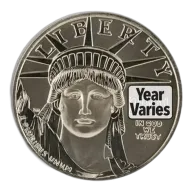
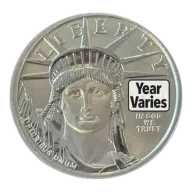
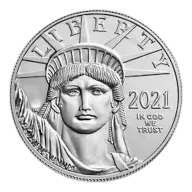
The American Platinum Eagle (1997, US Mint) carries a $100 face value and is the most recognised platinum coin in North America. Available in 1, 1/2, 1/4, and 1/10 oz. Annual proof versions feature rotating reverse designs that add collector interest. The Eagle's strong US dealer network makes it the most liquid platinum coin in the American market. IRA-eligible.
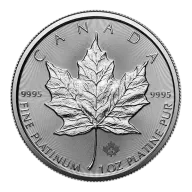
The Canadian Platinum Maple Leaf (1988, Royal Canadian Mint) was one of the earliest modern platinum coins and brought platinum into the mainstream bullion market. It carries a $50 CAD face value and features the same Bullion DNA micro-engraving security used on gold and silver Maple Leafs. Production has been intermittent in some years, which can limit current-year availability. Often among the most competitively priced sovereign platinum coins.
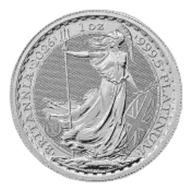
The Platinum Britannia (2018, Royal Mint) is the newest of the major platinum coins and the only platinum product that is CGT-exempt in the UK. Available in 1 oz and 1/10 oz. It carries the same advanced security features (tincture lines, micro-text) as the gold Britannia. For UK investors, the CGT exemption makes the Britannia the default platinum coin despite its premium being modestly higher than the Maple Leaf or Eagle.
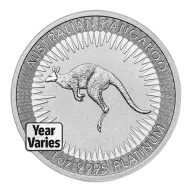
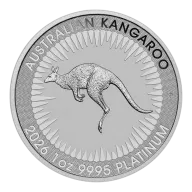
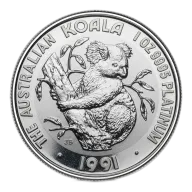
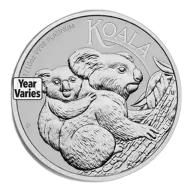
The Australian Platinum Kangaroo (2018, Perth Mint) carries a $100 AUD face value. Unlike the gold Kangaroo, the platinum version uses a fixed design rather than changing annually. Government-backed by the Western Australian Government. Building its market presence as a relatively new series.
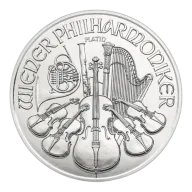
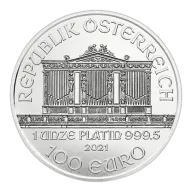
The Austrian Platinum Philharmonic (2016, Austrian Mint) uses the same Vienna Philharmonic design as the gold and silver versions. Denominated in euros (EUR 100 face value). Popular in continental European markets. The newest of the five major platinum coins.
Notable absences: the Austrian Mint started platinum Philharmonics only in 2016. South Africa does not produce a regular-issue platinum Krugerrand (despite being the world's largest platinum producer). No Asian sovereign mint produces a major platinum bullion coin.
Authenticating Platinum Coins
Sovereign platinum coins benefit from the same mint-level security features applied to their gold and silver counterparts: Bullion DNA on Maple Leafs, tincture lines on Britannias. These make modern platinum coins among the most difficult bullion products to counterfeit.
Platinum's physical properties provide additional authentication advantages. Its density of 21.45 g/cm3 is higher than any common inexpensive metal, so no affordable substitute can match both platinum's weight and dimensions in a coin-thickness piece. Tungsten, the primary counterfeiting concern for gold, is substantially lighter than platinum (19.25 versus 21.45 g/cm3) and would produce a coin that is either underweight or oversized. A simple weight check on a coin of known diameter is a strong authentication test.
Platinum's visual similarity to silver (both grey-white metals) can cause confusion, but the density difference is dramatic. A 1 oz platinum coin weighs the same as a 1 oz silver coin (31.1g) but is approximately half the diameter and thickness. Holding a platinum coin next to a silver coin of the same weight immediately reveals the difference. This visual-plus-weight check is the most basic and effective field test.
Standard dealer testing methods apply: Sigma Metalytics for conductivity verification, XRF for surface composition analysis. Counterfeit platinum coins are rare in practice because the difficulty of finding a convincing substitute material, combined with the small market for platinum bullion (limiting the counterfeiter's addressable market), makes it an unattractive target compared to gold.
For retail purchases from established dealers, the counterfeiting risk on sovereign platinum coins is very low. The concern is most relevant in private sales or secondary market transactions with unfamiliar sellers, where basic weight and dimension checks provide strong assurance.
Platinum Coins: frequently asked questions
-
The live platinum spot price is $1,806.00 per troy ounce. This is the benchmark price for raw platinum metal, before any fabrication or dealer premium is added. When comparing platinum coin prices, the premium over spot tells you how much extra you are paying above the underlying metal value.
-
This page currently tracks 232 platinum coin listings from 32 dealers. Comparing across multiple dealers lets you find where premiums over spot are lowest, since prices for the same coin can vary meaningfully between retailers.
-
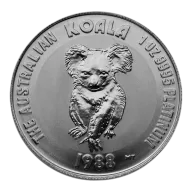
Most modern government-issued platinum bullion coins are .9995 fine (99.95% pure platinum). This includes well-known coins such as the Platinum Eagle, Maple Leaf, Britannia, and Koala. The .950 purity you may see in jewellery contexts is a different standard not used on modern investment-grade bullion coins.
-
Platinum coins are struck by government mints, carry a legal-tender face value, and are backed by a sovereign authority. Bars are produced by private or accredited refineries. Coins typically carry a slightly higher fabrication premium over spot than bars of equivalent weight, but they are more recognisable and easier to sell in smaller quantities.
-
CGT treatment depends on where you live. In the UK, gains above the £3,000 annual allowance are taxed at 18% or 24%. US investors pay up to 28% on gains from platinum coins. In Canada, 50% of any gain is included in taxable income.
- 10 oz Perth Mint Koala Platinum Coin
- 1/10 oz American Platinum Eagle Platinum Coin
- 1/10 oz Britannia Platinum Coin
- 1/10 oz Kookaburra Platinum Coin
- 1/10 oz Maple Leaf Platinum Coin
- 1/10 oz Panda Platinum Coin
- 1/10 oz Perth Mint Koala Platinum Coin
- 1/10 oz Perth Mint Lunar Platinum Coin
- 1/10 oz Philharmonic Platinum Coin
- 1/10 oz Pobjoy Mint Noble Platinum Coin
- 1/25 oz Philharmonic Platinum Coin
- 1/2 oz American Eagle Platinum Coin
- 1/2 oz American Platinum Eagle Platinum Coin
- 1/2 oz Australian Wildlife Platinum Coin
- 1/2 oz Britannia Platinum Coin
- 1/2 oz Maple Leaf Platinum Coin
- 1/2 oz Perth Mint Koala Platinum Coin
- 1/2 oz Philharmonic Platinum Coin
- 1/4 oz American Eagle Platinum Coin
- 1/4 oz American Platinum Eagle Platinum Coin
- 1/4 oz Britannia Platinum Coin
- 1/4 oz Perth Mint Koala Platinum Coin
- 1/4 oz Philharmonic Platinum Coin
- 1/4 oz Pobjoy Mint Noble Platinum Coin
- 1/4 oz Polar Bear Platinum Coin
- 1g Panda Platinum Coin
- 1 Kilo Perth Mint Koala Platinum Coin
- 1 oz American Eagle Platinum Coin
- 1 oz American Platinum Eagle Platinum Coin
- 1 oz Armillary Platinum Coin
- 1 oz Australian Platypus Platinum Coin
- 1 oz Big 5 Platinum Coin
- 1 oz Big Five Platinum Coin
- 1 oz Britannia Platinum Coin
- 1 oz Dragon Rectangular Platinum Coin
- 1 oz Maple Leaf Platinum Coin
- 1 oz Myths and Legends Platinum Coin
- 1 oz Panda Platinum Coin
- 1 oz Perth Mint Kangaroo Platinum Coin
- 1 oz Perth Mint Koala Platinum Coin
- 1 oz Perth Mint Lunar Platinum Coin
- 1 oz Philharmonic Platinum Coin
- 1 oz Platinum Coin
- 1 oz Platypus Platinum Coin
- 1 oz Pobjoy Mint Noble Platinum Coin
- 1 oz Queen's Beasts Platinum Coin
- 1 oz Robin Hood Platinum Coin
- 1 oz Royal Arms Platinum Coin
- 1 oz South African Mint Krugerrand Platinum Coin
- 1 oz Tower Mint Noble Platinum Coin
- 1 oz Tudor Beasts Platinum Coin
- 2 oz Perth Mint Koala Platinum Coin
- 30g Panda Platinum Coin
- Pre-Owned 1/10 oz American Platinum Eagle Platinum Coin
- Pre-Owned 1/10 oz Maple Leaf Platinum Coin
- Pre-Owned 1/10 oz Platinum Coin
- Pre-Owned 1/2 oz American Platinum Eagle Platinum Coin
- Pre-Owned 1/2 oz Platinum Coin
- Pre-Owned 1/4 oz American Platinum Eagle Platinum Coin
- Pre-Owned 1 oz American Platinum Eagle Platinum Coin
- Pre-Owned 1 oz Australian Platypus Platinum Coin
- Pre-Owned 1 oz Britannia Platinum Coin
- Pre-Owned 1 oz Maple Leaf Platinum Coin
- Pre-Owned 1 oz Perth Mint Kangaroo Platinum Coin
- Pre-Owned 1 oz Perth Mint Koala Platinum Coin
- Pre-Owned 1 oz Philharmonic Platinum Coin
- Pre-Owned 1 oz Platinum Coin
- Pre-Owned 1 oz Queen's Beasts Platinum Coin
- Pre-Owned 1 oz Somalia Elephant Platinum Coin
- Pre-Owned 1 oz Tudor Beasts Platinum Coin
- American Eagle
- American Platinum Eagle
- Armillary
- Australian Platypus
- Australian Wildlife
- Big 5
- Big Five
- Britannia
- Dragon Rectangular
- Isle of Man Noble
- Kookaburra
- Maple Leaf
- Myths and Legends
- Noble
- Panda
- Perth Kangaroo
- Perth Koala
- Perth Lunar
- Philharmonic
- Platypus
- Polar Bear
- Queen's Beasts
- Robin Hood
- Royal Arms
- SA Mint Krugerrand
- Somalia Elephant
- Tudor Beasts