1 listing Prices & premiums exclude tax to compare across countries
Filters
| Product | /oz | Premium | Price (ex. tax) | |
|---|---|---|---|---|

 Suisse Gold
Out of Stock
Suisse Gold
Out of Stock
|
$1,863.10 |
+2.91%
+11% inc.VAT
|
$1,863.02
€1,757 inc.VAT
|
View Deal |
Prices are fetched automatically and may not reflect current merchant prices. Currency conversions and tax treatment are approximate. Rankings are based solely on price. We are not a dealer and accept no responsibility for transactions with listed merchants. Past performance is not indicative of future results. This site does not provide investment advice. Full disclaimer
About the 1 oz Tower Mint Noble Platinum Coin
The 1 oz Platinum Noble: The First Platinum Bullion Coin
The 1 oz Isle of Man Noble holds a distinction no other coin can claim: first issued in November 1983, it is widely recognised as the world's first platinum bullion coin designed specifically for investors. The Canadian Maple Leaf and Australian Koala did not begin platinum issues until 1988, and the American Platinum Eagle not until 1997. Each Noble contains one troy ounce of .9995 fine platinum and is legal tender of the Isle of Man, a self-governing British Crown dependency, though like the Krugerrand it carries no fixed face value; its worth derives entirely from its metal content.
The series was primarily struck by Pobjoy Mint in Surrey, England, with later issues by other producers including Tower Mint in 2018. Regular annual production ended around 2016, so most Nobles on the market today are secondary-market coins. That scarcity cuts both ways. Low mintages give the Noble collector value above melt and genuine historical appeal, but liquidity is weaker than for 1oz American Platinum Eagles or Platinum Maple Leafs, so buy-sell spreads run wider. The Noble suits buyers who want a piece of bullion history alongside their platinum exposure; pure premium-minimisers are better served by the high-volume sovereign coins.
Platinum Noble Specifications
The 1 oz Noble is struck in .9995 fine platinum, the same purity standard shared by all four major platinum bullion coins, and the threshold required for US IRA eligibility.
| Specification | 1 oz Platinum Noble |
|---|---|
| Purity | .9995 fine platinum |
| Weight | 1 troy oz (31.1 g) |
| Diameter | 32.7 mm |
| Thickness | 2.38 mm |
| Edge | Reeded |
| Face value | None fixed (legal tender of the Isle of Man) |
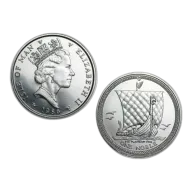
The platinum series was offered in 1/20 oz, 1/10 oz, 1/4 oz, 1/2 oz, and 1 oz sizes, with up to ten denominations appearing at various points, ranging as high as 10 oz; the larger sizes are extremely rare. The obverse carries a portrait of Queen Elizabeth II, with four distinct portrait versions used across the production run. The reverse shows a Viking longship under sail with seagulls overhead, framed by a Viking knot border and the triskelion, the three-legged symbol of the Isle of Man. The platinum content and fineness are inscribed beneath the waterline. The 1996 issue added a holographic feature, one of the earliest on any bullion coin. Gold (.9999) and silver (.999) variants of the Noble were also produced.
Platinum Noble Tax Treatment by Country
Platinum does not enjoy the investment-gold exemptions found in the UK and EU, and the Noble's Isle of Man legal tender status carries no UK tax benefit, so check your jurisdiction before buying.
- UK: 20% VAT applies on purchase, as with all new platinum bullion. The Noble is also not CGT-exempt: despite the Isle of Man being a Crown dependency, CGT exemption applies only to UK legal tender coins, and the Noble is not one. UK dealers explicitly list it as CGT liable.
- US: no federal sales tax and most states exempt bullion. Long-term gains are taxed at the collectibles rate of up to 28%. The Noble's .9995 purity meets the IRS threshold for platinum IRA eligibility.
- Canada: 0% GST/HST, since platinum at 99.5%+ purity in coin form is federally exempt.
- Australia: GST-free as investment-grade platinum at 99%+ purity.
- New Zealand: GST-exempt, with platinum qualifying at 99%+ purity.
- Singapore and Hong Kong: no GST or sales tax, and no capital gains tax in either jurisdiction.
- EU: standard VAT applies in most member states, typically 17-27% depending on country.
For UK buyers the combined 20% VAT and CGT liability makes any platinum coin a tax-heavy purchase; the Noble carries both burdens.
The Noble Since 1983: Norse Heritage on Platinum
The Noble takes its name from the medieval gold Noble coin, continuing a tradition of prestigious coinage. When it launched in November 1983, the dominant bullion coin in the world was the South African Krugerrand, and the Noble copied its no-face-value approach: a legal tender coin whose value floats with its metal. What was new was the metal itself. No mint had issued a platinum bullion coin for investors before, and the Noble held the field alone for five years.
The design leans on the island's Norse history. The Isle of Man was under Norse rule for centuries, and its parliament, Tynwald, is of Viking origin and claimed to be the world's oldest continuously operating parliament. The reverse's Viking longship and knot-work border reference that heritage, alongside the 13th-century triskelion that appears on the Manx flag. Production ran from 1983 to approximately 2016 with sporadic later issues, struck primarily by Pobjoy Mint, a family-owned private mint that has produced coins for over 30 nations, with the 2017 issue by Coin Investment Trust and the 2018 issue by Tower Mint. The series also showcased the island's appetite for numismatic innovation: a 1995 bimetallic gold-platinum issue, a 2009 silver-gold ring variant, and a 2012 palladium Noble that added a fourth metal. The Isle of Man also produced the first titanium and bimetallic bullion coins.
Noble vs Platinum Eagle, Maple Leaf, and Koala
All the major platinum bullion coins share the Noble's .9995 purity, so the choice comes down to liquidity, premiums, and collector appeal rather than metal content.
The American Platinum Eagle (US Mint, from 1997) arrived 14 years after the Noble but is now the dominant platinum bullion coin globally, with higher production volumes, a $100 face value, and the strongest resale demand in the US. The Canadian Platinum Maple Leaf (Royal Canadian Mint, from 1988) offers wide dealer recognition and trades more readily than the Noble, though its production has been intermittent. The Australian Platinum Koala (Perth Mint, from 1988) brought annual design changes and higher mintages than the Noble managed.
Against all three, the Noble trades recognition for rarity. Its premiums above spot run higher than the Eagle's because of scarcity, and selling may mean approaching specialist dealers rather than any coin shop. Its advantages are its place in history as the first platinum bullion coin and low mintages that support collector value above melt. UK buyers should note one further wrinkle: the 1oz Platinum Britannia (Royal Mint, from 2018) is the only platinum coin that is CGT-exempt for UK investors, an advantage the Noble cannot match. For buyers treating platinum purely as metal exposure, the high-volume sovereign coins win; for those who value the story, the Noble is the original.
1 oz Tower Mint Noble Platinum Coin: frequently asked questions
-
First issued in November 1983, the Isle of Man Noble is recognised as the first platinum bullion coin designed specifically for investors. It is legal tender of the Isle of Man and has been struck primarily by Pobjoy Mint, with later issues from Coin Investment Trust and Tower Mint. The reverse carries a Viking longship design referencing the island's Norse heritage, and the coin contains .9995 fine platinum with no fixed face value.
-
Each 1oz Isle of Man Noble contains 1 oz of 999.5 fine platinum. That works out to 31.1035 grams of platinum at 99.95% purity, giving a fine platinum content of approximately 31.09 grams per coin.