3 products · 10 deals Prices & premiums exclude tax to compare across countries




Prices are fetched automatically and may not reflect current merchant prices. Currency conversions and tax treatment are approximate. Rankings are based solely on price. We are not a dealer and accept no responsibility for transactions with listed merchants. Past performance is not indicative of future results. This site does not provide investment advice. Full disclaimer
About 1/2 oz Platinum Coins
The 1/2oz Platinum Coin: A Fractional Format in a Small Market
A 1/2oz coin contains 15.5517 grams of metal, and in platinum it sits in an unusual position. The platinum coin market is much smaller than gold or silver: fewer mints strike platinum, mintages are lower, and dealer inventory is more limited. The 1 oz size dominates platinum production, and fractional sizes such as 1/2 oz, 1/4 oz and 1/10 oz are available only from some mints, with production that is intermittent and less consistently available than gold fractionals. Buyers shopping at this weight are working with a narrower product list than they would find among 1/2oz gold coins, where every major sovereign mint offers the format.
The appeal of the half-ounce format is the lower outlay per coin against a 1 oz piece, which matters more in platinum than the raw spot price suggests. In VAT jurisdictions such as the UK and EU, platinum carries the full standard rate of tax on purchase (20% in the UK, 17-27% across the EU), so each coin bought is a meaningful commitment; a smaller denomination lets a buyer scale in gradually. Set against that, fractional platinum production runs are small and demand is inconsistent, which pushes acquisition costs up relative to the 1oz platinum coin.
All four major platinum coin series share .9995 fine purity, which clears the thresholds that matter for tax: the 99.95%+ purity required for US IRA eligibility, Canada's 99%+ GST/HST exemption, and the 99%+ purity rules in Australia, New Zealand and Singapore. Density is also on the buyer's side. Platinum at 21.45 g/cm3 is roughly twice as dense as silver, so a 1/2oz platinum coin is noticeably heavier than a silver coin of the same diameter, and no common cheap metal matches that density, which makes convincing counterfeits difficult.
How 1/2oz Platinum Premiums Compare Up and Down the Scale
Platinum coin premiums are substantially higher than gold coin premiums at every weight. For 1 oz platinum coins, premiums typically run 8-15% over spot, and during periods of low demand or tight supply they can spike higher. The drivers are structural: lower production volumes mean higher per-unit costs, there are fewer competing products, and smaller dealer inventories mean less price competition. Some mints also produce platinum only intermittently, which constrains supply unpredictably.
Moving down the weight scale makes this worse. The smaller fractional platinum coins at 1/4 oz and 1/10 oz carry very high premiums, sometimes 15-25% or more, because production runs are small and demand is inconsistent. The 1/2 oz sits between the relatively liquid 1 oz market and those expensive small fractionals, and its production shares the same intermittency that affects platinum fractionals generally. The pattern is familiar from gold, where a 1/2oz Gold Eagle runs 5-8% over spot against 3-5% for the 1 oz coin, but the absolute levels in platinum are far higher.
Tax compounds the premium in some markets. In the UK and EU, platinum coins carry the full VAT rate on purchase, and the effective cost including tax can reach 30-40% above spot for 1 oz coins; a fractional coin starts from an even higher premium base before VAT is added. Buyers in Singapore and Hong Kong face no purchase tax on qualifying platinum coins, so the dealer premium over spot is the entire cost consideration, which makes those among the most competitive jurisdictions for platinum. Platinum coins also generally carry higher premiums than platinum bars of equivalent weight, so cost-focused buyers sometimes weigh the coin format against platinum bars.
What Is Actually Available at 1/2oz in Platinum
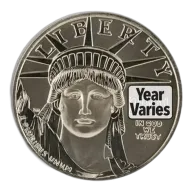
The confirmed 1/2oz platinum coin from a major sovereign mint is the 1/2oz American Platinum Eagle. The US Mint has struck the Platinum Eagle since 1997 in .9995 fine platinum, in 1 oz, 1/2 oz, 1/4 oz and 1/10 oz sizes, with annual proof versions carrying rotating reverse designs. The 1/2oz Platinum Eagle is IRA-eligible, and the series has the strongest resale demand in the US.
The other major platinum series offer less at this weight. The Platinum Britannia, struck by the Royal Mint since 2018, is produced in 1 oz and 1/10 oz, so UK buyers wanting the CGT exemption that comes with UK legal tender cannot get it in a half-ounce platinum coin. The Canadian Platinum Maple Leaf dates to 1988 and carries Bullion DNA security, but its production has been intermittent, and secondary market coins may be the primary option. The Australian Platinum Kangaroo from the Perth Mint, with its wave-textured background, is a newer series first issued in 2018 and is still building its market presence.
Two absences are worth knowing about so you do not search for products that do not exist: the Austrian Mint does not produce a platinum Philharmonic (only gold and silver), and the South African Mint does not produce a platinum Krugerrand in regular bullion production. All four series that do exist share .9995 purity, which keeps every one of them above the purity thresholds for IRA eligibility in the US and the GST exemptions in Canada, Australia, New Zealand and Singapore.
Selling and Storing 1/2oz Platinum Coins
Platinum coins are less liquid than gold coins at any weight. The buyer pool is smaller, dealer spreads are wider in both absolute and percentage terms, and not all bullion dealers carry platinum inventory at all. A realistic expectation is to lose 5-10% of the purchase price on a round trip (buy then sell) through a dealer. Selling may mean approaching specialist dealers or larger operations, since small local coin shops often will not offer competitive buy prices for platinum, and the metal's lower market profile means many private buyers are unfamiliar with the products. Coins from LBMA-accredited mints (the Eagle, Maple Leaf, Britannia and Kangaroo) have the best resale prospects, with the Platinum Eagle the most in-demand series in the US.
Authentication friction at resale is lower than the small market might suggest. Platinum's 21.45 g/cm3 density makes counterfeiting difficult: tungsten, the usual substitute in fake gold, is substantially lighter at 19.25 g/cm3, and counterfeit platinum coins are rare. A simple weight check on a coin of known diameter is a strong test, and Sigma or XRF testing is definitive.
Storage is straightforward. Platinum does not tarnish or corrode, so it needs none of the atmospheric precautions silver does, and it is harder and more durable than gold (Mohs 3.5 versus 2.5), making it more resistant to scratches and handling damage. Standard coin capsules and tubes work, though fewer platinum-specific tube sizes exist than for gold or silver, so verify capsule and tube compatibility before buying in quantity. Like gold, platinum coins concentrate high value in minimal space, so home storage planning follows the same logic as for a gold position.
1/2 oz Platinum Coins: frequently asked questions
-
A half-ounce platinum coin contains 1/2 oz of platinum. Its melt value is half the live spot ($1,806.00 per troy ounce). Dealer prices run above melt to cover striking and distribution; 8 dealers list coins at this weight, so comparing premiums helps you find the sharpest price.
-
Investment-grade half-ounce platinum coins are typically struck at 999.5 fine (99.95% platinum). This purity is well above the 950 alloy used in jewellery-grade platinum and ensures these coins qualify as bullion rather than jewellery-grade alloys.
-
Platinum has reached peaks well above current trading levels in the past, driven by supply constraints and high industrial demand. Its price history shows considerable volatility, and current prices may represent a significant discount relative to historical highs. Checking a long-term price chart gives useful context when evaluating whether platinum looks cheap today.
-
The current platinum spot is $1,806.00 per troy ounce. For much of the twentieth century platinum traded at a premium to gold, underpinned by its rarity and industrial demand. The relationship has shifted in recent years, with platinum trading at a discount to gold. The gap can narrow or widen substantially over time.
-
CGT treatment depends on your country. US investors face up to 28% on long-term gains from platinum coins. In Canada, 50% of any gain is taxed at your marginal rate. In the UK, platinum coin gains are subject to CGT at 18% or 24% above the £3,000 annual allowance.
- 1/2 oz American Eagle Platinum Coin
- 1/2 oz American Platinum Eagle Platinum Coin
- 1/2 oz Australian Wildlife Platinum Coin
- 1/2 oz Britannia Platinum Coin
- 1/2 oz Maple Leaf Platinum Coin
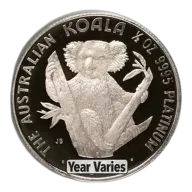
- 1/2 oz Perth Mint Koala Platinum Coin
- 1/2 oz Philharmonic Platinum Coin
- Pre-Owned 1/2 oz American Platinum Eagle Platinum Coin
- Pre-Owned 1/2 oz Platinum Coin