6 listings
Filters
| Product | /oz | Premium | Price | |
|---|---|---|---|---|

 Bullion Standard
|
$2,076.61 | +14.98% | $1,038.31 | View Deal |
|
1/
Austin Rare Coins & Bullion
|
$2,092.49 | +15.86% | $1,046.25 | View Deal |
| $2,097.79 | +16.16% | $1,048.90 | View Deal | |
 IDC Coin and Bullion
|
$2,136.57 | +18.30% | $1,068.29 | View Deal |
 The Bullion Bank
|
$2,216.15 | +22.71% | $1,108.08 | View Deal |
|
1/
|
$2,234.16 | +23.71% |
$1,117.11
S$1,428
|
View Deal |

 BullionStar
Prices are fetched automatically and may not reflect current merchant prices. Currency conversions and tax treatment are approximate. Rankings are based solely on price. We are not a dealer and accept no responsibility for transactions with listed merchants. Past performance is not indicative of future results. This site does not provide investment advice. Full disclaimer
About the 1/2 oz American Platinum Eagle Platinum Coin
The 1/2 oz American Platinum Eagle
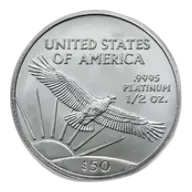
The 1/2 oz American Platinum Eagle contains 0.5003 troy ounces (15.56 grams) of 999.5 fine platinum and carries a $50 face value. Like the other fractional Platinum Eagle denominations, it was produced from 1997 through 2008 and has not been struck in bullion format since. All 1/2 oz Platinum Eagles available today are secondary market coins.
Among the three fractional Platinum Eagle sizes, the 1/2 oz occupies a useful middle position. Its premium over spot is lower than the 1/10 oz and 1/4 oz denominations, running in the range of 8-12% compared to 15-30% for the smallest size. The gap between the 1/2 oz and the full 1 oz Platinum Eagle is modest, roughly 3-5 percentage points, making it the most premium-efficient fractional option. At half the outlay of the 1 oz coin, it gives buyers more purchasing flexibility while keeping the cost penalty relatively contained.
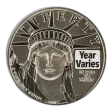
The obverse features John Mercanti's close-up portrait of the Statue of Liberty, unchanged since the series debut in 1997. The bullion reverse shows Thomas D. Rogers Sr.'s bald eagle soaring over a sunrise, also unchanged. At 27mm in diameter, the coin is similar in size to a UK 50p coin. It is noticeably heavier in hand than a silver coin of comparable dimensions, thanks to platinum's density of 21.45 g per cubic centimetre.
Liquidity is reasonable. The 1/2 oz is the largest fractional Platinum Eagle and benefits from tighter bid-ask spreads than the 1/4 oz or 1/10 oz. Major US bullion dealers actively buy and sell these coins, though the secondary-only market means availability depends on dealer inventory at any given time. Mintage figures for the 1/2 oz bullion Eagle were typically in the range of 9,000-33,000 coins per year during the production run, lower than the 1 oz but sufficient for a functioning secondary market.
1/2 oz American Platinum Eagle Dimensions and Details
| Property | Detail |
|---|---|
| Mint | United States Mint (West Point) |
| Metal | Platinum |
| Purity | 999.5 (99.95%) |
| Platinum content | 0.5003 troy oz (15.56g) |
| Diameter | 27.0 mm |
| Thickness | 1.75 mm |
| Face value | $50 USD |
| Edge | Reeded |
| Obverse designer | John Mercanti |
| Reverse designer | Thomas D. Rogers Sr. |
| Years of bullion production | 1997-2008 |
The 1/2 oz was part of the original four-denomination Platinum Eagle programme authorised by Congress and signed into law by President Clinton in 1996. Production ran at the West Point Mint in New York for twelve consecutive years before all fractional denominations were discontinued after 2008. The US Mint cited insufficient platinum blank supply and declining demand. No fractional bullion Eagles, in any denomination, have been produced since.
The Tenth Anniversary set, released in December 2007, contained two 1/2 oz proof Platinum Eagles and was originally priced at $1,949.95. The price was adjusted multiple times due to platinum spot volatility, eventually settling at $1,249.95. A total of 19,583 sets were sold. This set produced some of the most collected fractional proof Eagles.
1/2 oz Platinum Eagle Tax Treatment
The 1/2 oz Platinum Eagle shares the same statutory IRA eligibility as all American Platinum Eagle denominations. Section 408(m)(3)(A)(iv) of the Internal Revenue Code specifically names platinum coins described in 31 USC 5112(k), covering all Eagle sizes without restriction.
- United States: Explicitly IRA-eligible by statute. No ambiguity about eligibility. Most states exempt bullion from sales tax. Outside retirement accounts, classified as a collectible; long-term capital gains taxed at up to 28%. Short-term gains taxed as ordinary income. The 1099-B reporting threshold for Platinum Eagles is 25 or more coins in a single transaction.
- United Kingdom: 20% VAT on purchase. Subject to CGT on disposal (not UK legal tender). The Platinum Britannia offers CGT exemption in the UK that the American Eagle does not.
- Canada: GST/HST exempt for platinum at 99.5% purity or above.
- Australia: GST-free for platinum at 99% purity or above. 50% CGT discount for holdings over 12 months.
- New Zealand: GST-exempt for platinum at 99% purity or above. No capital gains tax.
- Singapore: GST-exempt under the IPM scheme for qualifying platinum coins that are or were legal tender. No capital gains tax.
- Hong Kong: No sales tax, no duties, no capital gains tax.
1/2 oz Platinum Eagle vs Other Fractional Sizes and Full-Ounce Coins
Within the Platinum Eagle programme, the 1/2 oz is the most premium-efficient fractional denomination. The step-down in premiums from 1/10 oz (15-30%) to 1/4 oz (10-15%) to 1/2 oz (8-12%) makes a clear case for buying the largest fractional size you can afford. The gap between the 1/2 oz and the full 1 oz Platinum Eagle is the smallest among fractionals, typically just 3-5 percentage points.
Against the 1 oz Platinum Britannia, the 1/2 oz Eagle offers a lower total outlay but at a higher premium per ounce of platinum. The Britannia's CGT exemption in the UK does not apply to the American Eagle. For US investors, the Eagle's statutory IRA eligibility and the familiarity of the US Mint programme are the deciding factors; the Britannia is less commonly stocked by US dealers.
The practical question for most buyers is whether to purchase a 1/2 oz Platinum Eagle or save toward a full 1 oz coin. The 1 oz offers lower premiums, better liquidity, and broader dealer support. The 1/2 oz makes sense for buyers who want to start accumulating platinum at roughly half the outlay, or who prefer a larger denomination than the 1/4 oz without committing to a full ounce. The production discontinuation after 2008 adds a mild scarcity element, though these are bullion coins, not rarities, and circulate freely in the secondary market.
1/2 oz American Platinum Eagle Platinum Coin: frequently asked questions
-
The best available price tracked for the 1/2 oz American Platinum Eagle is $1,038.31, about 15.0% over the current platinum spot of $1,806.00. The coin contains a half troy ounce of 99.95% pure platinum, so the metal value forms the floor and the premium covers the US Mint's fabrication cost plus dealer margin.
-
Two factors drive the cost. First, platinum's own spot price can be comparable to or above gold's depending on market conditions. Second, the 1/2 oz Platinum Eagle had low annual mintages and was discontinued after 2008, so secondary-market coins carry a collector premium on top of melt value. Gold Eagles in the same fractional size have much higher mintages and a deeper resale market, keeping premiums lower.
-
The 1/2 oz Platinum Eagle was produced only from 1997 to 2008, with annual mintages well below those of Gold Eagles in the same size. That makes specific years genuinely scarce. Liquidity is thinner than for gold or silver Eagles: most major bullion dealers will buy and sell them, but the market is narrower, bid-ask spreads can be wider, and finding a buyer quickly at spot-close pricing is less straightforward.
-
Yes. The 1/2 oz American Platinum Eagle is US legal tender carrying a $50 face value, authorised by Congress in 1996. The face value is purely nominal; the coin's platinum content is worth far more than $50 at current market prices.
-
The 1/2 oz American Platinum Eagle is 999.5 fine platinum (99.95%). This is the same fineness as the Canadian Platinum Maple Leaf and the Australian Platinum Platypus, and meets the LPPM Good Delivery standard. All mainstream investment platinum coins use 999 or 999.5 fineness rather than the 9999 standard used for gold or silver.