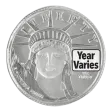
 Bullion Standard
5 listings
Filters

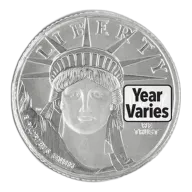

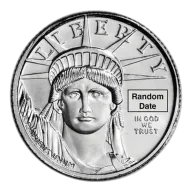

 BullionStar

Prices are fetched automatically and may not reflect current merchant prices. Currency conversions and tax treatment are approximate. Rankings are based solely on price. We are not a dealer and accept no responsibility for transactions with listed merchants. Past performance is not indicative of future results. This site does not provide investment advice. Full disclaimer
About the 1/10 oz American Platinum Eagle Platinum Coin
The 1/10 oz American Platinum Eagle
The 1/10 oz American Platinum Eagle is the smallest denomination in the US Mint's platinum bullion programme, containing 0.1001 troy ounces (3.11 grams) of 999.5 fine platinum. It carries a $10 face value and was produced from 1997 through 2008, when all fractional Platinum Eagle denominations were discontinued. No fractional bullion Platinum Eagles have been struck since then, making these coins available only on the secondary market.
At current platinum prices, the 1/10 oz Eagle sits at a price point under $200, which makes it one of the most accessible platinum coins available. That accessibility comes with a significant premium penalty. Fractional platinum coins carry premiums of 15-30% over spot, substantially more than the 5-12% typical of the 1 oz American Platinum Eagle. The economics are straightforward: minting costs for a tiny coin are nearly the same as for a full ounce, but those costs are spread over one-tenth the metal value. Accumulating a full ounce of platinum via ten of these coins costs meaningfully more than buying a single 1 oz coin.
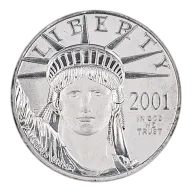
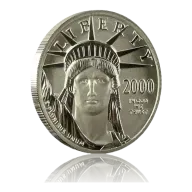
The coin shares the same obverse as all American Platinum Eagles: John Mercanti's "Liberty Looking to the Future" close-up of the Statue of Liberty. The reverse features Thomas D. Rogers Sr.'s "Eagle Soaring Over America" design. Both designs have remained unchanged across all bullion Eagle strikes since 1997. At just 16.5mm in diameter and 0.95mm thick, the coin is tiny, smaller than most modern circulating coins, and easy to misplace without proper storage.
Liquidity for the 1/10 oz Eagle is variable. Major US bullion dealers will buy them back, but the bid-ask spread is the widest among Platinum Eagle denominations. The coin's primary role is as a low-cost entry into platinum ownership or as a gift, rather than as a cost-efficient way to accumulate the metal. For buyers focused on premium efficiency, the full ounce is substantially better value.
1/10 oz American Platinum Eagle Dimensions and Details
| Property | Detail |
|---|---|
| Mint | United States Mint (West Point) |
| Metal | Platinum |
| Purity | 999.5 (99.95%) |
| Platinum content | 0.1001 troy oz (3.11g) |
| Diameter | 16.5 mm |
| Thickness | 0.95 mm |
| Face value | $10 USD |
| Edge | Reeded |
| Obverse designer | John Mercanti |
| Reverse designer | Thomas D. Rogers Sr. |
| Years of bullion production | 1997-2008 |
The 1/10 oz denomination was part of the original four-size Platinum Eagle programme launched in 1997. Fractional production ran for twelve years before being discontinued after 2008, alongside the 1/2 oz and 1/4 oz denominations. The discontinuation was linked to insufficient platinum blank supply and declining demand during a period of historically high platinum prices. Only the 1 oz bullion Eagle continued, resuming in 2014 after a five-year suspension.
All 1/10 oz Platinum Eagles were produced at the West Point Mint in New York. The reeded edge is consistent across all denominations. The coin is noticeably smaller in diameter than a 1/10 oz Gold Eagle (16.5mm versus 16.5mm for gold), but platinum's higher density (21.45 g/cm3 versus 19.3 g/cm3) means the platinum coin weighs slightly less than you might expect relative to its size.
Tax Treatment of the 1/10 oz Platinum Eagle
The American Platinum Eagle has a distinct tax advantage in the United States: it is specifically named in the Internal Revenue Code as eligible for inclusion in precious metals IRAs. Section 408(m)(3)(A)(iv) of the tax code references platinum coins described in 31 USC 5112(k), which covers all Eagle denominations. This explicit statutory naming removes any ambiguity about IRA eligibility that applies to some other platinum products.
- United States: IRA-eligible by statute. Sales tax varies by state; most states exempt bullion from sales tax. Outside retirement accounts, platinum Eagles are classified as collectibles with a maximum long-term capital gains rate of 28%, not the lower 15-20% rate applied to stocks. Short-term gains are taxed as ordinary income. Dealers must file Form 1099-B for sales of 25 or more Eagles in a single transaction.
- United Kingdom: 20% VAT on purchase (platinum does not receive the investment gold VAT exemption). Subject to Capital Gains Tax on disposal. Not CGT-exempt because the coin is not UK legal tender.
- Canada: Platinum at 99.5% purity or above is GST/HST exempt. The 999.5 fineness of the Platinum Eagle qualifies.
- Australia: GST-free for platinum at 99% purity or above. Capital gains tax applies with a 50% discount for holdings over 12 months.
- New Zealand: GST-exempt for platinum at 99% purity or above. No capital gains tax.
- Singapore: GST-exempt under the IPM scheme for platinum coins at 99% purity that are or were legal tender. The Platinum Eagle qualifies. No capital gains tax.
- Hong Kong: No sales tax, no duties, no capital gains tax.
- European Union: Standard VAT at the local rate (17-27%). No investment exemption for platinum.
1/10 oz Platinum Eagle vs Other Fractional Platinum Coins
The field of fractional platinum coins is small. The 1/10 oz Platinum Britannia from The Royal Mint is the most direct competitor, sharing the same 999.5 purity and comparable weight. The Britannia's key advantage for UK buyers is CGT exemption as UK legal tender, though both coins carry 20% VAT on purchase in the UK. The Platinum Eagle's advantage is its explicit IRA eligibility and deeper dealer network in the United States.
Among the 1/4 oz and 1/2 oz Platinum Eagles, the premium penalty decreases as the size increases. The 1/4 oz carries roughly 10-15% premiums, and the 1/2 oz falls closer to 8-12%. For buyers choosing between fractional sizes within the Eagle programme, the larger denominations offer better value per ounce of platinum, though they are equally limited to pre-2009 secondary market coins.
The fundamental question for any fractional platinum buyer is whether the low price point justifies the premium cost. Accumulating a full ounce through ten 1/10 oz Eagles costs substantially more than buying a single 1 oz Platinum Eagle. The 1/10 oz coin serves buyers who want platinum exposure at the lowest possible dollar outlay per unit, or who value divisibility for eventual barter or gifting purposes. For straight investment accumulation, the 1 oz denomination is more efficient by a wide margin.
1/10 oz American Platinum Eagle Platinum Coin: frequently asked questions
-
The cheapest 1/10 oz American Platinum Eagle tracked on this page is $292.67, about 62.1% over the current platinum spot of $1,806.00. Small fractional platinum coins carry higher percentage premiums than 1 oz coins because fabrication costs are spread over much less metal.
-
The American Platinum Eagle is the official US Mint platinum bullion coin, first issued in 1997. It is struck in 99.95% pure platinum and is US legal tender. The 1/10 oz size carries a $10 face value. The obverse features a portrait of the Statue of Liberty by John Mercanti; the bullion reverse shows an eagle soaring over America, a design that has remained unchanged since 1997.
-
The 1/10 oz American Platinum Eagle weighs 3.1104 g and contains 99.95% pure platinum. The coin is 16.5 mm in diameter and 0.95 mm thick, making it the smallest denomination in the Platinum Eagle range.
-
The 1/10 oz American Platinum Eagle carries a $10 USD face value as US legal tender, authorised by Congress in 1996. That figure is purely nominal: the coin's platinum content is worth considerably more than $10 at current market prices, so the face value has no practical relevance to what you pay or receive when buying or selling.