


Prices are fetched automatically and may not reflect current merchant prices. Currency conversions and tax treatment are approximate. Rankings are based solely on price. We are not a dealer and accept no responsibility for transactions with listed merchants. Past performance is not indicative of future results. This site does not provide investment advice. Full disclaimer
About 1/4 oz Platinum Coins
Quarter-Ounce Platinum Coins
A quarter-ounce coin contains 1/4 troy oz of metal, which works out to 7.7758 grams. In platinum, that metal is struck at .9995 fineness: every major sovereign platinum coin shares the same 99.95% purity standard, so the choice between products at this weight comes down to availability and premium rather than metal content.
The platinum coin market is much smaller than the markets for gold or silver. Fewer mints strike platinum at all, mintages are lower, and dealer inventory is thinner. That smallness is amplified at fractional weights. The 1 oz coin dominates platinum production, and fractional sizes such as 1/2 oz, 1/4 oz, and 1/10 oz are produced intermittently by some mints rather than consistently every year. A buyer who wants a specific quarter-ounce platinum coin may find it in stock one season and absent the next, which is a sharper supply constraint than gold buyers face with their fractional coins.
The case for buying platinum at this weight rests on price point and the metal itself. Platinum has traded below gold per ounce since 2015, having been the more expensive metal before 2014, so a quarter ounce of platinum costs considerably less than the equivalent gold coin. Platinum also carries a distinct investment thesis: it has strong industrial demand from automotive catalysts and hydrogen fuel cells that gold lacks, which makes its price more volatile and more tied to industrial cycles than to safe-haven flows. Buyers should also know that platinum looks much like silver to the eye, both being grey-white metals, but is roughly twice as dense at 21.45 g/cm3 against silver's 10.49 g/cm3. A quarter-ounce platinum coin feels noticeably heavier than a silver coin of the same diameter.
What Quarter-Ounce Platinum Costs Over Spot
Platinum coin premiums run well above gold coin premiums at every weight, and fractional sizes sit at the top of the scale. One-ounce platinum coins typically trade at 8 to 15% over spot. Fractional platinum coins, including the 1/4 oz and 1/10 oz sizes, carry very high premiums that can reach 15 to 25% or more, because production runs are small and demand is inconsistent. Moving up to 1oz platinum coins is the most direct way to cut the percentage paid over spot.
The structural reasons for elevated platinum premiums apply with extra force at this weight: lower production volumes mean higher per-unit minting costs, fewer competing products and smaller dealer inventories mean less price competition, and some mints only strike platinum intermittently. During periods of low demand or tight supply, premiums can spike higher still.
Tax adds another layer in some markets. Platinum follows the same pattern as silver rather than gold: the UK charges 20% VAT on new platinum bullion, and EU countries apply their full standard VAT rates, with no investment exemption equivalent to the one for gold. In those jurisdictions the all-in cost of a platinum coin can reach 30 to 40% above spot for a 1 oz piece once VAT is stacked on the dealer premium, and a fractional coin starts from a higher premium base. The picture is far better elsewhere: Canada exempts platinum at 99%+ purity from GST/HST, Australia and New Zealand are GST-free for qualifying investment platinum, Singapore exempts legal-tender platinum coins at 99%+ purity, and Hong Kong levies no tax at all. Every standard .9995 platinum coin clears all of these purity thresholds.
Quarter-Ounce Platinum Coins on the Market
Four sovereign series make up the core of the platinum coin market: the American Platinum Eagle, the Canadian Platinum Maple Leaf, the Platinum Britannia, and the Australian Platinum Kangaroo. All four are struck at .9995 fineness, but their fractional lineups differ, and at the quarter-ounce weight the field narrows sharply.
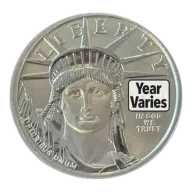
The 1/4oz American Platinum Eagle is the clearest documented quarter-ounce option. The US Mint has issued the Platinum Eagle since 1997 in 1 oz, 1/2 oz, 1/4 oz, and 1/10 oz sizes, and the series also runs annual proof versions with rotating reverse designs. As an American Eagle it is IRA-eligible, and at .9995 fineness it clears the 99.95% purity requirement the IRS sets for platinum in retirement accounts.
The other major series offer less at this weight. The Platinum Britannia, introduced by the Royal Mint in 2018, is struck in 1 oz and 1/10 oz, skipping the quarter ounce entirely. The Canadian Platinum Maple Leaf dates back to 1988 but its production has been intermittent, so availability in any given size is not guaranteed. The Australian Platinum Kangaroo, also launched in 2018, is a newer series still building its market presence.
Two absences are worth flagging because buyers often assume otherwise. The Austrian Mint does not produce a platinum Philharmonic, only gold and silver versions, and the South African Mint does not strike a platinum Krugerrand in regular bullion production. A stacker assembling a fractional platinum position is therefore working from a far shorter product list than the equivalent gold buyer.
Selling and Storing Quarter-Ounce Platinum
Platinum coins are less liquid than gold coins at any weight. The buyer pool is smaller, dealer spreads are wider in both absolute and percentage terms, and not every bullion dealer carries platinum inventory at all. A realistic expectation for a round trip, buying and later selling through a dealer, is a loss of 5 to 10% of the purchase price. Selling may mean approaching specialist dealers or larger operations, since small local coin shops often will not offer competitive buy prices for platinum. Private sales carry their own friction: platinum's lower market profile means many potential buyers are simply unfamiliar with the products.
Choice of coin matters for resale. Coins from LBMA-accredited mints, the Eagle, Maple Leaf, Britannia, and Kangaroo, have the best resale prospects. In the US the American Platinum Eagle commands the strongest resale demand, while the Britannia is the most recognised platinum coin in the UK.
Authentication works in the seller's favour. Platinum's density of 21.45 g/cm3 makes convincing counterfeits difficult: tungsten, the usual cheap substitute in fake gold, is substantially lighter at 19.25 g/cm3, and no common cheap metal matches platinum. A simple weight check on a coin of known diameter is a strong test, and Sigma or XRF testing is definitive. Counterfeit platinum coins are rare in practice.
Storage is straightforward. Platinum does not tarnish or corrode, so it needs none of the atmospheric precautions silver demands, and at Mohs 3.5 it is harder than gold (Mohs 2.5) and more resistant to scratches and handling wear. Standard coin capsules and tubes are suitable, though fewer platinum-specific tube sizes exist than for gold coins or silver, so check compatibility before buying storage. Like gold, quarter-ounce platinum packs substantial value into minimal space.
1/4 oz Platinum Coins: frequently asked questions
-
The intrinsic metal value of a 1/4 oz platinum coin is a quarter of the current $1,806.00 platinum spot price. Dealer prices run higher because they include a premium to cover minting, handling, and margin. Use the table above to compare current retail prices across dealers.
-
Most investment-grade 1/4 oz platinum coins are struck in 9995 fine platinum, equivalent to 99.95% purity. This is the standard used by major sovereign mints for coins such as the Platinum Maple Leaf, Platinum Britannia, and American Platinum Eagle.
-
Tax treatment depends on where you are based. In the UK, gains on platinum coins are taxed at 18% or 24% above the £3,000 annual allowance. US investors pay up to 28% on long-term gains. In Canada, 50% of the gain is included in taxable income.
- 1/4 oz American Eagle Platinum Coin
- 1/4 oz American Platinum Eagle Platinum Coin
- 1/4 oz Britannia Platinum Coin
- 1/4 oz Perth Mint Koala Platinum Coin
- 1/4 oz Philharmonic Platinum Coin
- 1/4 oz Pobjoy Mint Noble Platinum Coin
- 1/4 oz Polar Bear Platinum Coin
- Pre-Owned 1/4 oz American Platinum Eagle Platinum Coin