1 listing
Filters
| Product | /oz | Premium | Price | |
|---|---|---|---|---|

 Canadian PMX
|
$2,116.28 | +17.37% |
$2,116.39
CA$2,965
|
View Deal |
Prices are fetched automatically and may not reflect current merchant prices. Currency conversions and tax treatment are approximate. Rankings are based solely on price. We are not a dealer and accept no responsibility for transactions with listed merchants. Past performance is not indicative of future results. This site does not provide investment advice. Full disclaimer
About the 1 oz American Eagle Platinum Coin
The US Mint's Flagship Platinum Coin
The 1 oz American Platinum Eagle is the official platinum bullion coin of the United States, first struck in 1997 and carrying a $100 face value, the highest denomination ever placed on a US coin. It contains one troy ounce of .9995 fine platinum, matching the purity standard shared by all major sovereign platinum coins. For US buyers in particular, its explicit naming in the tax code (26 USC 408(m)(3)(A)(iv)) as IRA-eligible makes it the default choice for tax-advantaged platinum holdings.
The coin's production history is notably inconsistent. Bullion strikes were suspended entirely from 2009 to 2013, and again in 2015, due to insufficient platinum blank supply. Annual mintages have ranged from 133,002 in the peak year of 1998 down to just 6,000 in 2006. These low-mintage years now trade at significant premiums above their metal content. The 2000-2008 period produced some of the lowest-mintage US Mint bullion products ever issued.
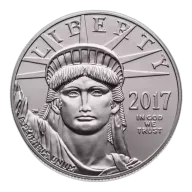
The obverse features John Mercanti's "Liberty Looking to the Future," a close-up portrait of the Statue of Liberty that has remained unchanged since 1997. The bullion reverse, Thomas D. Rogers Sr.'s "Eagle Soaring Over America," has also stayed constant. The proof version, by contrast, is unique among US bullion programmes in receiving a new reverse design every year, creating an ongoing collector series with no equivalent in other platinum programmes worldwide.
Compared to the 1 oz Platinum Noble, the Eagle offers far greater liquidity and dealer recognition. Against the Canadian Platinum Maple Leaf, the Eagle's advantage is its statutory IRA eligibility and deeper US dealer network, though both share .9995 purity. The Maple Leaf has been in production since 1988 (nine years earlier) and sometimes commands marginally lower premiums.
American Platinum Eagle Denominations and Dimensions
| Attribute | 1 oz | 1/2 oz | 1/4 oz | 1/10 oz |
|---|---|---|---|---|
| Face Value | $100 | $50 | $25 | $10 |
| Weight (troy oz) | 1.0005 | 0.5003 | 0.2501 | 0.1001 |
| Weight (grams) | 31.12 | 15.56 | 7.78 | 3.11 |
| Diameter | 32.7 mm | 27.0 mm | 22.0 mm | 16.5 mm |
| Thickness | 2.39 mm | 1.75 mm | 1.32 mm | 0.95 mm |
All denominations are .9995 fine platinum with reeded edges. The fractional sizes (1/2, 1/4, and 1/10 oz) were discontinued after 2008 for both bullion and proof versions. Only the 1 oz denomination remains in current production.
Platinum is denser than gold (21.45 g/cm3 versus 19.32 g/cm3), so the 1 oz Platinum Eagle is noticeably smaller in diameter than the 1 oz Gold Eagle despite containing the same troy ounce of metal. The 32.7 mm diameter compared to the Gold Eagle's 32.7 mm is almost identical, but the platinum version is thinner at 2.39 mm versus 2.87 mm for gold. In hand, the platinum coin feels distinctly heavier for its size.
The "W" mintmark appears on West Point Mint proof and burnished versions. Standard bullion strikes carry no mintmark. Burnished versions were produced only from 2006 to 2008, with the 2008-W $50 Burnished Eagle having a mintage of just 2,253 pieces, the lowest in the entire programme.
American Platinum Eagle Tax Treatment
The Platinum Eagle occupies a uniquely favourable position in US tax law, but platinum's treatment varies significantly across other jurisdictions.
- United States (IRA): Explicitly named as IRA-eligible in 26 USC 408(m)(3)(A)(iv). This is not a general purity-based qualification; the American Platinum Eagle is specifically listed in the statute. It qualifies for both Traditional (tax-deferred) and Roth (tax-free withdrawal) IRAs. Must be held by an approved custodian.
- United States (Capital Gains): Outside an IRA, classified as a collectible. Long-term gains (held over one year) taxed at maximum 28%, not the 15/20% rate that applies to equities. Short-term gains taxed as ordinary income. Net Investment Income Tax (3.8%) may apply additionally.
- United States (Sales Tax): Varies by state. Approximately 35 states fully exempt bullion coins from sales tax. States with thresholds include California (exempt over $2,000), Florida (over $500), and New York (over $1,000).
- United States (Reporting): Dealers must file Form 1099-B for sales of 25 or more American Platinum Eagles in a single transaction.
- United Kingdom: Subject to 20% VAT on platinum (platinum does not receive the investment gold VAT exemption). Also subject to CGT on profits. Not common in UK dealer inventories.
- Canada: Subject to GST/HST. Less commonly stocked than the domestic Platinum Maple Leaf.
- Australia: Platinum meeting 99% purity threshold is GST-free. The .9995 Eagle qualifies, though Perth Mint products dominate the local market.
- EU: Subject to local VAT rates (17-27%). No investment platinum exemption exists in EU law.
From Congressional Authorization to Production Gaps
The American Platinum Eagle programme originated in 1995 when US Mint Director Philip N. Diehl, American Numismatic Association President David L. Ganz, and Platinum Guild International Executive Director Jacques Luben began lobbying Congress for a platinum bullion coin. President Bill Clinton signed the authorizing legislation on September 30, 1996, and the first coins were struck the following year.
The 1997 launch made the Eagle a late entrant to platinum coinage. The Isle of Man Noble (1983), Canadian Maple Leaf (1988), and Australian Platinum Koala (1988) all preceded it. The Eagle quickly became the dominant platinum coin in the US market through sheer institutional weight: the US Mint's dealer network, recognisable branding, and statutory IRA eligibility gave it advantages that earlier products lacked.
Production peaked in 1998 at 133,002 pieces for the 1 oz bullion version, then declined sharply. By 2003-2007, annual mintages hovered between 6,000 and 8,000 coins. The five-year suspension from 2009 to 2013 was the longest interruption of any active US Mint bullion programme, driven by platinum blank shortages during a period of historically high prices. A single-year gap followed in 2015. Production resumed more consistently from 2016 onward, reaching 80,000 pieces in 2022 before dropping to 12,700 in 2023.
The proof programme has produced consistently low-mintage coins, with the 2025-W proof at just 3,645 pieces representing the current record low for the 1 oz denomination. The annually changing proof reverses have covered themes from Vistas of Liberty (1998-2002) through Foundations of Democracy (2006-2008) to the current First Amendment series (2021-2025), which highlights one constitutional freedom per year. The 2018-2020 proofs were the first US bullion coins to feature varying obverse designs as well as reverses.
A notable legal footnote: in 2009, Robert Kahre was convicted of tax fraud for paying employees in Gold Eagles and Platinum Eagles at face value ($100) to minimize reported income. The court established that bullion coins must be reported at fair market value, not legal tender face value, for tax purposes.
Platinum Eagle Against the Maple Leaf and Britannia
The three most accessible 1 oz platinum coins for English-speaking buyers are the American Eagle, the Canadian Maple Leaf, and the British Britannia. Each serves a slightly different buyer profile based on geography and tax treatment.
The Canadian Platinum Maple Leaf shares .9995 purity with the Eagle and has been in production since 1988 (nine years earlier). It carries a $50 CAD face value and the Royal Canadian Mint's Bullion DNA anti-counterfeiting feature. The Maple Leaf is GST/HST exempt in Canada and sometimes trades at marginally lower premiums than the Eagle. Its main disadvantage is intermittent production; certain years are unavailable in bullion format. For Canadian buyers, the Maple Leaf is the natural choice. For US buyers who want IRA eligibility, the Eagle's statutory listing removes any ambiguity.
The Platinum Britannia is the newest of the three, first struck in 2018 by the Royal Mint. For UK buyers, it offers a critical advantage: as UK legal tender, it is CGT-exempt on disposal. Given that platinum in the UK already carries 20% VAT on purchase, the CGT exemption on the exit side provides meaningful tax relief. No other platinum coin offers this benefit to UK investors. The Britannia also comes in a 1/10 oz fractional size. Its relative newness means a shorter track record and a smaller secondary market pool.
Against niche platinum coins such as the 1 oz Isle of Man Noble (first issued 1983) or the discontinued Perth Platinum Koala, the Eagle wins decisively on liquidity. Virtually every US bullion dealer buys and sells Platinum Eagles, and the buy-sell spread is narrower than for less common products. The Noble and Koala carry premiums that reflect scarcity and collector demand rather than pure metal value.
1 oz American Eagle Platinum Coin: frequently asked questions
-
The cheapest 1 oz Platinum American Eagle listed on our comparison is $2,116.39, with Canadian PMX currently offering the best deal at 17.4% over the platinum spot price. Prices shift with platinum spot, so checking the live comparison before buying will show you the most up-to-date figure.
-
The Platinum American Eagle is struck to 999.5 fine platinum (sometimes written as .9995). Each 1 oz coin contains a full troy ounce of platinum at that purity, with its weight and content guaranteed by the US Government.
-
The Platinum American Eagle is produced by the US Mint, the official coinage authority of the United States. First struck in 1997, it is sold through an authorised dealer network rather than directly to the public.
-
Several factors push premiums above generic platinum coins: the US Mint sells only through authorised dealers rather than direct to the public, which adds a layer of distribution cost; annual mintages are limited and adjusted to demand, so supply is constrained; and the coin carries collector as well as investor demand. The government guarantee of weight and purity also commands a quality premium over private-mint alternatives.