4 listings
Filters
| Product | /oz | Premium | Price | |
|---|---|---|---|---|
|
1O
 Baird & Co.
Out of Stock
Baird & Co.
Out of Stock
|
$1,958.90 |
+8.83%
+31% inc.VAT
|
$1,958.98
£1,762 inc.VAT
|
View Deal |

 CGS Coins
Out of Stock
CGS Coins
Out of Stock
|
$1,985.59 | +9.94% | $1,985.59 | View Deal |
 The Bullion Bank
Out of Stock
The Bullion Bank
Out of Stock
|
$1,999.16 | +10.70% | $1,999.16 | View Deal |
 AU Capital Management
Out of Stock
AU Capital Management
Out of Stock
|
$2,000.59 | +10.77% | $2,000.59 | View Deal |
Prices are fetched automatically and may not reflect current merchant prices. Currency conversions and tax treatment are approximate. Rankings are based solely on price. We are not a dealer and accept no responsibility for transactions with listed merchants. Past performance is not indicative of future results. This site does not provide investment advice. Full disclaimer
About the 1 oz Myths and Legends Platinum Coin
The 1oz Myths and Legends Platinum Coin
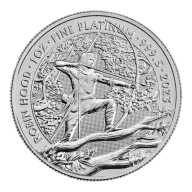
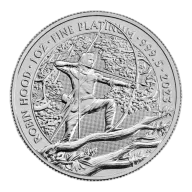
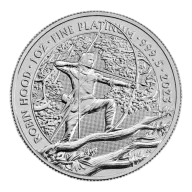
The 1 oz Myths and Legends Platinum Coin comes from The Royal Mint's Myths and Legends programme, a themed bullion series launched in 2021 that draws its subjects from British folklore. The series is structured as three-coin collections, each telling a complete story: Robin Hood (2021-2022), King Arthur (2023-2024) and Beowulf (2024-2025). A platinum issue from this range pairs an annually changing collectible design with a metal that few sovereign mints strike at all, making it a niche product even within the already small platinum coin market.
The case for picking this coin over a standard platinum bullion coin rests on two things. First, UK tax treatment: as UK legal tender, coins in the Myths and Legends series are CGT-exempt for UK residents, a status shared with the 1oz Platinum Britannia but not with the American Platinum Eagle or Canadian Platinum Maple Leaf. Second, thematic appeal: each collection is a self-contained three-coin arc, which attracts buyers who collect complete sets rather than accumulating identical coins year after year.
The trade-offs are real. Platinum coins as a class are less liquid than gold coins, with a smaller buyer pool, wider dealer spreads and patchier dealer inventory. Themed collectible ranges sit a further step from the mainstream than flagship coins like the Britannia, which has established liquidity and wider dealer recognition. Unlike the Britannia, the Myths and Legends series carries no advanced security features such as surface animation or tincture lines; authentication relies on Royal Mint provenance and dealer channels. Buyers wanting the simplest, most liquid route into platinum coins will usually be better served by one of the four major platinum bullion coins. Buyers who want a Royal Mint platinum coin with a story attached, and UK buyers who value the CGT exemption, are the natural audience here.
Myths and Legends Platinum Coin Specifications
The platinum issue of the Myths and Legends series contains one troy ounce of 999.5 fine platinum. That purity comfortably clears the thresholds that matter for tax treatment in several countries: Canada's 99% GST/HST exemption floor, Australia's investment-grade GST threshold, and the US IRA eligibility requirement of 99.95% for platinum.
| Attribute | Value |
|---|---|
| Weight | 1 troy ounce (31.1 g) |
| Purity | 999.5 fine platinum |
| Mint | The Royal Mint |
| Legal tender | United Kingdom |
| Series | Myths and Legends |
Designs change with each release rather than repeating annually. The series runs as three-coin collections, and the obverse carries the reigning monarch's portrait: earlier issues bear Queen Elizabeth II's effigy by Jody Clark, and later issues carry King Charles III's portrait by Martin Jennings. Which portrait appears depends on the individual coin's release date.
Platinum itself is worth understanding as a storage and handling proposition. It is denser than silver (21.45 g/cm3 against 10.49 g/cm3), so a platinum coin feels noticeably heavier than a silver coin of similar diameter. It is also harder than gold (Mohs 3.5 versus 2.5), more resistant to scratches, and does not tarnish or corrode, so no special atmospheric precautions are needed. That high density doubles as an authentication aid: no common cheap metal matches platinum's density, and a simple weight check on a coin of known size is a strong test.
Tax Treatment of the Myths and Legends Platinum Coin
Platinum follows the silver pattern rather than the gold pattern in most jurisdictions: it attracts sales tax in places where investment gold is exempt. The country-by-country position for this coin:
- UK: 20% VAT applies on purchase, as it does to all new platinum bullion. The offsetting advantage is that this is a UK legal tender coin, so it is CGT-exempt on disposal for UK residents. That combination, VAT on entry but no capital gains tax on exit, is shared with other UK legal tender platinum coins such as the Platinum Britannia. Foreign platinum coins sold in the UK carry both the VAT and a CGT liability.
- US: No federal sales tax; most states exempt bullion, with some applying thresholds or taxing it fully. Long-term gains are taxed at the collectibles rate of up to 28%. For IRA purposes, platinum must be at least 99.95% pure, which this coin's 999.5 fineness meets; confirm eligibility with the custodian before purchase.
- EU: Full standard VAT applies, typically 17-27% depending on the member state. There is no investment platinum exemption equivalent to the EU's investment gold rules.
- Canada: GST/HST exempt, since platinum refined to 99.5% or higher in coin form qualifies for the federal exemption.
- Australia: GST-free as investment-grade platinum.
- New Zealand: GST-exempt; platinum needs only 99% purity to qualify as fine bullion.
- Singapore: GST-exempt under the Investment Precious Metals scheme for qualifying legal tender platinum coins at 99% purity or higher. No capital gains tax.
- Hong Kong: No sales tax, no import duty, no capital gains tax.
The practical upshot: for UK buyers this coin's CGT exemption is its main tax draw, and buyers in Canada, Australia, Singapore and Hong Kong pay no purchase tax at all, so they should compare it against other platinum coins purely on premium.
The Myths and Legends Series Since 2021
The Royal Mint launched Myths and Legends in 2021 as a themed bullion programme built around British folklore, opening with Robin Hood, one of the most internationally recognisable figures in British legend. The series is organised into three-coin collections, each a complete narrative arc. The Robin Hood collection (2021-2022) comprised Robin Hood, Little John and Maid Marian. The King Arthur collection (2023-2024) followed with King Arthur, Merlin and Morgan Le Fay. The Beowulf collection (2024-2025) consists of Beowulf and Grendel, Beowulf and Grendel's Mother, and Beowulf and The Dragon, drawing on the oldest surviving long poem in Old English, composed somewhere between roughly 700 and 1000 AD.
The series spans a significant moment in Royal Mint history: the change of monarch. Robin Hood, Little John, Maid Marian, King Arthur and Merlin carry Queen Elizabeth II's portrait by Jody Clark; Morgan Le Fay and the entire Beowulf collection carry King Charles III's portrait by Martin Jennings. The switch landed mid-way through the King Arthur collection, which gives the earlier coins some potential numismatic interest as the only Myths and Legends issues with the late Queen's effigy. Reverse designers vary by coin; David Lawrence is credited with the Beowulf and Grendel design.
Within the Royal Mint's catalogue, Myths and Legends continued the market position established by the Queen's Beasts programme (2016-2021), the Mint's earlier themed bullion collection, and it runs concurrently with the Tudor Beasts series that began in 2023. Where those two ranges focus on heraldic creatures, Myths and Legends focuses on folklore characters. Bullion versions are not individually numbered or mintage-capped, unlike the proof editions, and the series continues with new themes as each collection completes.
Myths and Legends vs the Major Platinum Coins
The four major platinum bullion coins all share .9995 purity, so the choice between them and a Myths and Legends platinum coin comes down to tax status, liquidity and design philosophy.
The closest comparison is the 1oz Platinum Britannia, issued by the same mint since 2018. Both are UK legal tender and CGT-exempt for UK residents, so the tax position is identical. The Britannia is the Royal Mint's flagship: it has the stronger UK recognition, the more established liquidity, and tincture-line security features that Myths and Legends coins lack. What it does not offer is design variety; the Britannia repeats its core design, and Myths and Legends changes with every release. UK buyers choosing between the two are weighing liquidity against collectibility at the same tax treatment.
The American Platinum Eagle (US Mint, issued since 1997, $100 face value) has the strongest resale demand in the US market, and its proof versions carry rotating reverse designs. For a US buyer it is the default platinum coin; for a UK buyer it carries both VAT and CGT exposure, and the Myths and Legends coin avoids the CGT side. The Canadian Platinum Maple Leaf (Royal Canadian Mint, $50 CAD face value) is the longest-running of the four majors, issued since 1988, and carries Bullion DNA security, though its production has been intermittent. The Australian Platinum Kangaroo (Perth Mint, since 2018) is the youngest of the majors, with a wave-textured background, and like Myths and Legends it is still building market presence.
On resale, the LBMA-accredited majors hold the advantage: the Eagle, Maple Leaf, Britannia and Kangaroo have the best buyback prospects, and platinum spreads are already wider than gold, with a typical round-trip cost of 5-10% through a dealer. A themed coin from a smaller range adds a layer of unfamiliarity for some buyers. The Myths and Legends platinum coin earns its place where the buyer is in the UK, wants CGT exemption, and prefers a changing folklore design over the Britannia's fixed one.