1 listing
Filters
| Product | /oz | Premium | Price | |
|---|---|---|---|---|

 Hatton Garden Metals
Out of Stock
Hatton Garden Metals
Out of Stock
|
$1,913.18 |
+6.29%
+28% inc.VAT
|
$1,913.16
£1,720 inc.VAT
|
View Deal |
Prices are fetched automatically and may not reflect current merchant prices. Currency conversions and tax treatment are approximate. Rankings are based solely on price. We are not a dealer and accept no responsibility for transactions with listed merchants. Past performance is not indicative of future results. This site does not provide investment advice. Full disclaimer
About the 1 oz South African Mint Krugerrand Platinum Coin
The 1 oz Platinum Krugerrand
The platinum Krugerrand arrived in 2017, struck for the 50th anniversary of the coin that invented the modern bullion market. Unlike the gold original, which has been in continuous production since 1967, the platinum version was a limited issue, and the South African Mint does not produce a platinum Krugerrand in regular bullion production. That makes this a scarcer proposition than the big four platinum coins (the American Platinum Eagle, Platinum Maple Leaf, Platinum Britannia, and Platinum Kangaroo), all of which are or have been ongoing series.
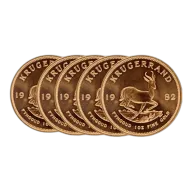
The coin carries the same design that has fronted the Krugerrand for nearly six decades: Paul Kruger's portrait on the obverse and Coert Steynberg's leaping springbok on the reverse. It also breaks with gold Krugerrand tradition in one respect. Gold Krugerrands carry no face value and are legal tender at their gold value; the platinum coin is denominated at R10, just as the silver Krugerrand introduced alongside it carries R1.
Platinum coins are a small market compared with gold or silver. Fewer mints strike them, dealer inventory is thinner, and 1 oz premiums typically run 8 to 15 percent over spot, well above gold coin levels. A limited-issue coin like this one trades partly on Krugerrand brand recognition and anniversary collectibility rather than pure bullion economics, so comparing prices across the dealers that stock it matters more than usual. Platinum's density (21.45 g/cm3) also works in the buyer's favour: no common cheap metal matches it, so a simple weight and diameter check is a strong authenticity test.
Platinum Krugerrand Specifications
| Attribute | Detail |
|---|---|
| Fine platinum | 31.1 g (1 troy oz) |
| Purity | .999 fine platinum |
| Face value | R10 (South African rand) |
| First issued | 2017 (50th anniversary issue) |
| Issuer | South African Mint |
| Obverse | Paul Kruger portrait, by Otto Schultz |
| Reverse | Springbok antelope, by Coert Steynberg |
The .999 purity is worth a close look because it differs from the platinum coin norm. The four major platinum bullion coins (Eagle, Maple Leaf, Britannia, Kangaroo) are all struck at .9995 fine, and that half-point matters for one specific purpose: US precious metals IRAs require platinum of at least 99.95% purity, which a .999 coin does not meet. The 2017 anniversary issues also carry a discreet privy mark distinguishing them from standard Krugerrands.
Handling characteristics favour platinum. The metal is harder than gold (Mohs 3.5 against 2.5), resists scratches, and does not tarnish or corrode, so no special atmospheric precautions are needed. Standard coin capsules are suitable, though fewer platinum-specific tube sizes exist than for gold and silver, so check compatibility before buying storage in bulk.
Platinum Krugerrand Tax Position by Country
Platinum follows the silver pattern rather than the gold one: no broad investment exemption in Europe, purity-based exemptions elsewhere. The gold Krugerrand's famous tax advantages do not carry over to this coin.
- UK: 20% VAT on purchase, and because the coin is South African rather than UK legal tender, gains are also subject to CGT. The Platinum Britannia is the only platinum coin that escapes CGT for UK buyers; the Krugerrand escapes neither tax.
- US: No federal sales tax; most states exempt bullion. Long-term gains are taxed at the 28% collectibles rate. At .999 fine the coin falls short of the 99.95% purity the IRS requires for platinum in a precious metals IRA, so unlike the gold Krugerrand it is not IRA-eligible.
- South Africa: The VAT zero-rating that covers gold Krugerrands applies to gold coins only; platinum bullion carries the full 15% VAT, and CGT applies on disposal.
- EU: Full local VAT, between 17% and 27% depending on the member state. The EU investment gold exemption has no platinum equivalent.
- Canada: GST/HST exempt; platinum qualifies at 99.5% purity or above, which .999 clears.
- Australia: GST-free as investment-grade platinum (99% threshold).
- New Zealand: GST-exempt; the platinum threshold is 99% purity.
- Singapore and Hong Kong: No tax in either market. Singapore exempts platinum of 99%+ purity under its Investment Precious Metals scheme, and Hong Kong has no sales tax or CGT at all, making these the cheapest jurisdictions to hold platinum.
Fifty Years On: Why a Platinum Krugerrand Exists
The Krugerrand was first struck on 3 July 1967 as the world's first modern gold bullion coin designed specifically for investment, beginning with 40,000 bullion pieces and 10,000 proofs. The gamble worked spectacularly: by 1980 the coin accounted for more than 90 percent of the global gold coin market, and every major sovereign bullion coin that followed, from the Maple Leaf in 1979 to the Britannia in 1987, was a direct response to its success. By 2017 more than 60 million Krugerrands containing over 53 million troy ounces of gold had been sold, making it the most widely held gold bullion coin in the world by cumulative volume.
For half a century the Krugerrand existed only in gold. The 2017 50th anniversary changed that, with the South African Mint introducing silver and platinum versions for the first time. These anniversary metals broke a long-standing convention: the gold coin has never carried a face value, being legal tender at its gold content value, while the new silver and platinum coins were denominated at R1 and R10 respectively. The platinum issue was produced in limited numbers as a commemorative of the milestone rather than the start of a regular bullion line.
The design the platinum coin inherits is one of the most stable in bullion history. Otto Schultz's portrait of Paul Kruger, president of the South African Republic, has fronted the obverse since 1967, with Coert Steynberg's springbok, the national animal of South Africa, in mid-leap on the reverse. The 2017 issues add only a small privy mark to mark the anniversary.
Platinum Krugerrand vs Eagle, Maple Leaf, and Britannia
The standing alternatives in 1 oz platinum are the American Platinum Eagle (US Mint, since 1997, $100 face value), the Platinum Maple Leaf (Royal Canadian Mint, since 1988, with Bullion DNA security but intermittent production), and the 1 oz Platinum Britannia (Royal Mint, since 2018). All three are struck at .9995 fine against the Krugerrand's .999, and that difference has a concrete consequence for American buyers: the big three qualify for precious metals IRAs and the Krugerrand does not.
Liquidity also favours the established series. The Platinum Eagle has the strongest resale demand in the US and the Britannia is the most recognised platinum coin in the UK, where it is additionally the only CGT-exempt option. The Krugerrand brand is among the most recognised in all of bullion, but its platinum incarnation is a limited 2017 anniversary issue rather than an annual product, so the pool of dealers actively trading it is smaller and spreads can be wider. Platinum coins already carry round-trip dealer spreads of roughly 5 to 10 percent; a niche issue sits at the wider end of that.
What the platinum Krugerrand offers that the others do not is scarcity and the anniversary connection to the coin that created the bullion market. Buyers wanting a pure platinum bullion position at the lowest friction are usually better served by the Eagle or Britannia; buyers drawn to the Krugerrand specifically are paying for a one-off chapter of its history, and should compare prices carefully given how few dealers list it.
1 oz South African Mint Krugerrand Platinum Coin: frequently asked questions
-
The current platinum spot price is $1,806.00 per troy ounce. Because a 1oz Platinum Krugerrand contains exactly one troy ounce of .999 fine platinum, spot is the key reference when evaluating dealer premiums on this coin.
-
No. The historical US import ban on Krugerrands (1985-1991) applied to gold Krugerrands, which were targeted alongside other South African exports under anti-apartheid sanctions. Platinum Krugerrands were not produced until 2017, more than two decades after those sanctions were lifted, so they were never subject to any import ban.
-
Yes, in most markets. Platinum Krugerrands carry legal-tender status in South Africa (face value R10), but this does not confer CGT exemption in other countries. In the UK, CGT applies at 18% or 24% on gains above the annual allowance; only UK legal-tender coins are exempt. US investors pay up to 28% on gains. In Canada, 50% of any gain is added to taxable income.