3 products · 23 deals Prices & premiums exclude tax to compare across countries
Filters



Prices are fetched automatically and may not reflect current merchant prices. Currency conversions and tax treatment are approximate. Rankings are based solely on price. We are not a dealer and accept no responsibility for transactions with listed merchants. Past performance is not indicative of future results. This site does not provide investment advice. Full disclaimer
About the Philharmonic Platinum
The Platinum Philharmonic: Austria's Entry into the Platinum Market
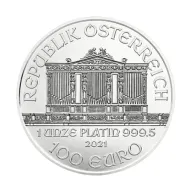
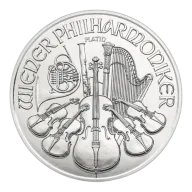
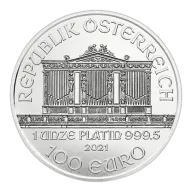
The Platinum Philharmonic was introduced in 2016 by the Austrian Mint (Munze Osterreich), making it the newest of the five major sovereign platinum coins. It carries a EUR 100 face value as Austrian legal tender and is struck in 999.5 fine platinum. The design mirrors its celebrated gold and silver siblings: the pipe organ of the Musikverein's Golden Hall on one side and an ensemble of Vienna Philharmonic Orchestra instruments on the other, both created by Austrian Mint engraver Thomas Pesendorfer for the original 1989 gold launch.
The Austrian Mint's heritage is one of the most unusual in the minting world. It traces its lineage to 1194, when Duke Leopold V of Austria used 12 tonnes of silver from Richard the Lionheart's ransom to establish large-scale coin production in Vienna. The Philharmonic series has been commercially successful from the start: the gold version was the world's best-selling gold coin in 1992, 1995, 1996, and 2000, and over 30 million silver Philharmonics were sold in the three-year period 2021-2023 alone.
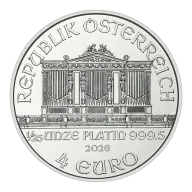
The platinum version extends this reputation into the smallest of the three bullion metals. It is currently available in the 1 oz and a small 1/25 oz size (EUR 4 face value). The 1/25 oz was specifically designed as an affordable entry point for European investors, though fractional platinum coins carry proportionally high premiums that make them less cost-efficient per ounce. The Philharmonic typically trades at competitive premiums in European markets, often matching or beating the Platinum Maple Leaf on price.
One detail that reveals the Philharmonic's authenticity to its subject: the horn depicted on the reverse is specifically a Wiener Horn (Vienna horn), not a standard French horn. The Vienna Philharmonic Orchestra insists on using Vienna horns for their warmer, rounder tone, and this commitment to historically informed performance practice is reflected in the coin's design.
Platinum Philharmonic Denominations and Dimensions
| Size | Face Value (EUR) | Weight | Diameter | Purity | First Year |
|---|---|---|---|---|---|
| 1 oz | 100 | 31.103 g | 37.0 mm | 999.5 | 2016 |
| 1/25 oz | 4 | 1.244 g | 13.0 mm | 999.5 | 2016 |
Edge type is reeded. The 37.0 mm diameter of the 1 oz is notably larger than most other 1 oz platinum coins: the Platinum Britannia is 32.69 mm, the Platinum Maple Leaf is 30.0 mm, and the Platinum Kangaroo is 32.10 mm. The Philharmonic's broader, thinner profile gives it a distinctive feel and display presence.
Gold and Silver Companions
The gold Philharmonic is available in five sizes (1 oz down to 1/25 oz), all at 999.9 purity. The silver version is produced only in the 1 oz size at 999 fineness, with a EUR 1.50 face value. The gold version was originally denominated in Austrian schillings and switched to euros in 2002.
Security
The Philharmonic has no dedicated anti-counterfeiting technology comparable to the Britannia's latent image system or the Maple Leaf's Bullion DNA. It relies on its highly detailed design (the intricate pipe organ and instrument ensemble are difficult to replicate precisely), reeded edges, and the Austrian Mint's government-backed guarantee. The year-date changes annually. The Austrian Mint's position is that the design complexity itself is a sufficient deterrent, though this places it behind the Britannia and Maple Leaf on security technology.
Platinum Philharmonic Tax Treatment by Country
Austria and the European Union
Platinum Philharmonics are subject to standard VAT rates in Austria (20%) and across the EU (17-27% depending on the country). There is no investment platinum directive equivalent to the EU's investment gold directive. Some EU dealers apply the margin scheme (Differenzbesteuerung in Germany) on secondary-market platinum coins, which can reduce the effective VAT. Despite bearing euro denominations, the Philharmonic is legal tender only in Austria and cannot be spent at face value in other eurozone countries. Gold Philharmonics appear on the EU's annual list of investment gold coins and are VAT-exempt across all member states.
United Kingdom
Platinum Philharmonics attract 20% VAT on import and purchase. They are not UK legal tender, so they are also subject to CGT on any gains. The gold version is VAT-exempt as a recognised investment gold coin, but this does not extend to platinum. For UK buyers, the Platinum Britannia is the only platinum coin offering CGT exemption.
United States
The Platinum Philharmonic is IRA-eligible. At 999.5 fineness, it meets the IRS requirement for platinum in precious metals IRAs. Capital gains are taxed as collectibles at a maximum 28% federal rate. The Philharmonic generally carries lower premiums than the American Platinum Eagle in the US market.
Other Jurisdictions
- Canada: GST/HST-exempt at 99.5% purity. Not RRSP-eligible (not issued by a Canadian mint).
- Australia: GST-free for investment platinum at 99% purity or higher. 50% CGT discount for holdings over 12 months.
- New Zealand: GST-exempt at 99% purity. No CGT.
- Singapore: IPM GST-exempt for qualifying platinum. No CGT.
- Hong Kong: No sales tax, no import duty, no CGT.
- South Africa: 15% VAT on platinum. No legal tender exemption.
- Japan: The Philharmonic has historically been one of the top-selling bullion coins in Japan. The Austrian Mint maintains strong distribution relationships with Japanese precious metals dealers.
From Richard the Lionheart's Ransom to Platinum Bullion
The Austrian Mint's founding story is more dramatic than most. In 1192, Duke Leopold V of Austria captured Richard I of England during his return from the Third Crusade. The ransom extracted (12 tonnes of silver) funded the expansion of Vienna's minting operations, establishing a production capability that has operated continuously for over 800 years. The modern Munze Osterreich is a direct descendant of that operation.
The Philharmonic coin series began in 1989 with the gold version, named after the Vienna Philharmonic Orchestra and featuring the Musikverein's Golden Hall organ. Thomas Pesendorfer designed both sides. The Musikverein, built in 1870, is renowned for its acoustics and is the venue for the orchestra's annual New Year's Concert, broadcast to over 90 countries. The coin design has remained essentially unchanged since 1989, aside from the year-date and the switch from Austrian schilling to euro denominations in 2002.
The gold Philharmonic's commercial success was immediate. By 1992, just three years after launch, it was the world's best-selling gold coin. It claimed that title again in 1995, 1996, and 2000. From 1989 to 2012, the Austrian Mint sold 14 million gold coins (equivalent to roughly 329 tonnes of pure gold). Annual production ranged from a low of 54,700 in 2001 (post-dot-com crash) to a peak of 903,047 in 2009 (global financial crisis demand).
Silver followed in 2008, and the platinum version launched in 2016. The platinum edition was part of a broader trend: between 2016 and 2018, three major sovereign mints added platinum to their bullion ranges (Austrian Mint in 2016, Royal Mint and Perth Mint both in 2018). This late expansion reflected a growing recognition that platinum, despite its small investment market, deserved a place in sovereign mint portfolios.
The design's fixed nature is sometimes contrasted with annually changing alternatives like the Kangaroo or Lunar. For the Philharmonic, the consistency is the point: the pipe organ and instrument ensemble are the permanent identity, with each year's coin identical to the last except for the date stamp. This is the same approach used by the Maple Leaf and mirrors the gold Philharmonic's philosophy since 1989.
Platinum Philharmonic vs Britannia, Maple Leaf, Eagle, and Kangaroo
The Platinum Philharmonic's competitive position is built on two factors: competitive premiums and European market strength. In Germany, Austria, and across much of the EU, the Philharmonic is among the most affordable sovereign platinum coins available. It also has unusually strong distribution in Japan, where the Austrian Mint has cultivated dealer relationships over decades.
Against the Platinum Britannia, the Philharmonic lacks the UK CGT exemption and the four-feature security suite. For UK buyers, the Britannia is superior on both counts. For European buyers without a UK CGT connection, the Philharmonic's lower premiums and local availability make it the more practical choice. The Philharmonic's 37.0 mm diameter gives it a noticeably larger presentation than the Britannia's 32.69 mm, which some buyers prefer aesthetically.
The Platinum Maple Leaf offers Bullion DNA individual authentication, which the Philharmonic cannot match. Premium levels are often comparable between the two, though this varies by market and dealer. The Maple Leaf has broader global liquidity, particularly in North America, while the Philharmonic has the edge in Central Europe and Japan. Both use fixed designs.
The American Platinum Eagle has the deepest secondary market in the United States and benefits from explicit Congressional IRA authorisation. It typically carries slightly higher premiums than the Philharmonic. For US investors, the choice between the Eagle (maximum domestic liquidity) and the Philharmonic (potentially lower premiums, IRA-eligible through standard purity provision) depends on whether price or convenience is the priority.
The Platinum Kangaroo adds annual design changes and strong Asia-Pacific distribution. The Kangaroo and Philharmonic rarely compete directly because their geographic strengths are complementary: Kangaroo in Australia, Singapore, and Hong Kong; Philharmonic in Germany, Austria, and Japan. For buyers in either region, the local option typically offers better premiums and availability.