2 products · 18 deals Prices & premiums exclude tax to compare across countries


Prices are fetched automatically and may not reflect current merchant prices. Currency conversions and tax treatment are approximate. Rankings are based solely on price. We are not a dealer and accept no responsibility for transactions with listed merchants. Past performance is not indicative of future results. This site does not provide investment advice. Full disclaimer
About the Perth Kangaroo Platinum
The Platinum Kangaroo: Perth Mint's Flagship Platinum Coin
The Platinum Kangaroo is the Perth Mint's current primary platinum bullion coin, struck in 999.5 fine platinum with an A$100 face value as Australian legal tender. The Kangaroo series launched in 1986 as a gold bullion coin (originally called the "Australian Gold Nugget" before the kangaroo redesign in 1989), and the platinum version was added in 2018, the same year as the Platinum Britannia. Both entered a market that already included the Platinum Maple Leaf (1988) and the American Platinum Eagle (1997).
The Kangaroo's most distinctive feature across all its metal variants is the annually changing reverse design. Each year features a new depiction of a red kangaroo in a natural Australian setting. This is unusual for bullion coins; most sovereign platinum coins (Eagle, Maple Leaf, Philharmonic) maintain the same design year after year. Only the Perth Mint's own Kookaburra and Koala share this annual-design approach. For buyers who value variety alongside their bullion holding, the Kangaroo offers a collector dimension that static-design coins do not.
The Perth Mint is a government-owned entity of Western Australia, established in 1899 and LBMA-accredited. All Kangaroo coins carry the "P" mintmark and a micro-laser engraved letter on the reverse as a security feature, introduced with the 2016 silver bullion release and applied across all metals. The Platinum Kangaroo currently ships in the 1 oz size only, with no fractional platinum denominations in regular production.
Australia's GST exemption for platinum at 99% purity or higher (lower than the 99.5% threshold for gold) makes domestic purchases tax-free. For Australian buyers, the Kangaroo is the natural choice: local mint, domestic legal tender, and no GST. The Perth Mint also operates a depository storage programme that allows allocated and unallocated storage for Australian residents.
Platinum Kangaroo Specifications
| Attribute | Value |
|---|---|
| Weight | 31.10 g (1 troy oz) |
| Diameter | 32.10 mm |
| Thickness | 2.65 mm |
| Purity | 999.5 (99.95%) |
| Face Value | A$100 |
| Edge | Milled |
| Mintmark | P (Perth) |
The 999.5 fineness matches every other major sovereign platinum coin. Currently produced in the 1 oz size only. The platinum version shares the same 32.10 mm diameter and 2.65 mm thickness as the 1 oz Gold Kangaroo, though platinum's higher density (21.45 g/cm3 vs gold's 19.3 g/cm3) means the coin feels slightly heavier in hand despite having the same troy ounce weight.
Security Features
Each Platinum Kangaroo carries a micro-laser engraved letter on the reverse, detectable only under magnification. This was first introduced with the 2016 silver Kangaroo bullion release and has been applied to all gold, silver, and platinum Kangaroo coins since. The letter is placed within the design field and varies by year.
The Perth Mint does not have a coin-level digital authentication system comparable to the Royal Canadian Mint's Bullion DNA. Authentication relies on the micro-engraving, the "P" mintmark, and physical verification of weight and dimensions. For comparison, the Platinum Britannia carries four distinct visual security features (latent image, surface animation, micro-text, and tincture lines), while the Platinum Maple Leaf offers individual coin-level database verification through Bullion DNA.
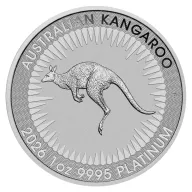
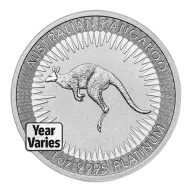
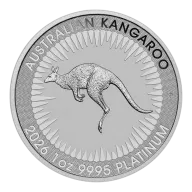
The reverse design changes annually, showing a bounding or resting red kangaroo with stylised landscape elements. The text "AUSTRALIAN KANGAROO" appears along with weight, purity, and year date. The obverse currently carries the Dan Thorne portrait of King Charles III (from 2024; previously various Elizabeth II portraits).
Platinum Kangaroo Tax Treatment by Country
Australia
Investment-grade platinum at 99% purity or higher is GST-free when in coins or bars tradeable on international bullion markets. The Kangaroo's 999.5 fineness comfortably exceeds this threshold. Note that Australia's purity threshold for platinum (99%) is lower than for gold (99.5%) or silver (99.9%), making platinum relatively easy to qualify for GST exemption. Capital gains tax applies on disposal, with a 50% discount for individuals holding the asset for more than 12 months. There is no blanket CGT exemption for Australian legal tender bullion coins (unlike the UK's exemption for sterling legal tender).
United States
The Platinum Kangaroo is IRA-eligible. It meets the IRS purity requirement for platinum (99.95% or higher) and qualifies as a sovereign legal tender coin from a recognised foreign mint. Must be held by an approved custodian. Capital gains are taxed as collectibles at a maximum 28% federal rate. Most states exempt investment platinum from sales tax.
United Kingdom
Platinum Kangaroos attract 20% VAT on import and purchase. They are not UK legal tender, so they are also subject to CGT on disposal. For UK buyers wanting platinum with CGT exemption, the Platinum Britannia is the only option. The double tax exposure (VAT on purchase, potential CGT on sale) makes the Kangaroo an expensive choice for UK-based investors.
Other Jurisdictions
- Canada: GST/HST-exempt at 99.5% purity or higher. Standard capital gains treatment.
- New Zealand: GST-exempt at 99% purity. No CGT. The Perth Mint is the nearest major sovereign mint for NZ buyers.
- Singapore: IPM GST-exempt for platinum at 99% or higher. No CGT. The Perth Mint has strong distribution in Singapore.
- Hong Kong: No sales tax, no import duty, no CGT.
- South Africa: 15% VAT on platinum. No platinum Krugerrand exists.
- European Union: Subject to standard VAT rates. No investment platinum directive.
Platinum Kangaroo vs Britannia, Maple Leaf, Eagle, and Philharmonic
The Platinum Kangaroo's annual design change is its most obvious differentiator from the four other major sovereign platinum coins. The Platinum Maple Leaf, American Platinum Eagle, and Platinum Philharmonic all maintain fixed designs. The Platinum Britannia changes its design annually as well, so this is not unique to the Kangaroo, but it narrows the field of platinum coins with collector-friendly design rotation.
On security, the Kangaroo's micro-laser engraving is a step below the Maple Leaf's Bullion DNA (individual coin database verification) and the Britannia's four-feature visual security suite (latent image, surface animation, micro-text, tincture lines). The Philharmonic has no specific anti-counterfeiting technology beyond its detailed design. For authentication confidence, the Maple Leaf and Britannia lead the field.
On pricing, the Kangaroo typically sits in the middle of the pack. The Maple Leaf and Philharmonic tend to trade at slightly lower premiums in their respective home markets. The Eagle carries slightly higher premiums in the US but with the deepest domestic secondary market. The Britannia commands a premium in the UK partly because of its CGT exemption.
For Australian and Asia-Pacific buyers, the Kangaroo is the natural default: domestic mint, local legal tender, strong regional distribution, and GST-free in Australia. The Perth Mint's geographic proximity to Asian bullion markets (Singapore, Hong Kong, Japan) has established the Kangaroo as a widely recognised coin in the region. For UK buyers, the Britannia's CGT exemption makes it the clear winner. For North American buyers, the Maple Leaf or Eagle will typically offer better domestic availability and tighter spreads.
The Perth Mint's other platinum offerings, the Koala and Kookaburra, occupy niche positions beneath the Kangaroo. The Koala has historical significance (first national platinum coin in 1988, predating the Eagle by nine years) but its original platinum production ceased in 2000 before being revived. The Kookaburra's primary market is silver. The Kangaroo is positioned as the flagship and receives the broadest dealer support.
Perth Kangaroo Platinum: frequently asked questions
-
Kangaroo coin prices track the live $1,806.00 spot price for the metal you choose, with a fabrication premium on top. 13 dealers list 18 Kangaroo products across gold, silver, and platinum. Use the comparison table to see current prices by weight and dealer, as premiums vary. Larger sizes (1 oz and above) typically carry lower per-ounce premiums than fractional coins.
-
The Perth Kangaroo is a bullion coin series produced by the Perth Mint, a government-owned refinery established in 1899 and LBMA-accredited. The coins are Australian legal tender. The series launched in 1986 as the 'Australian Gold Nugget' and was redesigned with kangaroo motifs from 1989. Like the Chinese Panda, the reverse design changes annually. Gold and silver coins are .9999 fine; platinum is .9995 fine.
-
Gold Kangaroos are available from 1/20 oz to 1 kg, with the most common sizes being 1/10 oz, 1/4 oz, 1/2 oz, and 1 oz. The silver Kangaroo is produced in 1 oz (.9999 fine), introduced in 2016. The platinum Kangaroo is currently offered in 1 oz (.9995 fine). In total, 18 products across all three metals are tracked on this page.
-
Tax treatment depends on your country. In the UK, Australian legal-tender coins do not qualify for the CGT exemption that applies to UK legal-tender coins; gains are taxed at 18% or 24% above the £3,000 annual allowance. In Australia, CGT applies on disposal, though individuals holding for more than 12 months qualify for a 50% discount. US investors face collectibles CGT of up to 28% on long-term gains. In Canada, 50% of any gain is included in taxable income.
-
Yes, in general. Coins carry fabrication costs from minting individual pieces, legal-tender production standards, and the design refresh each year. Cast bars are produced at lower per-unit cost and typically trade closer to spot. The Kangaroo's annual design change also creates mild collector demand that can widen the gap versus bars. If minimising premium is the priority, large minted or cast bars are usually cheaper per ounce.