5 products · 19 deals Prices & premiums exclude tax to compare across countries
Filters
| Product | /oz | Premium | Price (ex. tax) | |
|---|---|---|---|---|
| $1,943.34 | +7.60% | $1,943.34 | View Deal | |

12 deals
|
$1,977.29 |
+9.85%
+32% inc.VAT
|
$1,977.29
£1,778 inc.VAT
|
Compare |

3 deals
|
$2,050.53 |
+13.92%
+37% inc.VAT
|
$1,025.26
£922 inc.VAT
|
Compare |

2 deals
|
$2,083.75 | +15.38% | $520.94 | Compare |
| $2,197.02 |
+22.06%
+46% inc.VAT
|
$219.70
£198 inc.VAT
|
View Deal |



Prices are fetched automatically and may not reflect current merchant prices. Currency conversions and tax treatment are approximate. Rankings are based solely on price. We are not a dealer and accept no responsibility for transactions with listed merchants. Past performance is not indicative of future results. This site does not provide investment advice. Full disclaimer
About the Perth Koala Platinum
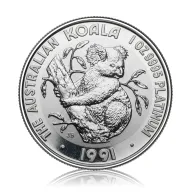
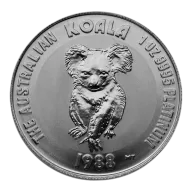
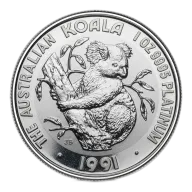
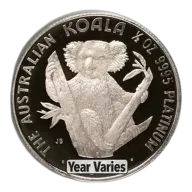
The Platinum Koala: One of the World's First National Platinum Coins
The Platinum Koala holds a significant place in bullion history. First struck in September 1988 by the Perth Mint, it was the first national coin series to offer 1 oz platinum bullion, beating the American Platinum Eagle (1997) to market by nearly a decade. The Australian Government approved platinum minting on 18 June 1987, and the Perth Mint used over 18 tonnes of platinum through the Koala programme, with approximately 85% sold internationally.
The original platinum production ran from 1988 to 2000, when it was discontinued due to insufficient demand. Only 2,048 coins were struck in the final year against a maximum mintage of 100,000, illustrating how thin the platinum retail market was at the turn of the millennium. The series was later revived with modern production, and today the Platinum Koala is available alongside the Perth Mint's Platinum Kangaroo (the flagship platinum coin) and the Platinum Kookaburra.
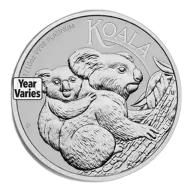
Like all Perth Mint animal series, the Koala features annually changing reverse designs showing koalas in various natural settings. The purity is 999.5 (99.95% fine platinum), matching the universal standard. The coins carry Australian dollar face values as legal tender, backed by a government guarantee on weight and purity from the Government of Western Australia.
The Koala is offered in a wider range of platinum sizes than most competitors. The 1 oz, 1/2 oz, 1/4 oz, 1/10 oz, and 1/20 oz are available, as well as larger 2 oz, 10 oz, and 1 kg sizes. This range exceeds what most sovereign mints offer in platinum, where the 1 oz is typically the only size in regular production.
Platinum Koala Denominations and Dimensions
| Size | Face Value (AUD) | Diameter | Thickness | Purity |
|---|---|---|---|---|
| 1/20 oz | $5 | 14.1 mm | 1.32 mm | 999.5 |
| 1/10 oz | $10 | 16.1 mm | 1.40 mm | 999.5 |
| 1/4 oz | $25 | 20.1 mm | 1.90 mm | 999.5 |
| 1/2 oz | $50 | 25.1 mm | 2.03 mm | 999.5 |
| 1 oz | $100 | 32.1 mm | 2.70 mm | 999.5 |
| 2 oz | $200 | 40.6 mm | 3.80 mm | 999.5 |
| 10 oz | $1,000 | 60.3 mm | 7.90 mm | 999.5 |
| 1 kg | $3,000 | 75.3 mm | 13.90 mm | 999.5 |
Edge type is reeded on all sizes. The larger sizes (2 oz, 10 oz, 1 kg) were introduced in 1991 during the original platinum production run. All coins carry the "P" mintmark identifying the Perth Mint.
The Koala does not carry specific anti-counterfeiting technology such as the micro-laser engraving used on the Kangaroo series (from 2016). Authentication relies on the Perth Mint's production quality, the mintmark, and physical verification. Each coin ships in a Perth Mint protective capsule (individual coins) or mint tube (bulk).
Silver Koala Companion
The Silver Koala was introduced in 2007 as a companion to the platinum series. Silver purity was upgraded from 999 to 9999 (four nines) starting with the 2018 edition. From 2018 onward, the silver series was streamlined to 1 oz (300,000 annual mintage cap) and 1 kg (mint-to-order). The silver version's lower mintage cap compared to the Silver Kookaburra (500,000 cap) gives it a slightly tighter supply profile.
Platinum Koala Tax Treatment by Country
Australia
Investment-grade platinum at 99% purity or higher is GST-free when in coins or bars tradeable on international bullion markets. The Koala's 999.5 fineness qualifies. Capital gains tax applies on disposal, with a 50% discount for individual holders over 12 months. The Perth Mint's status as a government-owned entity of Western Australia underscores the coin's legitimacy as investment-grade legal tender.
United States
The Platinum Koala is specifically listed as IRA-eligible in IRS Section 408(m)(3)(A), which is a stronger designation than the generic purity-based provision that other foreign coins rely on. This explicit listing provides clearer regulatory certainty for IRA custodians. Capital gains are taxed as collectibles at up to 28% federal rate. Most states exempt investment platinum from sales tax.
United Kingdom
Platinum Koalas attract 20% VAT on import and purchase. They are not UK legal tender, so they are also subject to CGT on disposal. For UK buyers, the Platinum Britannia offers CGT exemption that the Koala cannot match. The combination of 20% VAT on purchase and potential CGT on sale makes the Koala an expensive option for UK-based platinum investors.
Other Jurisdictions
- Canada: GST/HST-exempt at 99.5% purity. Standard capital gains treatment.
- New Zealand: GST-exempt at 99% purity. No CGT.
- Singapore: IPM GST-exempt for qualifying platinum at 99% or higher. No CGT. Strong Perth Mint distribution in Singapore.
- Hong Kong: No sales tax, no import duty, no CGT. Perth Mint bullion has strong recognition in the Hong Kong market.
- South Africa: 15% VAT on platinum. No legal tender coin exemption for platinum.
- European Union: Subject to standard VAT rates. No investment platinum directive. Gold Koalas likely qualify for the EU investment gold exemption.
From Pioneer to Niche: The Koala's Platinum Journey
The Platinum Koala's history spans two distinct eras. The first era (1988-2000) was pioneering: the Perth Mint launched platinum bullion at a time when only the Isle of Man's Noble (1983-1989, a short-lived private mint production) had attempted it. The Australian Government's June 1987 approval for platinum minting positioned the Perth Mint to enter the market alongside the Royal Canadian Mint's Platinum Maple Leaf, both debuting in 1988.
During this first era, the Perth Mint processed over 18 tonnes of platinum through the Koala programme. Approximately 85% was sold internationally, making the Gold Corporation (Perth Mint's parent entity) one of Australia's top 30 export earners. The coin was available in eight sizes from 1/20 oz to 1 kg, an exceptionally broad range for platinum. Annual designs featured koalas in eucalyptus trees, on branches, and with joeys, each year bringing a new composition.
The programme ended in 2000, a victim of weak platinum investment demand at the turn of the millennium. The final year's mintage of just 2,048 coins against a 100,000 maximum tells the story of how thin the market had become. The American Platinum Eagle (launched 1997) had entered the market with the US Mint's substantial distribution infrastructure, and the Koala's niche was squeezed.
The second era began when the Perth Mint revived platinum production. The Koala returned alongside the Perth Mint's broader platinum push that also introduced the Platinum Kangaroo in 2018 as the new flagship. In this modern configuration, the Kangaroo is positioned as the primary platinum bullion coin with the broadest dealer distribution, and the Koala occupies a complementary position with its established collector following and historical significance.
The silver Koala, introduced in 2007, has had a more continuous life. The 2007 debut used a distinctive "shimmer" background technique. From 2018, the silver series was streamlined to just 1 oz (300,000 cap) and 1 kg (mint-to-order), with purity upgraded from 999 to 9999. Multiple finish types have been produced over the series: bullion, proof, high-relief, coloured, and gilded editions.
Platinum Koala vs Kangaroo, Kookaburra, and International Rivals
Within the Perth Mint's own range, the Platinum Koala competes primarily with the Platinum Kangaroo. The Kangaroo is Perth Mint's flagship platinum coin with stronger market recognition, more dealer support, and micro-laser engraved security features that the Koala lacks. The Koala's advantage is historical prestige (the Kangaroo only entered platinum in 2018, three decades after the Koala pioneered it) and a wider size range including fractional denominations and larger pieces up to 1 kg.
The Platinum Kookaburra shares the annual-design-change format but has its primary identity as a silver series. The Koala and Kookaburra both upgraded their silver versions to 9999 purity in 2018, and the Koala carries a lower silver mintage cap (300,000 vs the Kookaburra's 500,000), giving it a somewhat tighter supply.
Against international sovereign platinum coins, the Koala has one concrete advantage for US investors: it is specifically listed as IRA-eligible in IRS Section 408(m)(3)(A), providing clearer regulatory certainty than the generic purity-based provision that other foreign coins rely on. The Platinum Maple Leaf offers Bullion DNA authentication and typically competitive premiums. The Platinum Britannia provides UK CGT exemption. The Platinum Philharmonic trades at competitive premiums in European markets.
The Koala's optimal buyer is someone who values the Perth Mint's provenance, wants access to fractional and larger platinum sizes that most mints do not offer, and appreciates the annual design variety. The 2000 final-year platinum issue (2,048 mintage) and other scarce early dates also appeal to collectors of platinum history. For pure cost efficiency, the Maple Leaf or Philharmonic typically offer lower premiums per ounce of metal.