2 products · 6 deals Prices & premiums exclude tax to compare across countries


Prices are fetched automatically and may not reflect current merchant prices. Currency conversions and tax treatment are approximate. Rankings are based solely on price. We are not a dealer and accept no responsibility for transactions with listed merchants. Past performance is not indicative of future results. This site does not provide investment advice. Full disclaimer
About the Noble Platinum
The Platinum Noble: The World's First Platinum Bullion Coin
The Noble holds a unique place in bullion history: it was the world's first platinum coin struck specifically for investors. Issued by the Isle of Man Government and minted by Pobjoy Mint, the first Platinum Noble was released in November 1983. This predates every other platinum bullion coin: the Perth Mint's Platinum Koala (1988), the Canadian Platinum Maple Leaf (1988), and the American Platinum Eagle (1997). The Noble's six-year platinum production run (1983-1989) was short, but it established platinum as a viable retail investment metal and paved the way for every sovereign platinum programme that followed.
The coin is struck in 999.5 fine platinum, the same standard that later became universal across all major platinum bullion coins. It carries legal tender status on the Isle of Man, but with an unusual feature shared by only a handful of bullion coins worldwide (the Krugerrand and the Mexican Libertad among them): the Noble has no fixed face value. It is denominated as "ONE NOBLE" (or fractional equivalents), with its legal tender value floating at the precious metal content. This follows the Krugerrand model rather than the fixed-denomination approach of the Eagle, Maple Leaf, or Britannia.
Production was irregular rather than annual, and three different private mints have struck the Noble: Pobjoy Mint (1983-2016), Coin Investment Trust (2017), and Tower Mint (2018). The series appears dormant since 2018 with no regular production. This means surviving platinum Nobles are a closed set, with no new supply entering the market. The combination of historical significance and finite quantity gives the Noble a collector dimension beyond its metal content.
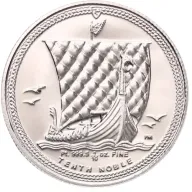
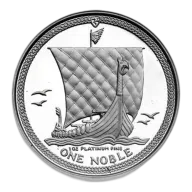
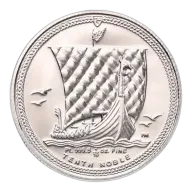
The reverse features a Viking longship with four birds and the Isle of Man's triskelion (three-legged coat of arms), surrounded by elaborate Viking knotwork. The design reflects the Isle of Man's Norse heritage from the centuries of Viking rule that shaped the island's culture and governance.
Noble Platinum Denominations and Dimensions
| Size | Weight | Diameter | Thickness | Purity |
|---|---|---|---|---|
| 1 oz | 31.10 g | 32.7 mm | 2.38 mm | 999.5 |
| 1/2 oz | 15.55 g | 25.1 mm | - | 999.5 |
| 1/4 oz | 7.78 g | 22.0 mm | - | 999.5 |
| 1/10 oz | 3.11 g | 17.0 mm | - | 999.5 |
| 1/20 oz | 1.56 g | 14.0 mm | - | 999.5 |
Rare proof editions also exist in 5 oz (mintage: 26 pieces, 1986) and 10 oz (mintage: 15 pieces, 1988) sizes. These are among the rarest modern platinum coins in existence.
Gold Nobles are struck in 999.9 fine gold, and silver Nobles in 999 fine silver. Gold and silver variants were introduced from 1994 onwards and continued sporadically through 2018. A single palladium Noble (1 oz) was issued in 2012.
Notable Mintages
The 1985 bullion platinum Noble had a mintage of 99,000 coins, making it the most common date. Earlier and later years are scarcer. The total platinum processed through the Noble programme contributed to the broader Perth Mint and Isle of Man precious metals ecosystem.
Security and Design
In 1996, Pobjoy Mint produced what it claimed was the world's first holographic coin, a Noble featuring a holographic sail on the Viking ship. Bimetallic editions were also produced: a 1995 gold ring with platinum centre and a 2009 silver ring with gold centre. Beyond these special issues, the Noble does not carry modern anti-counterfeiting features such as micro-engraving, laser marks, or digital authentication.
Noble Platinum Tax Treatment
The Noble's tax position is unusual because the Isle of Man is a Crown Dependency of the British Crown, not part of the United Kingdom. This creates specific complexities for UK buyers.
United Kingdom
Platinum Nobles attract 20% VAT on import and purchase, the same as all non-gold platinum bullion in the UK. The critical question is CGT. Noble coins are not Royal Mint legal tender and do not carry a sterling face value, so they are not automatically CGT-exempt in the UK. Some dealers have listed certain Isle of Man gold coins as CGT-exempt when they meet specific criteria, but this should be verified with a tax adviser on a case-by-case basis. For straightforward CGT exemption on platinum, the Platinum Britannia is the established choice.
United States
Platinum Nobles at 999.5 fineness are IRA-eligible under the standard purity provision (platinum must be 99.95% or higher). Gold Nobles at 999.9 also qualify. Capital gains are taxed as collectibles at up to 28% federal rate.
Isle of Man
The Isle of Man has no capital gains tax. The Noble is legal tender at metal value on the island. For residents of the Isle of Man, there is no tax on gains from selling Nobles.
Other Jurisdictions
- European Union: Gold Nobles qualify for the EU investment gold VAT exemption (purity above 900, post-1800 legal tender). Platinum Nobles are subject to standard VAT rates.
- Australia: Platinum at 99% purity or higher is GST-free. CGT applies with 50% discount for holdings over 12 months.
- Canada: GST/HST-exempt at 99.5% purity. Standard capital gains inclusion rate.
- Singapore: IPM GST-exempt for qualifying platinum. No CGT.
- Hong Kong: No sales tax, no import duty, no CGT.
The Coin That Started Platinum Bullion Investment
Before 1983, no sovereign or semi-sovereign entity had struck platinum specifically for retail investors. Small platinum bars existed from Japanese dealer Tanaka Kogyo (dating to the late 1970s), and platinum was well established as an industrial metal, but the concept of a platinum bullion coin was untested. The Isle of Man Government and Pobjoy Mint changed this with the Noble's launch in November 1983.
The name references the medieval Noble, a 14th-century English gold coin first struck under Edward III. Pobjoy Mint, a family-owned private mint founded in 1965 and based in Surrey, England, had a long relationship with the Isle of Man for commemorative coinage and saw an opportunity in platinum. The Isle of Man's independent coinage authority (it is not part of the UK's monetary system) gave it the flexibility to issue legal tender in platinum, something larger nations had not yet attempted.
The platinum production run lasted six years, from 1983 to 1989. By 1988, two major national mints had entered the platinum market: the Perth Mint with the Koala and the Royal Canadian Mint with the Platinum Maple Leaf. The Noble had proved the concept, and the larger mints had the production capacity and distribution networks to scale it. When the American Platinum Eagle launched in 1997, the mainstream platinum bullion market was firmly established on foundations the Noble had laid.
Gold Noble production began in 1994 with 999.9 purity, and silver followed in 999 fineness. These variants continued sporadically through 2018 across three different minting facilities: Pobjoy Mint (to 2016), Coin Investment Trust (2017), and Tower Mint (2018). The shift between mints was driven by changes in the minting contract rather than by design evolution. Since 2018, there has been no regular Noble production, leaving the series in an apparently dormant state.
The Noble vs Modern Sovereign Platinum Coins
The Noble's position in the platinum market is fundamentally different from its competitors. It is a historical piece with finite supply rather than an actively minted bullion coin competing on price and availability. This shapes the comparison in practical terms.
The Platinum Maple Leaf (1988) appeared five years after the Noble, carries the same 999.5 purity, and is continuously produced with global distribution. It has Bullion DNA digital authentication, competitive dealer premiums, and deep liquidity at major bullion retailers worldwide. For a buyer seeking to accumulate platinum at the lowest cost per ounce, the Maple Leaf is the more practical choice by every metric except historical significance.
The American Platinum Eagle (1997) has the deepest secondary market in North America and carries explicit Congressional authorisation for IRA inclusion. It arrived 14 years after the Noble and benefits from US Mint production capacity and dealer network effects. The Platinum Koala (1988) was the first platinum coin from a major national mint, debuting in the same year as the Maple Leaf. Its production ceased in 2000, making it another closed set with collector value.
The Platinum Britannia (2018) offers the UK CGT exemption that the Noble cannot clearly claim. For UK buyers who want tax-efficient platinum, the Britannia is the straightforward choice, and its four-feature security suite is more advanced than anything on the Noble.
The Noble's value proposition rests on its pioneer status. It was the coin that proved platinum could work as a retail investment metal, and the 1983-1989 platinum production window means no more will be made. The 5 oz and 10 oz proof editions (26 and 15 pieces respectively) are among the rarest modern platinum coins in the world. For collectors of platinum history, the Noble is irreplaceable. For buyers focused on bullion accumulation, the actively minted sovereign coins offer better value and liquidity.
Noble Platinum: frequently asked questions
-
Noble coins are priced off the live metal spot. With $1,806.00 as today's reference, 5 dealers are currently listing Nobles on BullionFerret across 7 products. Prices vary by weight (from 1/20 oz to 1 oz) and year of issue, so compare listings to find the keenest premium for the size you want.
-
The Noble is an Isle of Man bullion coin series launched in November 1983 by Pobjoy Mint. The platinum Noble was the world's first platinum coin struck specifically for investors. Gold and silver versions followed from 1994. Production was irregular rather than annual, with the series running until 2018 across three minting houses (Pobjoy Mint, Coin Investment Trust, and Tower Mint). The reverse depicts a Viking longship reflecting the Isle of Man's Norse heritage.
-
Platinum Nobles were issued in five fractional sizes: 1 oz, 1/2 oz, 1/4 oz, 1/10 oz, and 1/20 oz, all at .9995 purity. Rare 5 oz and 10 oz platinum proof editions were also struck in very small quantities. Gold Nobles (.9999 fine) were produced in select denominations from 1994 onwards. All carry a "Noble" denomination with no fixed face value, floating at metal content.
-
Platinum is produced in far smaller quantities than gold each year. However, rarity alone does not determine price; industrial demand (particularly from the automotive sector) and investment flows both influence the platinum market, which can make platinum trade below gold despite its lower annual supply.
-
Yes. The Noble series spans both metals. The platinum Noble (1983-1989) was the first platinum bullion coin issued for investors anywhere in the world. Gold Nobles (.9999 fine) were introduced in 1994 and continued sporadically through 2018. BullionFerret tracks Noble listings under both /platinum/noble and /gold/noble, so you can compare available stock across both metals in one place.