4 products · 23 deals
Filters




Prices are fetched automatically and may not reflect current merchant prices. Currency conversions and tax treatment are approximate. Rankings are based solely on price. We are not a dealer and accept no responsibility for transactions with listed merchants. Past performance is not indicative of future results. This site does not provide investment advice. Full disclaimer
About the Maple Leaf Platinum
The Platinum Maple Leaf: One of the Longest-Running Platinum Coins
The Platinum Maple Leaf has been in continuous production since 1988, making it one of the oldest platinum bullion coins in the world. Only the Isle of Man Noble (1983-1989) and the Perth Mint's Platinum Koala (1988-2000) have comparable or earlier start dates, and neither is still in production. The Maple Leaf is produced by the Royal Canadian Mint, a Crown corporation that also refines its own gold from raw ore to finished product, and it carries Canadian dollar face values as legal tender of Canada.
The coin is struck in 999.5 fineness (99.95% pure platinum), the universal standard for platinum bullion. This purity is consistent across the entire Maple Leaf range, which spans gold (999.9), silver (999.9), platinum (999.5), and palladium (999.5). The platinum version was originally available in 1 oz, 1/2 oz, 1/4 oz, and 1/10 oz sizes. Fractional sizes were discontinued from 2002 to 2008 due to rising platinum prices before being partially reintroduced.
The Maple Leaf's primary advantages in the platinum market are its longevity, competitive pricing, and the Royal Canadian Mint's Bullion DNA anti-counterfeiting technology. Bullion DNA provides individual coin-level authentication through micro-engraved laser marks that are recorded in an encrypted database and verified via dedicated reader devices at participating dealers. No other platinum coin offers this level of individual verification. The Maple Leaf consistently trades at competitive premiums relative to the American Platinum Eagle or Platinum Britannia, making it an efficient choice for buyers focused on acquiring the most platinum per dollar spent.
Canada's GST/HST exemption for platinum at 99.5% purity or higher makes domestic purchases tax-free, one of the more favourable purchase tax positions globally. For US buyers, the Maple Leaf is IRA-eligible and widely available through major dealers, providing a strong alternative to the domestically produced Platinum Eagle.
Platinum Maple Leaf Denominations and Dimensions
| Size | Weight | Diameter | Thickness | Face Value (CAD) |
|---|---|---|---|---|
| 1 oz | 31.11 g | 30.0 mm | 2.87 mm | $50 |
| 1/2 oz | 15.55 g | 25.0 mm | 2.23 mm | $20 |
| 1/4 oz | 7.78 g | 20.0 mm | 1.78 mm | $10 |
| 1/10 oz | 3.11 g | 16.0 mm | 1.13 mm | $5 |
Edge type is reeded on all sizes. The purity is 999.5 (99.95% fine platinum), matching every other major sovereign platinum coin. Fractional sizes (1/2 oz, 1/4 oz, 1/10 oz) were available from 1988 to 2001, discontinued when platinum prices rose, and selectively reintroduced from 2009. The 1/20 oz and 1/15 oz have been issued at various points as well. Not all fractional sizes are produced consistently each year.
Security Features
The Platinum Maple Leaf benefits from the same security technologies applied to the gold and silver versions:
- Micro-engraved laser mark: A textured maple leaf privy mark and the last two digits of the production year, laser-engraved on each die. Visible only under magnification.
- Radial lines (from 2015): Precisely machined lines across both surfaces creating a light-diffracting pattern unique to each coin and extremely difficult to replicate.
- Bullion DNA: The Royal Canadian Mint captures a high-resolution image of each die's micro-engraved mark, encrypts it, and stores it in a secure database. Participating dealers use a dedicated reader to verify individual coins against the database for instant authenticity confirmation.
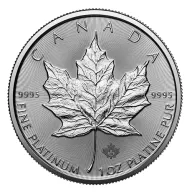
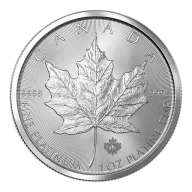
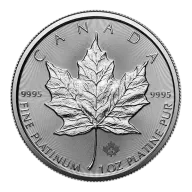
The reverse features the iconic sugar maple leaf design, which has remained essentially unchanged since 1979 (when the gold version launched). Minor refinements have occurred, but the fundamental image is the same. The obverse carries the portrait of the reigning monarch: Queen Elizabeth II (various portraits through 2023) and King Charles III (2024 onward, by Steven Rosati).
Platinum Maple Leaf Tax Treatment by Country
Canada
Platinum bullion at 99.5% purity or higher is GST/HST-exempt when in bar, ingot, coin, or wafer form. The Platinum Maple Leaf's 999.5 fineness qualifies. This exemption is federal and applies uniformly across all provinces, with no provincial variation. Capital gains are taxed at the 50% inclusion rate (50% of the gain is added to taxable income and taxed at the individual's marginal rate). Physical platinum is not eligible for RRSP or TFSA accounts; only mining stocks and precious metal ETFs qualify for these registered accounts.
United States
The Platinum Maple Leaf is IRA-eligible. It meets the IRS purity requirement for platinum (99.95% or higher) under Section 408(m). Must be held by an IRS-approved custodian; home storage is not permitted. Capital gains on platinum are taxed as collectibles at a maximum 28% federal rate for long-term holdings. Short-term gains (held less than one year) are taxed as ordinary income. Most states exempt investment platinum from sales tax.
United Kingdom
Platinum Maple Leafs attract 20% VAT on import and purchase. The coin is not UK legal tender, so it is also subject to CGT on disposal (unlike the Platinum Britannia, which is CGT-exempt). For UK buyers, the combination of 20% VAT on purchase and potential CGT on sale makes platinum an expensive proposition. VAT-free vault storage is available from some dealers as a mitigation.
Australia
Platinum at 99% purity or higher is GST-free as investment-grade precious metal. The 999.5 fineness qualifies. CGT applies on disposal with a 50% discount for holdings over 12 months.
Other Jurisdictions
- New Zealand: GST-exempt at 99% purity. No CGT.
- Singapore: IPM GST-exempt for platinum at 99% or higher. No CGT.
- Hong Kong: No sales tax, no import duty, no CGT.
- South Africa: 15% VAT on platinum. No legal tender coin exemption.
- European Union: Subject to standard VAT rates (17-27%). No investment platinum directive. Some dealers apply margin scheme on secondary-market coins.
Platinum Maple Leaf vs Eagle, Britannia, Kangaroo, and Philharmonic
The Platinum Maple Leaf's strongest competitive advantage is the combination of Bullion DNA authentication, competitive pricing, and a production history that stretches back to 1988. Against the American Platinum Eagle (1997), the Maple Leaf typically trades at lower premiums while offering superior anti-counterfeiting technology. The Eagle has a deeper secondary market in the United States and benefits from a specific Congressional exemption for IRA eligibility, though the Maple Leaf qualifies under the standard purity provision anyway. For US buyers, the choice between the two often comes down to whether marginally lower premiums (Maple Leaf) or maximum domestic liquidity (Eagle) is the priority.
The Platinum Britannia (2018) carries one advantage that no other platinum coin can match: CGT exemption for UK residents due to its legal tender status. For UK buyers, this makes the Britannia the default choice despite its higher premiums and shorter track record. The Maple Leaf's Bullion DNA technology is more sophisticated than the Britannia's four-feature visual security suite, but in practice both are highly resistant to counterfeiting.
The Platinum Kangaroo (2018) offers annual design changes and strong Asia-Pacific distribution. It carries slightly higher premiums than the Maple Leaf in most markets. The Platinum Philharmonic (2016) tends to trade at competitive premiums in European markets and has particularly strong distribution in Germany, Austria, and Japan.
The Maple Leaf's fixed design is sometimes cited as a drawback compared to coins with annual design variation (Kangaroo, Kookaburra). For pure bullion buyers, the static design is irrelevant; for those who value collectibility alongside their investment, the annually changing alternatives hold more appeal. The Maple Leaf's 999.9 gold purity is the highest among major gold coins, but in platinum all competitors match it at 999.5, so purity is not a differentiator.