5 products · 54 deals
Filters





Prices are fetched automatically and may not reflect current merchant prices. Currency conversions and tax treatment are approximate. Rankings are based solely on price. We are not a dealer and accept no responsibility for transactions with listed merchants. Past performance is not indicative of future results. This site does not provide investment advice. Full disclaimer
About the American Platinum Eagle Platinum
American Platinum Eagle: The US Mint's Statutory IRA-Eligible Platinum Coin
The American Platinum Eagle is the only platinum coin in the world with explicit, statutory IRA eligibility written into US tax law. Authorized by Congress and first issued in 1997, it is named specifically in 26 USC 408(m)(3)(A)(iv), removing any ambiguity about its qualification for self-directed precious metals retirement accounts. For US investors who want platinum in an IRA, the Eagle is the default choice with the clearest legal standing.
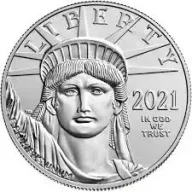
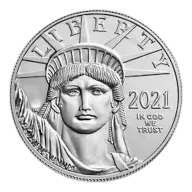
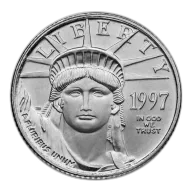
Struck in 99.95% pure platinum (999.5 fine) by the US Mint at West Point, the 1 oz Eagle carries a $100 face value, the highest denomination ever to appear on a US coin. It is legal tender "for all debts public and private," though its metal value far exceeds its face amount. The obverse features John Mercanti's "Liberty Looking to the Future," a close-up portrait of the Statue of Liberty, unchanged since the 1997 debut. The bullion reverse, Thomas D. Rogers Sr.'s "Eagle Soaring Over America," has likewise remained fixed on all bullion strikes.
The Eagle's production history has been irregular. Four denominations (1 oz, 1/2 oz, 1/4 oz, 1/10 oz) were produced from 1997 to 2008. Bullion production was suspended entirely from 2009 to 2013 due to insufficient platinum blanks and declining demand during a period of high platinum prices. After resuming in 2014 with the 1 oz size only, production was again suspended in 2015 before continuing from 2016 onward. The fractional sizes have not returned since 2008. This intermittent production has created low-mintage years (some under 10,000 coins) that trade at significant premiums.
Platinum bullion carries structurally higher premiums and wider buy-sell spreads than gold, reflecting platinum's higher melting point (1,768°C vs gold's 1,064°C), more expensive refining and fabrication, and a thinner retail market. The Eagle's premiums are in line with other sovereign platinum coins such as the Platinum Philharmonic and Canadian Platinum Maple Leaf.
American Platinum Eagle Denominations
| Denomination | Face Value | Weight (troy oz) | Weight (g) | Diameter | Thickness |
|---|---|---|---|---|---|
| 1 oz | $100 | 1.0005 | 31.12 | 32.7mm | 2.39mm |
| 1/2 oz | $50 | 0.5003 | 15.56 | 27.0mm | 1.75mm |
| 1/4 oz | $25 | 0.2501 | 7.78 | 22.0mm | 1.32mm |
| 1/10 oz | $10 | 0.1001 | 3.11 | 16.5mm | 0.95mm |
All denominations are 99.95% pure platinum (999.5 fine) with reeded edges. The fractional sizes (1/2, 1/4, 1/10 oz) were discontinued after 2008 for both bullion and proof formats. Only the 1 oz denomination is currently produced.
Platinum is denser than gold (21.45 g/cm3 vs 19.32 g/cm3), so the 1 oz Platinum Eagle is noticeably smaller than a 1 oz Gold Eagle despite containing the same troy weight. This compactness is a minor storage advantage.
Proof versions of the Platinum Eagle are unique among US bullion programmes: they are the only US bullion coins with annually changing reverse designs. These proof series have included "Vistas of Liberty" (1998-2002), "Foundations of Democracy" (2006-2008), "Preamble to the Constitution" (2009-2014), "Torches of Liberty" (2015-2016), "Preamble to the Declaration of Independence" (2018-2020), and "First Amendment" (2021-2025). The 2018-2020 proofs were the first US bullion coins to feature varying obverse designs as well.
American Platinum Eagle Tax Treatment
- United States (IRA): Explicitly IRA-eligible under 26 USC 408(m)(3)(A)(iv), referencing platinum coins described in 31 USC 5112(k). This is direct statutory authorization, not an interpretation of general purity rules. The Eagle is one of very few platinum products qualifying for US retirement accounts with no ambiguity. Must be held by an approved custodian, not personally. Both Traditional IRA (tax-deferred growth) and Roth IRA (tax-free withdrawals) structures are available.
- United States (Capital Gains): Outside an IRA, platinum coins are classified as collectibles. Long-term capital gains (held over one year) are taxed at a maximum 28% federal rate, the same collectibles rate that applies to gold and silver. Short-term gains are taxed as ordinary income.
- United States (Reporting): Dealers must file Form 1099-B for sales of 25 or more American Platinum Eagles in a single transaction.
- United States (Sales Tax): State-dependent. Most states that exempt precious metals bullion include platinum. The $100 face value as legal tender may also provide exemption in states that exempt legal tender coins specifically.
- United Kingdom: Platinum coins are subject to 20% VAT in the UK. Unlike gold bullion, platinum does not receive a VAT exemption. Subject to CGT on profits. The Platinum Britannia, as UK legal tender, is CGT-exempt, but the American Platinum Eagle is not.
- European Union: Platinum is not VAT-exempt (the investment gold exemption does not extend to platinum). Subject to local VAT rates of 17-27%.
- Canada: Platinum bullion at 99.5% purity or above is GST/HST-exempt. The Eagle at 999.5 fine qualifies.
- Australia: Platinum at 99% purity or above in investment form is GST-free. The Eagle qualifies.
- New Zealand: Platinum at 99% purity or above is GST-exempt. No formal capital gains tax.
- Singapore: Platinum bars and coins at 99% purity or above from LPPM-accredited sources qualify as Investment Precious Metals (GST-exempt). No capital gains tax.
- Hong Kong: No sales tax, import duty, or capital gains tax on platinum bullion.
America's First Platinum Coin
The American Platinum Eagle programme originated in 1995 when US Mint Director Philip N. Diehl, ANA President David L. Ganz, and Platinum Guild International Executive Director Jacques Luben began working to create the first US platinum coin. President Bill Clinton signed the authorizing legislation on 30 September 1996, and the first coins were issued in 1997.
The launch made the Platinum Eagle the first platinum coin ever produced by the United States Mint, though it entered a market where the Canadian Platinum Maple Leaf (1988) and the now-discontinued Isle of Man Noble (1983-1989) had already established the category. The early years saw strong uptake: 1998 produced 133,002 bullion 1 oz coins, the series peak. After 2000, mintages fell sharply. The 2003 through 2007 period saw annual 1 oz bullion production between 6,000 and 8,007 coins, making these among the lowest-mintage bullion products the US Mint has ever issued.
The 2009-2013 production suspension, the longest interruption of any active US Mint bullion programme, coincided with historically high platinum prices and constrained blank supply. When production resumed in 2014, only the 1 oz denomination returned. The fractional sizes have not been produced for bullion or proof since 2008. The 2015 vintage was also skipped for bullion, making the series erratic compared to the continuous production of Gold and Silver Eagles.
Low-mintage proof issues are particularly notable. The 2008-W Burnished $50 Platinum Eagle had a mintage of just 2,253 pieces, the lowest in the entire series. The 2015-W Proof $100 saw 3,886 pieces, and the 2025-W Proof holds the current record low at 3,645 pieces. These small proof runs, combined with the annually changing proof reverse designs, have created a dedicated collector market alongside the bullion programme.
A notable legal footnote: in 2009, Robert Kahre was convicted of tax fraud for paying employees in gold and platinum bullion coins at face value ($100 Platinum Eagles) to reduce reported income. He argued wages should be reported at face value. The courts rejected this, establishing that bullion coins must be reported at fair market value for tax purposes.
Platinum Eagle vs Platinum Maple Leaf, Britannia, and Philharmonic
The Canadian Platinum Maple Leaf, in production since 1988, is the Eagle's longest-standing competitor. Both are government-issued, high-purity platinum coins at 999.5 fine. The Maple Leaf carries a $50 CAD face value and is often among the most competitively priced sovereign platinum coins. Both are IRA-eligible for US investors (the Maple Leaf qualifies under the general purity rules). The Maple Leaf has been in production for nine years longer than the Eagle and has not experienced the same multi-year production gaps, giving it more consistent availability. The Eagle's advantage is its explicit statutory IRA eligibility and its larger US dealer network.
The Platinum Britannia, introduced in 2018 by the Royal Mint, is a recent entrant. At 999.5 fine with a £100 face value, it carries a decisive advantage for UK investors: CGT exemption as UK legal tender. The American Platinum Eagle receives no CGT exemption in the UK and also attracts 20% VAT (as does the Britannia, since platinum is not VAT-exempt). For UK buyers, the Britannia is the clearly superior platinum coin. For US investors with no UK tax exposure, the distinction is less relevant.
The Austrian Platinum Philharmonic, introduced in 2016, uses the same orchestral design as the gold and silver versions. At 999.5 fine with a EUR 100 face value, it competes primarily in European markets. The Eagle has better distribution in the US; the Philharmonic is more accessible through European dealers. Both carry similar premiums in their respective home markets.
The Perth Mint's Platinum Kangaroo (2018 for bullion) rounds out the major sovereign options. At 999.5 fine and A$100 face value, it serves the Australian and Asia-Pacific markets where the Perth Mint has established distribution. For Australian investors, the Kangaroo is GST-free (platinum at 99% purity or above qualifies in Australia).
Across all these competitors, premiums converge in a relatively narrow band for 1 oz platinum coins: roughly 5-12% over spot. The premium gap between coins and bars is smaller for platinum than for gold or silver, meaning the liquidity and authentication benefits of sovereign coins come at a modest incremental cost.
American Platinum Eagle Platinum: frequently asked questions
-
Dealer prices track the live platinum spot ($1,806.00) plus a premium that reflects the coin's collector demand and relatively low mintage. BullionFerret compares 57 listings from 18 dealers, so you can see the full spread of current offers and find the most competitive price for your preferred year and finish.
-
The American Platinum Eagle is the official platinum bullion coin of the United States, first issued by the US Mint in 1997. The 1 oz coin is struck in .9995 fine platinum and carries a $100 face value, making it legal tender. Bullion editions carry a fixed reverse design; proof versions feature a new reverse design each year, making them an ongoing collector series as well as a bullion product.
-
Several factors push premiums above generic platinum bars. The US Mint charges a production premium, mintages have been low in many years (especially for proofs and during periods of suspended production), and the annually changing proof designs sustain strong collector demand. Generic platinum bars, by contrast, carry minimal fabrication premiums above spot because they are produced in large volumes with no collector component.
-
Yes. The 1 oz bullion coin carries a $100 USD face value, which is the highest denomination ever to appear on a US coin. Fractional sizes (1/2 oz, 1/4 oz, 1/10 oz) carry $50, $25, and $10 denominations respectively, though those sizes were discontinued after 2008. The face value is nominal; the coin's platinum content is worth substantially more.
-
Platinum and gold prices have traded both above and below each other over the decades. Historically platinum was the higher-priced metal, but gold has exceeded platinum for an extended period in recent years. The ratio depends on industrial demand (especially from the automotive sector), mining supply (concentrated in South Africa), and broader investor flows. Neither metal has a permanent premium over the other.