1 listing
Filters
| Product | /oz | Premium | Price | |
|---|---|---|---|---|

 IDC Coin and Bullion
|
$1,962.16 | +8.65% | $1,962.16 | View Deal |
Prices are fetched automatically and may not reflect current merchant prices. Currency conversions and tax treatment are approximate. Rankings are based solely on price. We are not a dealer and accept no responsibility for transactions with listed merchants. Past performance is not indicative of future results. This site does not provide investment advice. Full disclaimer
About the 1 oz Big Five Platinum Coin
South Africa's Wildlife Series in Platinum
The 1 oz Big Five Platinum Coin is produced by the South African Mint, a subsidiary of the South African Reserve Bank. The Big Five programme, announced at the World Money Fair in Berlin in February 2019, features Africa's five iconic large animals: elephant, lion, rhinoceros, leopard, and Cape buffalo. A new design is released approximately every six months, and the series has expanded across three cycles, each revisiting all five animals with fresh artistic interpretations.
At 999.5 fine platinum, the coin carries a 50 Rand face value and is struck as a proof, with mirror-like fields and frosted raised elements. The platinum version has an extremely limited mintage of 500 per design, placing it firmly in numismatic territory rather than as a pure bullion product. This scarcity commands premiums well above the platinum spot price.
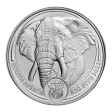
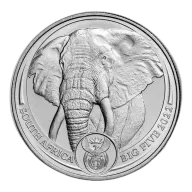
The design concept is distinctive in modern coinage. The obverse features a bisected animal portrait, with each half placed at opposite edges of the coin. When two coins are aligned side by side, the complete portrait emerges. This "herd effect" extends across multiple coins, creating a visual that no other major mint series replicates. Series III, beginning in 2024, incorporates a Cape honey bee micro-engraving as both an ecological symbol and an anti-counterfeiting feature.
South Africa produces 72% of the world's platinum mine supply, making this a product from the dominant producer nation. The country does not mint a platinum Krugerrand, so the Big Five occupies the space that the Gold Krugerrand fills in gold: South Africa's primary platinum coin offering, though positioned for collectors rather than bulk investment.
Big Five Platinum Coin Specifications
| Attribute | Value |
|---|---|
| Metal | 999.5 fine platinum |
| Weight | 1 troy ounce (31.107 g) |
| Face value | 50 Rand (R50) |
| Finish | Proof |
| Mintage | 500 per design |
| Manufacturer | South African Mint |
| Issuing authority | South African Reserve Bank |
Series Timeline
| Series | Years | Animals |
|---|---|---|
| Series I | 2019-2021 | Elephant, Lion, Rhinoceros, Leopard, Cape Buffalo |
| Series II | 2021-2023 | Elephant, Lion, Black Rhino, Leopard, Buffalo |
| Series III | 2024-2026 | Elephant, Lion (released); Rhinoceros, Leopard, Buffalo (expected) |
All coins feature the South African coat of arms on the reverse with "South Africa" inscription. The obverse uses a distinctive split-portrait concept where the animal face is bisected, with each half placed at opposite edges of the coin. When two coins are positioned side by side, the complete portrait emerges, creating a visual effect the South African Mint calls the "herd effect" that extends across multiple coins in the collection.
The 500-coin mintage for the platinum version is significantly lower than the silver BU versions (10,000-15,000 per design) and comparable to the gold proof (also 500 per design). Series III coins, beginning with the 2024 Elephant, incorporate a Cape honey bee micro-engraving as both an ecological conservation symbol and an additional anti-counterfeiting feature. A certificate of authenticity accompanies each proof coin, and the pieces ship in protective packaging designed to preserve the mirror-like proof finish with frosted raised elements.
Tax Position of the Big Five Platinum Coin
Platinum carries a heavier tax burden than gold in most jurisdictions. The Big Five's South African origin and legal tender status affect its treatment differently across markets.
South Africa
Platinum bullion is subject to 15% VAT. South Africa does not extend the gold Krugerrand's VAT zero-rating to platinum products. The Big Five's legal tender status does not confer a VAT advantage. CGT applies on disposal at a 40% inclusion rate for individuals.
United Kingdom
Platinum coins attract 20% VAT on purchase. The Big Five is not UK legal tender, so it is not CGT-exempt. Both taxes apply on entry and exit respectively. The annual CGT allowance (currently £3,000) may shelter small gains.
United States
The 999.5 purity meets the IRS threshold for precious metals IRA eligibility. Most states exempt investment-grade platinum from sales tax. Capital gains are taxed at the 28% collectibles rate. The Big Five is available from major US dealers including APMEX and JM Bullion.
European Union
Platinum coins are subject to standard VAT rates across the EU (19-27% depending on country). No investment platinum exemption exists equivalent to the EU Investment Gold Directive. The Big Five has a following in German-speaking markets through European dealers.
Canada
Platinum at 99.5% or above is GST/HST-exempt. Capital gains at the 50% inclusion rate.
Australia
GST-free at 99% or above for investment-grade platinum. Capital gains tax with 50% discount for holdings over 12 months.
Hong Kong and Singapore
No sales tax and no capital gains tax in either jurisdiction, making both among the most favourable markets for platinum purchases.
Big Five Platinum vs Other Platinum Coins
The Big Five Platinum Coin straddles the line between bullion and numismatics, and comparing it to pure bullion products requires acknowledging that distinction. With a mintage of 500 per design, it is produced at a fraction of the volume of coins like the 1 oz Platinum Britannia or the 1 oz American Platinum Eagle, and its premiums reflect that scarcity.
For buyers looking to acquire platinum at the lowest cost per ounce, sovereign bullion coins are the straightforward choice. The Britannia, Eagle, Platinum Kangaroo, and Platinum Maple Leaf all trade at premiums in the 8-15% range over spot, with deeper resale markets. The Big Five's proof finish and limited mintage push its premium substantially higher.
Against the Gold Krugerrand, South Africa's flagship bullion coin, the comparison highlights purpose. The Krugerrand is 22 karat gold alloy with essentially unlimited mintage, designed for cost-efficient gold accumulation. The Big Five is 999.5 fine platinum in a proof strike with 500-coin production runs. They serve entirely different buyers despite sharing a national origin.
The Big Five's split-portrait design is genuinely unique in modern coinage, and the three-series structure (each revisiting all five animals) follows the Perth Mint Lunar model of building collector engagement across multiple cycles. For buyers who value the combination of African wildlife artistry, low-mintage exclusivity, and platinum exposure, the Big Five fills a niche that generic bullion coins do not attempt. The trade-off is higher cost, wider resale spreads, and the need to find specialist buyers or dealers who appreciate the numismatic premium.
1 oz Big Five Platinum Coin: frequently asked questions
-
The cheapest 1oz Big Five platinum coin tracked on this page is $1,962.16 at IDC Coin and Bullion, carrying a premium of 8.6% over the $1,806.00 platinum spot price. Prices update as dealers reprice and display in your local currency.
-
The coin currently trades at around 8.6% over the $1,806.00 platinum spot price at IDC Coin and Bullion. Big Five platinum coins have a mintage of 500 per design, so premiums reflect both fabrication costs and collector demand rather than spot metal alone.
-
A 1 troy ounce platinum coin contains 1 oz of platinum (31.1035 g). Platinum is denser than gold, so a 1oz platinum coin is physically smaller than a 1oz gold coin of equivalent weight. The Big Five 1oz platinum coin is struck to 999.5 fine platinum and carries a 50 Rand face value as South African legal tender.
-
Annual platinum mine production is substantially lower than gold mine production, making platinum considerably scarcer by extraction volume. All platinum mining is concentrated in a small number of countries, with South Africa accounting for the large majority of global output.