1 listing
Filters
| Product | /oz | Premium | Price | |
|---|---|---|---|---|

 Indigo Precious Metals
Out of Stock
Indigo Precious Metals
Out of Stock
|
$2,052.83 | +14.04% |
$2,052.72
£1,538
|
View Deal |
Prices are fetched automatically and may not reflect current merchant prices. Currency conversions and tax treatment are approximate. Rankings are based solely on price. We are not a dealer and accept no responsibility for transactions with listed merchants. Past performance is not indicative of future results. This site does not provide investment advice. Full disclaimer
About the 1 oz Big 5 Platinum Coin
South Africa's Big 5 in Platinum
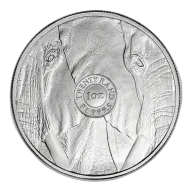
The 1 oz Big 5 Platinum Coin is part of the South African Mint's flagship wildlife series, which cycles through Africa's five most iconic animals: elephant, lion, rhinoceros, leopard, and buffalo. First announced at the World Money Fair in Berlin in February 2019, the Big 5 programme spans three distinct series released biannually, with Series III currently in production from 2024. The platinum version carries a 20 Rand face value and contains one troy ounce of .9995 fine platinum.
This coin sits at the intersection of bullion and numismatics. It is issued in proof finish with controlled mintages, giving it a collector dimension that pure bullion products like the 1 oz American Platinum Eagle lack. The signature design element across all three series is the "split face" concept: two halves of an animal's face shown side by side on the reverse. When placed together, coins from the same series create the visual impression of a herd, encouraging collectors to acquire the full five-coin set.
The South African Mint is a subsidiary of the South African Reserve Bank, giving these coins full sovereign backing. This is the same institution that produces the Krugerrand, though the Big 5 occupies a very different market position: .9999 gold (versus the Krugerrand's .9167), limited mintages, proof quality, and multi-metal availability. The platinum variant is the least common of the three metals offered.
For pure platinum investment without numismatic considerations, the American Eagle or Canadian Maple Leaf offer better liquidity and lower premiums. The Big 5 Platinum appeals to buyers who value the artistic design, limited production, and the thematic connection to African wildlife conservation. Its controlled mintage means the secondary market may price these above metal value as earlier series years become scarce.
Big 5 Platinum Coin Technical Details
| Attribute | Detail |
|---|---|
| Weight | 1 troy ounce (31.107 g) |
| Purity | .9995 fine platinum (99.95%) |
| Face Value | 20 Rand |
| Diameter | 32.69 mm |
| Finish | Proof |
| Issuing Authority | South African Mint (SARB subsidiary) |
| Legal Tender | Republic of South Africa |
The proof finish features mirror-field backgrounds with frosted relief elements, a standard technique for premium numismatic coins. Each coin ships in tamper-evident packaging with a certificate of authenticity from the South African Mint. The platinum version matches the gold coin's 32.69 mm diameter.
The Big 5 programme also includes 1 oz gold (.9999 fine, 50 Rand face value), 1 oz silver (.999 fine, 5 Rand face value), and from Series II onward, large-format 5 oz and 1 kg gold and silver coins. The 1 kg coins were described as Africa's first of that size produced by a continental mint. The platinum version has remained at 1 oz throughout all three series.
Big 5 Platinum Tax Considerations
The Big 5 Platinum Coin's tax treatment depends on the buyer's jurisdiction. As platinum, it does not benefit from the investment gold exemptions available in most countries.
- South Africa: Platinum bullion is subject to 15% VAT. The gold Krugerrand's zero-rating under s11(1)(k) does not extend to platinum products, including platinum from the same mint. CGT applies at a 40% inclusion rate for individuals.
- United Kingdom: Subject to 20% VAT on purchase as platinum bullion. The gold version would be VAT-exempt (legal tender of a recognised state, .999+ purity), but platinum does not qualify for this exemption. Not UK legal tender, so also subject to CGT on profits.
- United States: Sales tax varies by state; approximately 35 states exempt bullion. The .9995 purity meets IRA eligibility requirements, but the Big 5 is not universally listed on custodian approved lists. The series' proof/collectible positioning may complicate IRA classification. Capital gains at 28% collectibles rate.
- Canada: GST/HST exempt for platinum at 99.5% purity or above. The .9995 Big 5 exceeds this threshold.
- Australia: GST-free at 99% purity threshold for investment platinum. Subject to CGT with 50% discount for holdings over 12 months.
- EU: Gold Big 5 coins meeting EU Gold Directive criteria are VAT-exempt (legal tender, .900+ purity, post-1800). Platinum versions attract full local VAT (17-27%).
- Singapore: GST-exempt under IPM scheme for platinum at 99% purity from a legal tender source.
1 oz Big 5 Platinum Coin: frequently asked questions
-
The Big 5 is a coin program issued by the South African Mint, launched in 2019. It features Africa's five iconic large animals: elephant, lion, rhinoceros, leopard, and buffalo. The series is structured in multi-year sets (Series I, II, III), with each animal released in turn. The signature design element is a split-face portrait showing two halves of the animal's face on the coin's reverse; when coins from the same series are placed side by side, they form a visual herd effect.
-
South Africa is home to the Bushveld Igneous Complex, a geological formation that contains an extraordinary concentration of platinum-group metals. The country accounts for the large majority of global platinum mining output. This geological abundance is why the South African Mint, which produces the Krugerrand and the Big 5 series, has a natural connection to platinum coinage.
-
Platinum has a thinner secondary market than gold. Fewer dealers actively buy and sell platinum coins, and bid-ask spreads can be wider. Platinum's price is also driven partly by industrial demand (catalytic converters), which adds volatility unrelated to monetary investment trends. These factors can make platinum coins slower to liquidate compared with gold, though demand from serious collectors exists for limited series like the Big 5.