4 listings
Filters

 Elite Rare Coins



Prices are fetched automatically and may not reflect current merchant prices. Currency conversions and tax treatment are approximate. Rankings are based solely on price. We are not a dealer and accept no responsibility for transactions with listed merchants. Past performance is not indicative of future results. This site does not provide investment advice. Full disclaimer
About the 1 Kilo Baird & Co. Platinum Bar
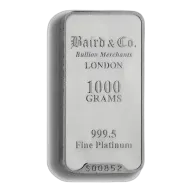
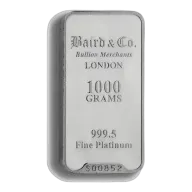
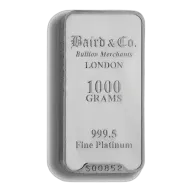
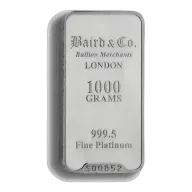
The 1 Kilo Baird & Co. Platinum Bar
The 1 Kilo Baird & Co. platinum bar is a large-format investment bar from the UK's only LBMA-accredited gold refinery. Containing 1,000 grams (32.15 troy ounces) of 999.5 fine platinum, it represents a substantial allocation to the metal and delivers among the lowest per-ounce premiums available in the retail platinum market. Baird & Co. produces this bar at its facility in Beckton, East London, making it the only kilo platinum bar refined and manufactured entirely on British soil by an LBMA member.
Baird & Co. was founded in 1967 by Tony Baird, who began as a numismatic coin dealer and expanded into refining in 1979. The company became an LBMA member in 2000 and has been an official Royal Mint Partner since 2016. The refinery's 30,000 sq ft high-security facility in Beckton was opened in 2008 and produces bars in gold, silver, platinum, and palladium. Baird also operates a branch in Singapore, established in 2013.
At the kilo weight, premium efficiency improves significantly compared to smaller sizes. Platinum kilo bars from LBMA-accredited refiners typically carry premiums of 3-6% above spot, compared to 5-10% for 1 oz bars and 20-40% for 1g bars. The tradeoff is liquidity: a kilo platinum bar is an all-or-nothing sale, and at current prices it represents a commitment of roughly $30,000-35,000. The secondary market for kilo platinum bars is thinner than for 1 oz products, and not all dealers maintain ready inventory at this size. Sellers may need to work with larger specialist dealers or the refiner directly.
For UK investors specifically, the Baird kilo bar carries additional relevance. It meets HMRC requirements for SIPP and SSAS pension schemes (which require minimum 99.5% purity from an accredited refiner), and Baird & Co. offers vault storage at its Beckton facility, insured by Lloyd's of London. Buying from a UK manufacturer with UK-based vaulting simplifies the custody chain for pension-held platinum.
1 Kilo Baird & Co. Platinum Bar Specifications
| Property | Detail |
|---|---|
| Manufacturer | Baird & Co. |
| Metal | Platinum |
| Weight | 1 kilogram (32.1507 troy oz) |
| Fineness | 999.5 (99.95% pure) |
| Type | Minted and cast versions available |
| Accreditation | LBMA |
| Serial number | Yes (unique) |
| Packaging | Assay card (minted); loose with certificate (cast) |
| Face value | None (not legal tender) |
| Country of origin | United Kingdom |
Baird produces the kilo bar in both minted and cast formats. Minted bars are precision-struck with a smooth, reflective finish and typically come sealed in assay cards. Cast bars are produced by pouring molten platinum into moulds, resulting in a rougher, more organic surface. Cast bars may carry slightly lower premiums due to lower manufacturing costs, but both types contain the same weight and purity of metal.
Platinum's density (21.45 g/cm³) means a kilo bar is compact relative to its value. A kilo of platinum occupies roughly 46.6 cm³, less than the volume of a standard pack of playing cards. This extreme density makes authentication simpler, as no common cheap metal can match platinum's weight-to-volume ratio. Tungsten (19.25 g/cm³), the most common counterfeit substitute for gold, would be detectably lighter in a correctly dimensioned platinum bar.
Tax Treatment of the 1 Kilo Baird & Co. Platinum Bar
The tax position of this bar varies significantly by country. Platinum bars do not receive the investment gold VAT exemption in the UK or EU, and no platinum bar carries legal tender status for CGT purposes.
Purchase Tax
- United Kingdom: 20% VAT applies on all platinum bullion. On a kilo bar worth roughly $30,000-35,000, this represents a VAT charge of $6,000-7,000 at delivery. Many UK buyers avoid this by using VAT-free vault storage, where the platinum remains in a bonded facility. Baird & Co. offers its own vault storage at Beckton, insured by Lloyd's of London, which allows buyers to hold platinum without triggering the VAT charge.
- United States: No federal sales tax. Most states exempt investment-grade precious metals. State-level variations apply.
- Canada: GST/HST exempt for platinum at 99.5%+ purity in bar form.
- Australia: GST-free for investment-grade platinum at 99%+ purity.
- New Zealand: GST-exempt at 99%+ purity. No capital gains tax.
- Singapore: GST-exempt as IPM. Baird has a physical branch in Singapore (established 2013), which may simplify purchasing for Singapore-based buyers.
- Hong Kong: No sales tax, no import duty, no CGT.
- EU: Standard VAT applies (17-27%). No platinum investment exemption.
- South Africa: 15% VAT on platinum bullion.
Capital Gains and Pensions
- UK: CGT at 18-24% on gains above the annual exempt amount. No legal tender exemption for bars. Platinum held within a SIPP or SSAS pension wrapper is not subject to CGT. Baird bars at 999.5 purity exceed the HMRC minimum (99.5%) for pension eligibility.
- US: Collectible rate, maximum 28% long-term. IRA-eligible at 99.95% purity from an LBMA-accredited refiner. This bar qualifies.
- Canada: 50% inclusion rate for capital gains. RRSP and TFSA eligible.
- Australia: CGT with 50% discount for holdings over 12 months.
1 Kilo Baird & Co. vs Other Kilo Platinum Bars
The kilo platinum bar market has fewer options than gold or silver at this weight, reflecting the smaller scale of the platinum investment market. The main branded alternatives are the 1 Kilo Valcambi platinum bar, the 1 Kilo PAMP Suisse platinum bar, and the 1 Kilo Fortuna platinum bar.
The Valcambi kilo bar is the most widely available at this weight, stocked by more dealers than any other brand. Valcambi's strength is competitive pricing: as the world's largest precious metals refinery by volume, its per-unit costs are low and its bars typically carry the most competitive premiums among branded products. For buyers focused on minimising the premium paid, Valcambi is the default choice.
The PAMP Suisse kilo bar and its Fortuna-branded variant carry higher premiums reflecting the PAMP brand, design, and CertiPAMP authentication packaging. At the kilo weight, the absolute premium difference between PAMP and Valcambi is larger than at smaller sizes (the percentage gap is similar but the dollar amount grows with bar value). Whether the PAMP premium is justified depends on the buyer's plans: for long-term vault storage where resale may happen internationally, the PAMP name carries recognition in markets (particularly Asia and the Middle East) where Baird is less known.
Baird's distinguishing feature is UK provenance. It is the only LBMA-accredited refinery based in the United Kingdom that produces platinum bars, and it offers integrated UK-based vault storage. For UK pension holders using a SIPP or SSAS, buying from a UK refiner with UK vaulting keeps the entire chain domestic. The Swiss alternatives (Valcambi, PAMP, Argor-Heraeus) offer equivalent metallurgical quality but require cross-border custody arrangements for UK-vaulted pension storage.
Compared to 1 oz platinum bars, the kilo format sacrifices flexibility for premium efficiency. Thirty-two individual 1 oz bars could be sold one at a time as needed; a single kilo bar cannot be divided. For buyers who may need to liquidate in smaller increments, the 1 oz format retains that option at a higher per-ounce cost.
1 Kilo Baird & Co. Platinum Bar: frequently asked questions
-
This bar is 999.5 fine platinum, which means 999.5 parts per thousand pure metal. That is investment-grade purity, higher than the 950 or 900 grades used in jewellery. The bar weighs 1,000 g and carries no face value; it is a cast bar produced by Baird & Co. in London.
-
Platinum and gold have historically traded at different relative levels depending on industrial and investment demand. Platinum's price is heavily influenced by the automotive sector, particularly diesel catalysts, while gold is driven more by investment flows and central-bank demand. The gap between the two has widened in recent years, with gold trading higher than platinum. The two metals are independently priced and the relationship can shift over time.
-
Baird & Co is a London-based precious metals refiner and dealer. The company produces cast and minted bars in gold, silver, platinum, and other metals. Each bar carries a stamp showing the weight, purity, and refiner's mark, which allows the metal content to be independently verified.
-
Platinum is one of the densest metals, with a density of around 21.45 g/cm³, nearly twice that of lead. A 1 Kilo platinum bar is therefore surprisingly compact given its mass. The combination of small size and substantial weight is a defining characteristic that makes platinum bars efficient to store and transport.