3 products · 9 deals Prices & premiums exclude tax to compare across countries
Filters



Prices are fetched automatically and may not reflect current merchant prices. Currency conversions and tax treatment are approximate. Rankings are based solely on price. We are not a dealer and accept no responsibility for transactions with listed merchants. Past performance is not indicative of future results. This site does not provide investment advice. Full disclaimer
About 50g Platinum Bars
50g Platinum Bars: The Metric Sweet Spot
The 50g platinum bar occupies a compelling position in the platinum weight range. At 1.6075 troy ounces of 999.5 fine platinum, it delivers meaningfully more metal than a standard 1oz platinum bar while keeping the capital outlay at a level accessible to individual investors rather than institutions. This in-between positioning makes it a natural accumulation unit for buyers who want premium efficiency without the commitment of a 100g bar or larger.
The premium economics favour 50g over smaller sizes. The transition from gram-weight bars (1g-10g, where premiums run 10-40%) to the 50g bracket represents the steepest improvement in premium efficiency across the platinum size range. At 50g, fixed manufacturing costs become a small fraction of the metal value, and premiums compress to levels comparable to 1oz bars. Since platinum's high melting point (1,768 degrees Celsius) makes fabrication inherently more expensive than gold, this premium compression matters more per percentage point.
The format is almost exclusively a metric-market product. European buyers (particularly in Germany, Switzerland, and Austria) treat 50g bars as a core accumulation weight, while North American buyers more naturally gravitate toward troy-ounce equivalents. The Middle Eastern market also embraces 50g bars, where they circulate as a traditional savings denomination through gold souks and bank counters.
Physically, a 50g platinum bar is remarkably compact. Platinum's density of 21.45 g/cm3 (higher than gold) means the bar is slightly smaller than a 50g gold bar. Typical dimensions are approximately 44mm x 24mm x 3.5mm for minted versions, roughly the size of a small USB drive. This portability, combined with platinum's resistance to tarnishing, makes 50g bars straightforward to store whether in a home safe, safety deposit box, or professional vault.
Premium Structure for 50g Platinum Bars
Premiums on 50g platinum bars typically fall in the 5-10% range over spot, representing a significant improvement over smaller gram-weight bars but still above the efficiency of larger formats. For context, 10g platinum bars carry premiums of 10-20%, while 100g bars compress to approximately 4-8%. The 50g bracket captures most of the available premium benefit without requiring double the capital of a 50g purchase.
The gap between 50g and 1oz (31.1g) is worth examining. In practice, the per-gram premium on a 50g bar is comparable to or slightly better than a 1oz bar, despite containing 60% more metal. This is unusual in the gold market (where 1oz bars are more liquid and sometimes cheaper per gram than 50g), but in platinum the thinner market and smaller production runs mean metric weights compete effectively with troy weights on pricing.
Brand premiums remain visible at 50g. A PAMP Suisse Fortuna will typically cost more than a Valcambi or Argor-Heraeus of the same weight and purity. Whether the PAMP premium is recovered at resale depends on the local dealer market; in markets where PAMP's VeriScan authentication and Lady Fortuna branding carry weight, the answer is typically yes.
Buy-sell spreads for 50g platinum bars are wider than for gold at the same weight. Round-trip costs (purchase premium plus resale discount) for branded 50g platinum bars typically run 10-15%, compared to 5-8% for gold. This wider spread is a function of platinum's thinner dealer market and reflects the reality that platinum bars spend longer in inventory before finding a buyer.
Major Refiners Producing 50g Platinum Bars
The 50g platinum bar market is served primarily by LPPM-accredited refiners from Switzerland, the UK, Australia, and Japan. All produce bars at 999.5 fineness; differentiation comes from brand recognition, packaging, authentication features, and geographic dealer support.
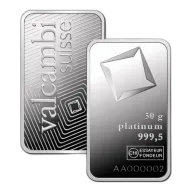
The 50g Valcambi Platinum Bar is the most widely available option in this category. Valcambi, based in Balerna, Switzerland, is the world's largest precious metals refinery by volume and offers competitive pricing. Their bars come sealed in tamper-evident assay cards with serial numbers and are accepted by dealers globally.
The 50g PAMP Suisse Fortuna Platinum Bar carries the Lady Fortuna motif and PAMP's VeriScan digital authentication. Each bar's microscopic surface topography is recorded at manufacture, allowing buyers to verify authenticity via smartphone app. PAMP commands the highest premiums but also achieves the strongest resale prices among minted bars.
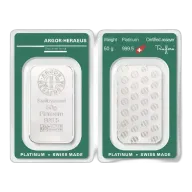
The 50g Argor-Heraeus Platinum Bar comes from the Heraeus Group subsidiary in Mendrisio, Switzerland. Argor-Heraeus bars sit in the middle tier for pricing, above Valcambi but below PAMP, and carry strong international recognition.
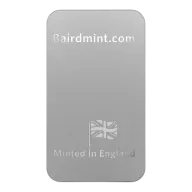
From the UK, the 50g Baird and Co. Platinum Bar is produced by Britain's largest refinery in East London. Baird has been an LBMA member since 2000 and produces both minted and cast formats. Their bars are a natural choice for UK buyers seeking a domestic product.
The 50g ABC Refinery Platinum Bar serves Australian investors. As the country's only independent LBMA-accredited refinery, ABC offers a domestic supply chain advantage and universal acceptance among Australian dealers.
Valcambi's 50g CombiBar Platinum Bar is a distinctive variant: a single 50g bar pre-scored into 50 individual 1g segments that can be snapped apart by hand. This divisible format suits buyers who want the premium efficiency of a 50g purchase with the option to liquidate in small increments.
The 50g Johnson Matthey Platinum Bar is a legacy product from the historic British refiner that sold its operations to Asahi Refining in 2015. JM bars remain in circulation on the secondary market and are recognised by dealers worldwide, though no new bars are being produced.
Resale and Storage for 50g Platinum
Liquidity for 50g platinum bars is good within the constraints of the platinum market generally. The platinum investment market is fundamentally smaller than gold or silver (702,000 ounces of total investment demand in 2024, versus thousands of tonnes for gold), and this limited pool of participants affects all platinum products regardless of size.
At 50g, the bar is large enough to justify dealer attention (unlike 1g-5g bars that some dealers consider uneconomical to transact) but small enough to find a broad buyer pool. Multiple dealers describe 50g as a "strong balance of liquidity and value" for platinum, where the per-unit economics justify the dealer's time while the capital requirement remains within individual buyer range.
Brand matters more for platinum resale than for gold. Because platinum's white colour is visually indistinguishable from several cheaper metals (silver, palladium, white gold, stainless steel) to the untrained eye, dealers rely heavily on packaging integrity and brand recognition for rapid authentication. Sealed bars in original assay cards from PAMP, Valcambi, Heraeus, or Argor-Heraeus can be bought and sold with minimal friction. A loose bar without documentation will typically require independent verification (XRF testing, sigma testing, or weighing against dimensions) before a dealer offers full buyback value.
Storage for a 50g platinum bar is trivial from a physical standpoint. The bar fits comfortably in a wallet, safety deposit box, or small home safe. Platinum does not tarnish or corrode under normal conditions, requires no capsules or anti-tarnish measures, and is harder than gold (Mohs 3.5 versus 2.5), making it resistant to surface damage. The minted versions in their assay cards store flat and stack efficiently. For vault storage, costs are assessed on insured value rather than physical dimensions, so the compact format provides no cost advantage over other metals of equivalent value.
50g Platinum Bars: frequently asked questions
-
A 50g platinum bar's melt value is the live spot price ($1,806.00 per troy ounce) divided by 31.1035 to get the per-gram rate, then multiplied by 50g. Dealer prices will sit above melt to cover refining and distribution costs. Compare listed prices across dealers to find the lowest premium.
-
The current platinum spot price is $1,806.00 per troy ounce. This is the raw metal price before dealer premiums; the price you pay for a 50g bar will be higher, reflecting fabrication, packaging, and the dealer's margin.
-
One troy ounce equals 31.1035 grams. A 50g platinum bar is therefore approximately 1.608 troy ounces. Troy ounces are the standard weight unit for precious metals and are used in all spot price quotations worldwide.
-
For much of the twentieth century platinum traded at a premium to gold, reflecting its greater rarity and industrial demand. The relationship has shifted over time, and platinum has in recent years traded below the gold price. The gap fluctuates with automotive demand (platinum is used in catalytic converters) and investor sentiment. Whether platinum currently sits below gold can be checked against live spot prices.
-
Platinum bars are not legal tender and carry no coin-based CGT exemption. In the UK, gains on bars are subject to CGT at 18% or 24% above the £3,000 annual allowance. US investors face up to 28% on long-term gains; in Canada 50% of the gain is included in taxable income.