

Prices are fetched automatically and may not reflect current merchant prices. Currency conversions and tax treatment are approximate. Rankings are based solely on price. We are not a dealer and accept no responsibility for transactions with listed merchants. Past performance is not indicative of future results. This site does not provide investment advice. Full disclaimer
About 1/2 oz Platinum Bars
The 1/2oz Weight in a Bar-Dominated Platinum Market
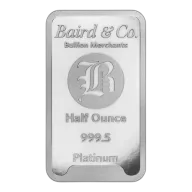
A 1/2 troy ounce bar contains 15.5517 grams of metal. In gold, the half ounce is an established fractional weight produced by every major sovereign mint, but the same cannot be said for bars: even in gold, bars at this weight are a niche product made by some private mints rather than a market staple. In platinum the picture is narrower still. The standard retail sizes for platinum bars run 1g, 5g, 10g, 1 oz, 50g, 100g, 500g and 1 kg, and the 1/2oz format does not feature in that standard lineup. Buyers shopping at this weight are working at the edge of an already small market.
That market context matters. Platinum's investment demand was just 8.5% of total demand in 2024, around 702 koz, against automotive and industrial uses that together account for the majority. Fewer buyers means fewer products, less competition between refiners, and a narrower range of sizes consistently in stock. Not all bullion dealers carry platinum bars at all, and the refiners that do produce them offer a narrower range than they do for gold or silver.
The economic case for a half-ounce platinum bar is a smaller outlay than the 1oz platinum bar, which is the most commonly traded retail size and the minimum practical investment size by most measures. The trade-off is that smaller platinum bars carry progressively higher premiums per ounce, and anything below the 1 oz benchmark sacrifices some of the resale advantage that the standard size enjoys. Buyers who want roughly half an ounce of platinum can also consider the coin route: the American Platinum Eagle is issued in a 1/2 oz denomination alongside its 1 oz, 1/4 oz and 1/10 oz sizes, giving the half-ounce weight a sovereign-mint option that the bar market largely lacks.
Where 1/2oz Sits on the Platinum Bar Premium Ladder
Platinum bar premiums scale steeply with size. The approximate bands by weight are:
| Bar size | Typical premium over spot |
|---|---|
| 1g | 20-40% |
| 10g | 10-20% |
| 1 oz | 5-10% |
| 100g | 4-8% |
| 1 kg | 3-6% |
The 1/2oz weight (15.55g) sits between the 10g and 1 oz rungs of that ladder, and because it is not a standard platinum bar size there is no established premium band for it. What the ladder makes clear is the direction of travel: stepping down from the 1 oz benchmark moves you toward the 10-20% territory of small-gram bars, while the 1 oz size holds the 5-10% band that makes it the standard retail unit. Small gram-weight platinum bars are widely regarded as not cost-efficient for investment purposes, and the half ounce inherits some of that small-size penalty.
Platinum bar premiums are also structurally higher than gold bar premiums at equivalent sizes. The reasons are specific: lower production volumes, a smaller market with fewer competing refiners, and higher fabrication difficulty driven by platinum's 1,768C melting point against 1,064C for gold. Every step down the size ladder multiplies fabrication cost across less metal, which is why the small-bar penalty bites harder in platinum than in gold.
One consolation for buyers in VAT jurisdictions: within the platinum market, bars offer the best premium efficiency of any form, which partially offsets the tax impact. UK and EU buyers pay full VAT on platinum (20% in the UK, 17-27% across the EU), so starting from the lowest available premium matters more here than in tax-exempt jurisdictions such as Canada, Australia, New Zealand, Singapore or Hong Kong, where investment-grade platinum bars escape purchase tax entirely.
Who Makes Platinum Bars, and What Exists Near This Weight
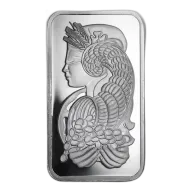
Platinum bars are produced primarily by private refineries rather than sovereign mints, and the brands are the same LBMA-accredited names that dominate gold and silver: PAMP Suisse, Valcambi, Heraeus and Argor-Heraeus, alongside the government-backed Perth Mint. Credit Suisse bars still circulate on the secondary market although they are no longer produced, Credit Suisse having sold its bullion operations.
| Refiner | Country | Notable |
|---|---|---|
| PAMP Suisse | Switzerland | LBMA accredited; sizes from 1g to 100g; sealed in assay card |
| Valcambi | Switzerland | LBMA accredited; multiple sizes including CombiBars |
| Heraeus | Germany | LBMA accredited; popular in the European market |
| Argor-Heraeus | Switzerland | LBMA accredited; kinebar holographic security |
| Perth Mint | Australia | Government-backed; kangaroo design |
| Credit Suisse | Switzerland | Discontinued; secondary market only |
None of these refiners lists 1/2oz among the standard platinum sizes, which run from gram weights up through 1 oz to kilo bars. The range of platinum products from each refiner is narrower than for gold or silver, and not all sizes are consistently in stock even within the standard lineup. Buyers fixed on the half-ounce weight should check current dealer inventory rather than assume availability.
The practical alternatives bracket the weight. Below it, 10g bars from the major refiners are a standard size, though at a 10-20% premium band. Above it, the 1oz platinum bar with assay card is the most common retail product in the metal. And in coin form, the American Platinum Eagle's 1/2 oz denomination covers the weight with sovereign-mint backing, part of a series issued since 1997 with a $100 face value on the 1 oz coin.
Resale and Storage for Small Platinum Bars
Platinum bars from LBMA-accredited refiners are sellable, but the market is thinner than for gold or silver, and the thinness is felt most away from the standard sizes. The 1 oz bar has the best resale liquidity among platinum bars; non-standard weights below it do not share that advantage. Buy-sell spreads on platinum bars are wider than on gold bars in both absolute and percentage terms, and during low-liquidity periods they widen further, platinum having the thinnest market of the three main bullion metals. Dealers typically buy platinum at roughly spot minus 3-6% and sell at spot plus 5-10%, putting the round-trip cost on 1 oz products at around 8-15%.
Provenance does real work at resale. Sealed bars in assay cards from recognised refiners such as PAMP, Valcambi and Heraeus command better resale prices than generic or loose bars, and LBMA-branded assay cards with serial numbers provide strong provenance. Geography matters too: the smaller the dealer network in a country, the wider the spread, with the US and UK having the most established platinum dealer networks. Some smaller or regional dealers do not handle platinum at all, so selling may mean shipping to a larger online dealer rather than walking into a local shop.
Storage is the easy part. Platinum does not tarnish or corrode, so no atmospheric precautions are needed, and it is harder than gold (Mohs 3.5 against 2.5), making it more resistant to scratches. At 21.45 g/cm3 it is the densest of the main bullion metals, so a half-ounce bar is a physically small object; minted bars in assay cards store flat and stack efficiently. Counterfeiting is a lesser worry than with most metals because no common cheap metal approaches platinum's density: tungsten at 19.25 g/cm3 would be detectably lighter in a bar of correct dimensions, and the metals that do match (iridium, osmium) cost more than platinum itself.