 BullionStar

Prices are fetched automatically and may not reflect current merchant prices. Currency conversions and tax treatment are approximate. Rankings are based solely on price. We are not a dealer and accept no responsibility for transactions with listed merchants. Past performance is not indicative of future results. This site does not provide investment advice. Full disclaimer
About the 5g Kinebar Gold Bar
The 5g Argor-Heraeus Kinebar
The Kinebar is a gold bar with a Kinegram, a diffractive optically variable image device (DOVID), embossed directly into the gold surface. The name is a portmanteau of "Kinegram" and "bar." The technology was originally developed by OVD Kinegram AG for securing banknotes and government identity documents, and the Kinebar represents one of the very few commercial applications of this government-grade security technology. Introduced in December 1993 by Union Bank of Switzerland (UBS) through Argor-Heraeus, the Kinebar has been in production since 1994.
Argor-Heraeus SA, the manufacturer, is one of the world's largest precious metals refiners. Based in Mendrisio, Switzerland, the company traces its origins to 1951 and processes approximately 400 tonnes of gold annually. The Kinebar is struck to 999.9 fine gold (four nines) and sealed in a tamper-evident assay card containing a certified weight, purity, and matching serial number. The 5g size is among the original weights offered at launch, alongside 1g, 2g, 10g, 20g, and 1 oz bars.
The Kinegram is what separates this bar from every other gold product on the market. It is not a holographic sticker or an applied film. The Kinegram is embossed directly into the gold surface through sub-micron engravings less than 0.0015 mm deep. These engravings reflect light in different ways, producing dynamic, shifting patterns and colours when the bar is tilted. Because the holographic effect is created by physical surface topology rather than applied materials, it is permanent, cannot wear off, and cannot be peeled away or transferred. The same technology secures banknotes in numerous countries, and the sub-micron precision makes it extremely difficult to replicate.
Why the Kinebar Stands Out
The core appeal of the Kinebar is instant visual authentication. A buyer can verify the security feature by tilting the bar and observing the shifting Kinegram patterns, with no equipment, no app, and no database lookup required. This is fundamentally different from PAMP Suisse's Veriscan technology, which scans microscopic surface topology and verifies against a database via smartphone, or the Royal Canadian Mint's Bullion DNA system, which requires proprietary electromagnetic equipment. The Kinebar's authentication is self-contained, making it particularly useful for peer-to-peer transactions and in markets where digital infrastructure is unreliable.
The premium for this security feature is modest. A Kinebar typically costs only $2-5 per ounce more than a standard Argor-Heraeus bar of the same weight, making it one of the cheapest security-enhanced gold products available. For a 5g bar, the absolute premium difference is even smaller. Given that the Kinegram is a permanent, non-removable part of the gold itself, many investors consider the small additional cost worthwhile for the added authentication confidence it provides at resale.
5g Kinebar Specifications
| Attribute | Value |
|---|---|
| Weight | 5 grams (0.1607 troy oz) |
| Purity | 999.9 fine gold (24 karat) |
| Manufacturer | Argor-Heraeus SA, Mendrisio, Switzerland |
| Type | Minted bar |
| Edge | Smooth |
| Serialisation | Individual serial number |
| Packaging | Tamper-evident blisterpack with assay card |
| Security | Kinegram holographic element (embossed into gold surface) |
| Accreditation | LBMA Good Delivery |
| Trademark | Kinebar is a registered trademark of UBS AG |
Available Kinebar Sizes
| Size | Introduced |
|---|---|
| 1 g | 1994 |
| 2 g | 1994 |
| 5 g | 1994 |
| 10 g | 1994 |
| 20 g | 1994 |
| 1 oz (31.1 g) | 1994 |
| 50 g | 2012 |
| 100 g | 2012 |
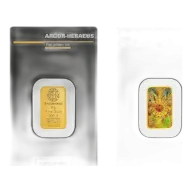
The obverse features the Argor-Heraeus logo, "Switzerland" country of origin, weight and purity markings, melter/assayer marking, and individual serial number. The full reverse is occupied by the Kinegram holographic element. The design has remained consistent since 1994, with no annual variations. The 50g and 100g sizes were not added until 2012, eighteen years after the original launch, suggesting that the smaller sizes (1g to 1 oz) remain the primary market.
Kinebars are exclusively gold. No silver or platinum Kinebars are produced.
Kinebar Tax Treatment by Country
The 5g Kinebar qualifies as investment gold in all major markets. As a 999.9 fine gold bar from an LBMA-accredited Swiss refiner, it meets or exceeds every purity threshold for investment gold exemptions.
- United Kingdom: VAT-exempt as investment gold (995+ purity). Subject to Capital Gains Tax on disposal. Gold bars are not CGT-exempt in the UK; only UK legal tender coins (Britannias, Sovereigns) qualify for CGT exemption. Annual CGT allowance of £3,000 applies. SIPP-eligible.
- United States: IRA-eligible. Argor-Heraeus is an LBMA/COMEX-approved refiner, and the 999.9 purity exceeds the IRS 99.5% threshold for precious metals IRAs. No federal sales tax; approximately 35 states exempt bullion from state sales tax. Outside retirement accounts, long-term gains taxed at the 28% collectibles rate.
- European Union: VAT-exempt as investment gold under EU Directive 98/80/EC. In Germany, gains on gold held for over one year are completely tax-free.
- Switzerland: VAT-exempt on investment gold. Argor-Heraeus is a domestic Swiss refiner, and the Kinebar has strong home-market recognition.
- Canada: GST/HST-exempt for gold at 99.5%+ purity. RRSP-eligible when held through an approved custodian.
- Australia: GST-free for investment-grade gold (99.5%+ purity). Subject to CGT on disposal with a 50% discount for holdings over 12 months.
- Singapore: GST-exempt as Investment Precious Metal. No capital gains tax.
- Hong Kong: No sales tax, no import duty, no capital gains tax.
- New Zealand: GST-exempt for gold at 99.5%+ purity.
The Kinebar Since 1993
The Kinebar was introduced in December 1993 through Union Bank of Switzerland (UBS), which at the time owned Argor-Heraeus. The first retail Kinebars went on sale in early 1994, initially in six sizes from 1g to 1 oz. UBS retains the Kinebar trademark to this day, even though Argor-Heraeus has since become a subsidiary of the Heraeus Group.
The Kinegram technology that gives the Kinebar its name was developed by OVD Kinegram AG, a Swiss company specialising in security features for banknotes and government documents. The technology is described as "exclusively provided to governments" for high-security applications, making the Kinebar an unusual exception: a commercial product carrying the same authentication technology used to protect national currencies and passports. "Kinegram" is a registered trademark, and no other precious metals manufacturer uses this specific technology.
The original six sizes served the retail market for nearly two decades before Argor-Heraeus expanded the range. In 2012, the 50g and 100g sizes were added, likely reflecting increased demand from institutional and high-net-worth buyers seeking larger bars with the same holographic authentication feature. The long gap between the original launch and the expansion suggests that the smaller sizes (1g through 1 oz) have historically been the strongest sellers, with the 5g bar occupying the sweet spot between affordability and per-gram premium efficiency for retail buyers in metric-system markets.
The Kinegram's optical effects are created through physical surface engravings at the sub-micron scale. Because these engravings are part of the gold itself, the holographic effect has remained unchanged across three decades of production. No refinements or redesigns have been made to the layout or format of the bar since 1994, though advances in optical technology have allowed for incremental improvements to the Kinegram patterns themselves. This design stability is characteristic of investment-grade bullion products, where consistency and recognition are more valuable than novelty.
Kinebar vs Other 5g Gold Bars
The Kinebar's defining feature, the Kinegram, puts it in a specific competitive position. It is not the cheapest 5g gold bar (plain refiner bars from Heraeus or Valcambi typically cost slightly less) and it is not the most heavily branded (the PAMP Fortuna has stronger global recognition). It sits between those two categories, offering a security enhancement at a minimal premium over plain bars.
The comparison with PAMP Suisse's Veriscan technology is worth understanding in detail. Veriscan works by scanning the microscopic surface topology of each bar during manufacturing and storing the scan in a database. Buyers can then verify authenticity using PAMP's smartphone app, which compares the bar's surface against the stored record. This is a powerful system, but it is database-dependent: without app access or if PAMP's servers were ever unavailable, verification would not be possible. The Kinebar's Kinegram is self-verifying. Tilt the bar, observe the shifting holographic patterns. No equipment, no internet connection, no third-party database required. For buyers who value authentication independence, the Kinebar has a structural advantage.
The 5g Perth Mint Kangaroo bar offers government backing (the Perth Mint is owned by the Western Australian Government) and a recognisable kangaroo design with tamper-evident blister cards. It does not have a holographic or digital authentication feature comparable to the Kinegram or Veriscan. The Perth Mint's authentication relies on the micro-laser engraved letter found on their coins, but this feature is not consistently applied to their bar range.
For pure cost efficiency, the 5g IGR bar and other LBMA-accredited refiner bars trade at the lowest premiums. The trade-off is the absence of any advanced security feature beyond standard serial numbers and assay cards. The Kinebar's premium over these plain bars is small enough that many buyers consider it a worthwhile insurance policy against authentication concerns at resale.
The Kinebar is exclusively a gold product. Buyers looking for silver or platinum bars cannot access Kinegram technology in those metals. This is both a limitation and a mark of exclusivity within the gold bar market.
5g Kinebar Gold Bar: frequently asked questions
-
The cheapest 5g Kinebar listed on this page is S$1,020.80 from BullionStar. Compare against the 5g gold spot value to see the current dealer premium.
-
A Kinebar is a 999.9 fine gold minted bar from Argor-Heraeus, a Swiss refinery based in Mendrisio, with a Kinegram on the reverse. The Kinegram is a diffractive optical element embossed directly into the gold surface, not a sticker, producing shifting colours when tilted. The same technology secures banknotes and government documents. Each bar has an individual serial number and comes in a sealed assay card. The Kinegram makes authentication straightforward without any equipment or database.
-
The 5g Kinebar is a small minted bar. At 5 grams, it contains only a fraction of a troy ounce of gold, which keeps the entry cost low but means small bars typically carry a higher percentage premium over spot than larger bars.
-
Dealers on this page are currently charging 14.0% over the S$5,569.14 gold spot price, with the lowest offer from BullionStar. Small bars like this 5g size carry a higher percentage premium than larger bars because fabrication costs are spread over less metal content.