14 listings
Filters
| Product | /oz | Premium | Price | |
|---|---|---|---|---|
| S$89.37 | +4.60% | S$89.37 | View Deal | |
|
20
|
S$91.06 | +6.58% | S$91.06 | View Deal |
|
20
|
S$91.06 | +6.58% | S$91.06 | View Deal |
|
20
|
S$93.17 | +9.05% | S$93.17 | View Deal |
|
20
|
S$93.17 | +9.05% | S$93.17 | View Deal |
|
20
|
S$93.17 | +9.05% | S$93.17 | View Deal |
|
20
|
S$93.17 | +9.05% | S$93.17 | View Deal |
| S$93.17 | +9.05% | S$93.17 | View Deal | |
|
20
|
S$93.17 | +9.05% | S$93.17 | View Deal |
|
20
|
S$93.17 | +9.05% | S$93.17 | View Deal |
|
20
|
S$93.17 | +9.05% | S$93.17 | View Deal |

 Indigo Precious Metals
|
S$93.93 | +10.26% |
S$93.96
£55
|
View Deal |
 Indigo Precious Metals
|
S$94.24 | +10.76% |
S$94.39
£55
|
View Deal |
 Indigo Precious Metals
|
S$94.24 | +10.76% |
S$94.39
£55
|
View Deal |

Prices are fetched automatically and may not reflect current merchant prices. Currency conversions and tax treatment are approximate. Rankings are based solely on price. We are not a dealer and accept no responsibility for transactions with listed merchants. Past performance is not indicative of future results. This site does not provide investment advice. Full disclaimer
About the 1 oz Philharmonic Silver Coin
The Austrian Mint's Silver Philharmonic
The 1 oz Silver Philharmonic is struck by Munze Osterreich (the Austrian Mint) in .999 fine silver, carrying a face value of 1.50 EUR. First issued in 2008, it extended the Philharmonic brand that had already dominated European gold bullion markets since 1989. The Austrian Mint traces its lineage to 1194, when Duke Leopold V of Austria used 12 tonnes of ransom silver from Richard the Lionheart to establish large-scale coin production in Vienna.
The Silver Philharmonic consistently ranks among the lowest-premium sovereign silver coins available. In European markets particularly, it competes directly with the 1 oz Silver Britannia and the 1 oz Silver Maple Leaf on price, and frequently undercuts both. This competitive pricing, combined with euro denomination and EU VAT-exempt status for the gold version, has made the Philharmonic series the most popular bullion coin on the European continent.
From 2008 to 2012 alone, the Austrian Mint sold 54 million silver Philharmonics. Over 30 million more were sold in the three-year period from 2021 to 2023, reflecting sustained demand during and after the pandemic-era precious metals surge. The coin is available only in the 1 oz size for silver; the Austrian Mint has chosen not to produce fractional or larger silver versions.
The design celebrates the Vienna Philharmonic Orchestra and the Musikverein's Golden Hall, one of the world's finest concert venues. The annual New Year's Concert broadcast from this hall reaches over 90 countries, giving the Philharmonic brand global cultural recognition that few bullion coins can match.
Silver Philharmonic Dimensions and Details
| Attribute | Value |
|---|---|
| Weight | 31.103 g (1 troy oz) |
| Purity | .999 fine silver |
| Diameter | 37.0 mm |
| Face Value | 1.50 EUR |
| Edge | Reeded |
| Obverse | Pipe organ of the Musikverein Golden Hall |
| Reverse | Ensemble of Vienna Philharmonic instruments |
| First Year | 2008 |
| Mintage | Unlimited |
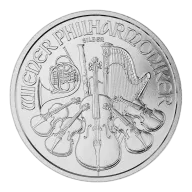
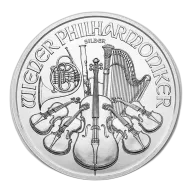
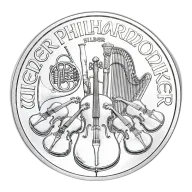
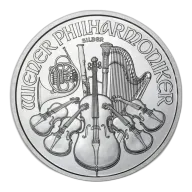
The obverse features the Rieger organ of the Grosser Musikvereinssaal (Great Music Association Hall), built in 1870 and renowned for its acoustics. The reverse depicts an ensemble of orchestral instruments: a cello at centre, flanked by four violins, with a Vienna horn, bassoon, and harp behind them. The Vienna horn (Wiener Horn) shown is specifically not a French horn; it has a warmer, rounder tone and reflects the orchestra's commitment to historically informed performance practice.
The design by Thomas Pesendorfer has remained unchanged since the gold coin's 1989 launch. The only variations across the entire series are the year-date and the switch from Austrian schilling denominations to euro denominations in 2002. This design stability makes the Philharmonic instantly recognisable worldwide.
The 1.50 EUR face value is nominally the lowest of any major government-issued 1 oz silver bullion coin, though in practice it is comparable to the American Silver Eagle's $1 USD face value.
Silver Philharmonic Tax Treatment by Country
As a silver coin, the Philharmonic is subject to purchase tax in most jurisdictions. The gold version benefits from the EU investment gold directive; the silver does not.
- Austria/EU: Subject to VAT at local rates (20% in Austria, 19% in Germany, 21% in the Netherlands). In Germany, the margin scheme (Differenzbesteuerung) applies to imported and pre-owned silver coins, reducing the effective VAT to the dealer's margin only (typically 3-7%). This makes the Philharmonic significantly cheaper in Germany through dealers using differential taxation. Not CGT-exempt in Austria; Germany exempts gains on assets held for more than one year.
- United Kingdom: Subject to 20% VAT on purchase. Not CGT-exempt (not UK legal tender). The Silver Britannia is the preferred choice for UK buyers seeking CGT exemption. The margin scheme applies to pre-owned Philharmonics through UK dealers.
- United States: IRA-eligible (.999 silver meets the .999 minimum purity requirement). Sales tax varies by state, with most states exempting bullion. Capital gains taxed at the 28% collectibles rate.
- Canada: GST/HST exempt for silver coins at .995+ purity. Not RRSP-eligible (not issued by a Canadian mint through the standard designation).
- Australia: The .999 silver purity meets the 99.9% threshold for GST-free treatment as investment-grade precious metals. Capital gains tax applies with a 50% discount for holdings over 12 months.
- Singapore: GST-exempt as an Investment Precious Metal (silver at .999+ purity on the MAS-approved list). No capital gains tax.
- Hong Kong: No sales tax, no import duty, no capital gains tax.
The Philharmonic is legal tender only in Austria, despite bearing a euro denomination. It cannot be spent at face value in other eurozone countries.
From Ransom Silver to Modern Bullion
The Austrian Mint's founding story is one of the most colourful in the minting world. In 1192, Duke Leopold V of Austria captured King Richard I of England (Richard the Lionheart) during the Third Crusade. The ransom extracted was approximately 12 tonnes of silver, and these funds helped establish large-scale coin production in Vienna. The mint has operated continuously since 1194, making it one of the oldest active mints in the world.
The gold Philharmonic launched on 10 October 1989. It was the world's best-selling gold coin in 1992, 1995, 1996, and 2000. From 1989 to 2012, the Austrian Mint sold 14 million gold Philharmonics, equivalent to approximately 329 tonnes of pure gold. Annual production has ranged from 54,700 coins in 2001 (the post-dot-com low) to 903,047 in 2009 (during the global financial crisis).
The silver version arrived on 1 February 2008, responding to rising retail demand for silver bullion during the late-2000s commodities boom. It launched with the same design and immediately found a market, particularly in Germany and Austria. The platinum Philharmonic followed in 2016, along with a small-format 1/25 oz gold coin introduced in 2014 specifically as an affordable entry point for new European bullion investors.
A notable special edition is the "Big Phil," a 31 kg (1,000 troy oz) gold coin with a face value of 100,000 EUR, produced in 2004. Only 15 were made. At the time, it was the largest gold coin ever minted. A 20 oz gold showcase piece with a face value of 100,000 EUR was also created.
Philharmonic vs Britannia, Maple Leaf, and Krugerrand in Silver
The Silver Philharmonic's core advantage is pricing. It consistently trades at among the lowest premiums of any government-issued 1 oz silver coin, particularly in European markets where it benefits from local distribution and, in Germany, favourable margin scheme tax treatment.
Against the 1 oz Silver Britannia, the Philharmonic gives up the UK CGT exemption and the Britannia's four-feature security suite (latent image, micro-text, tincture lines, surface animation). For UK buyers, the Britannia is clearly superior on tax grounds. For European buyers without CGT concerns, the Philharmonic's lower premium is the deciding factor.
Against the 1 oz Silver Maple Leaf, the Philharmonic is .999 versus .9999 purity. The Maple Leaf also has the Bullion DNA verification system and MintShield anti-tarnish coating, both absent from the Philharmonic. The Maple Leaf has broader global distribution, but the Philharmonic competes strongly in European markets.
Against the 1 oz Silver Krugerrand, the two coins share .999 purity and lack advanced security features. The Krugerrand carries far more brand recognition globally due to the gold version's 60-year history, but in Europe the Philharmonic has the home-market advantage.
The Philharmonic does not have any proprietary anti-counterfeiting technology comparable to the Britannia's latent image or the Maple Leaf's micro-engraved laser mark. It relies on the complexity of its detailed instrument engravings and the Austrian Mint's reputation. For buyers prioritising security features, the Britannia or Maple Leaf are stronger choices. For buyers prioritising low cost and European availability, the Philharmonic is hard to beat.
1 oz Philharmonic Silver Coin: frequently asked questions
-
The cheapest 1oz Silver Philharmonic we track is S$89.37 at BullionStar, sitting 4.6% over the S$85.44 silver spot price. Like all bullion silver coins, its price closely tracks the silver market with a modest dealer premium on top.
-
The Vienna Philharmonic silver coin is struck annually by Münze Österreich (the Austrian Mint) and has been issued since 2008. The reverse depicts instruments of the Vienna Philharmonic Orchestra, while the obverse shows the pipe organ of Vienna's Musikverein concert hall. It is legal tender in Austria with a face value of 1.50 euro, though it is bought and sold as a bullion coin rather than currency.
-
The Silver Philharmonic is struck in 999 fine silver, with a weight of 1 oz. The 1 oz size is the only silver denomination the Austrian Mint produces in this series; no fractional or larger silver versions are issued.
-
The 1oz Silver Philharmonic measures 37 mm in diameter. It is the same diameter as the 1oz gold Philharmonic, so the two coins are dimensionally matched when displayed side by side.
-
Silver Philharmonics are sold individually or in mint tubes and monster boxes. Buying by the tube or box is common among stackers, as it typically reduces per-coin handling costs compared to individual purchases.