14 listings
Filters
| Product | /oz | Premium | Price | |
|---|---|---|---|---|
|
30
|
S$99.41 | +16.35% | S$95.88 | View Deal |
|
20
 BullionStar
|
S$101.11 | +18.34% | S$97.52 | View Deal |
 Indigo Precious Metals
|
S$104.51 | +22.76% |
S$100.91
£59
|
View Deal |
 Indigo Precious Metals
|
S$104.51 | +22.78% |
S$100.92
£59
|
View Deal |
|
20
BullionStar
|
S$106.04 | +24.11% | S$102.28 | View Deal |
|
20
BullionStar
|
S$106.04 | +24.11% | S$102.28 | View Deal |
|
20
BullionStar
|
S$106.04 | +24.11% | S$102.28 | View Deal |
|
20
BullionStar
|
S$106.04 | +24.11% | S$102.28 | View Deal |
|
20
BullionStar
|
S$106.04 | +24.11% | S$102.28 | View Deal |
|
20
BullionStar
|
S$106.04 | +24.11% | S$102.28 | View Deal |
|
20
BullionStar
|
S$106.04 | +24.11% | S$102.28 | View Deal |
|
20
BullionStar
|
S$106.04 | +24.11% | S$102.28 | View Deal |
 Indigo Precious Metals
|
S$107.00 | +25.39% |
S$103.07
£60
|
View Deal |
 Indigo Precious Metals
|
S$107.00 | +25.39% |
S$103.07
£60
|
View Deal |
Prices are fetched automatically and may not reflect current merchant prices. Currency conversions and tax treatment are approximate. Rankings are based solely on price. We are not a dealer and accept no responsibility for transactions with listed merchants. Past performance is not indicative of future results. This site does not provide investment advice. Full disclaimer
About the 30g Panda Silver Coin
The 30g China Silver Panda
The 30g Silver Panda is China's flagship silver bullion coin, produced by the China Gold Coin Corporation (CGCC) under the authority of the People's Bank of China. First issued in 1983, the silver Panda is one of the longest-running silver bullion programmes in the world, predating the American Silver Eagle by three years.
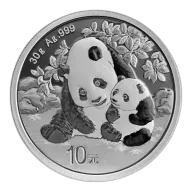
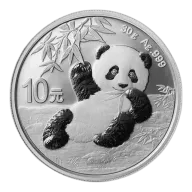
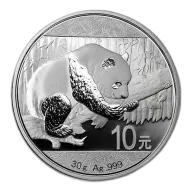
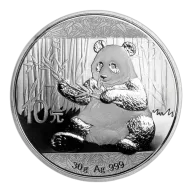
The coin's most distinctive feature is its annually changing reverse design. Each year depicts a new scene of giant pandas in different poses and settings, making the Silver Panda one of the few sovereign bullion coins where the design is never repeated. The only exception was 2001-2002, when a policy decision froze the design. The collector backlash was severe enough to reverse the policy from 2003 onwards.
The 30g weight is the result of a significant change in 2016, when the People's Bank of China converted the entire Panda series from troy ounces to metric grams. The standard silver denomination shifted from 1 troy ounce (31.103 g) to 30 grams (0.9645 troy oz), a reduction of approximately 3.6% in silver content. The physical dimensions remained unchanged. This makes the post-2016 Silver Panda slightly lighter than a standard 1 oz silver coin from other sovereign mints.
Despite the weight anomaly, the Silver Panda maintains strong global demand. Its combination of sovereign mint status, annually changing designs, and cultural significance creates a hybrid market position between pure bullion and numismatic collecting. Specific years, particularly early issues and years with low mintages, can trade at substantial premiums above the silver content value.
Silver Panda Specifications
| Attribute | Post-2016 (Metric) | Pre-2016 (Troy) |
|---|---|---|
| Weight | 30 g (0.9645 troy oz) | 1 troy oz (31.103 g) |
| Purity | 999 fine silver | 999 fine silver (from 1989) |
| Face value | 10 yuan | 10 yuan |
| Diameter | 40 mm | 40 mm |
| Legal tender | People's Republic of China | People's Republic of China |
Silver Panda Purity History
| Years | Purity | Notes |
|---|---|---|
| 1983-1985 | 900 | 27 g proof quality; more numismatic than bullion |
| 1987 | 925 (sterling) | 1 oz sterling silver |
| 1989-2015 | 999 | Standard bullion format established |
| 2016-present | 999 | 30 g metric weight |
No Silver Pandas were produced in 1986 or 1988, creating gaps in the year sequence. The obverse has remained unchanged since 1982: the Hall of Prayer for Good Harvests (Qinian Dian) at the Temple of Heaven complex in Beijing, with "Zhonghua Renmin Gongheguo" (People's Republic of China) and the year of issue.
The coins are struck by the China Gold Coin Corporation (CGCC) at multiple facilities across China, including Beijing, Shanghai, Shenyang, and Shenzhen. Unlike most sovereign mints, the CGCC does not use standardised mintmarks, making attribution to a specific facility difficult without specialist knowledge of die variations. Modern annual silver Panda production reaches approximately 10,000,000 coins based on 2017-2019 data, placing it among the highest-volume silver bullion programmes globally. The 2016 metric conversion left physical dimensions unchanged despite the 3.6% weight reduction, so the difference between a pre-2016 and post-2016 Silver Panda is invisible without a precision scale.
Silver Panda Tax Treatment by Country
The Silver Panda is legal tender of the People's Republic of China with a 10 yuan face value. Its tax treatment varies by jurisdiction, with one notable anomaly regarding US retirement accounts.
United States
Silver Pandas meet the IRS 999 purity requirement for self-directed precious metals IRAs, and silver Pandas are typically accepted by IRA custodians. This contrasts with Gold Pandas, which are generally considered not IRA-eligible because the IRS does not recognise the Chinese mint as an approved foreign mint for gold IRA purposes. This gold/silver distinction catches many investors off guard. Capital gains are taxed at the collectibles rate of up to 28% federal. Sales tax varies by state.
United Kingdom
Silver Pandas attract 20% VAT on purchase. They are not CGT-exempt because they are not UK legal tender. UK buyers seeking CGT-exempt silver are better served by the Silver Britannia or Tudor Beasts. Gold Pandas are VAT-exempt in the UK as investment gold meeting the 995 purity threshold.
European Union
Silver Pandas are subject to VAT at local standard rates across EU member states. Germany's margin scheme (Differenzbesteuerung) may apply to pre-owned coins on the secondary market. Gold Pandas are VAT-exempt under the EU Investment Gold Directive.
Australia
Investment-grade silver at 999 purity or above is GST-free. The Silver Panda qualifies. Capital gains tax applies with a 50% discount for holdings over 12 months.
Canada
Standard GST/HST exemption applies to silver at 995+ purity. Silver Pandas are not RRSP or TFSA-eligible in Canada.
Singapore and Hong Kong
Singapore exempts Investment Precious Metals at 999+ silver purity from GST. Neither jurisdiction imposes capital gains tax. Hong Kong has no sales tax or import duty on bullion.
China
No VAT on precious metal coins domestically. The Panda is a cultural icon and popular gift item, particularly during Chinese New Year.
From State Gold Reserves to Silver Bullion Icon
China introduced the Gold Panda in 1982, partly to monetise domestic gold reserves and partly as a soft-power cultural export. The Silver Panda followed in 1983, though its early years were inconsistent. The first silver Pandas (1983-1985) were proof-quality coins containing 27 grams of 900 fine silver, making them more numismatic products than bullion. Production was suspended entirely in 1986 and 1988. A 1987 issue used 925 sterling silver. The series did not settle into a consistent 999 fine silver bullion format until 1989.
The obverse has never changed: the Hall of Prayer for Good Harvests at the Temple of Heaven in Beijing, one of China's most recognisable architectural landmarks. The reverse, featuring a new panda illustration each year, is the series' defining characteristic. The CGCC commissions new artwork annually, depicting the giant panda in various natural poses: eating bamboo, playing, resting, walking, or with cubs.
The 2001-2002 design freeze remains a notable episode. China announced that the 2001 design would be retained for 2002, breaking the annual tradition. The collector response was strongly negative, and China reverted to annual changes from 2003 onwards. The shared design makes 2001 and 2002 Pandas distinguishable only by the date on the obverse.
The 2015 issue created separate controversy: Gold Pandas were issued without denomination, weight, fineness, or metal inscriptions, leaving just the panda image and year. This was widely criticised for both aesthetic and security reasons, and the practice was not repeated.
The most significant change came in 2016, when the entire Panda series switched from troy ounces to metric grams. The standard silver denomination shifted from 1 oz (31.103 g) to 30 g (0.9645 oz), reducing the silver content by approximately 3.6%. China cited alignment with the metric system used domestically, where gold and silver prices are quoted in grams. Critics noted that pricing remained comparable, making the switch an effective price increase. Physical dimensions stayed the same, so the weight reduction is invisible without a scale.
Modern annual silver Panda production reaches approximately 10,000,000 coins (based on 2017-2019 data), making it one of the highest-volume silver bullion coin programmes globally. The 1983 proof Silver Panda, with a mintage of just 10,000, has appreciated to approximately $16,430 in top grade, illustrating the numismatic premium that early, low-mintage Pandas can command.
Silver Panda vs American Silver Eagle, Maple Leaf, and Britannia
The Silver Panda occupies a distinctive position among sovereign silver coins: it is the only major series that changes its design annually and uses a non-standard weight (30 g versus the 1 troy ounce standard used by competitors).
Against the American Silver Eagle, the Panda carries higher premiums due to collector demand for the annual designs. The Eagle has a fixed design (Type II since 2021), legal tender status as US currency, and IRA eligibility. The Eagle contains a full troy ounce versus the Panda's 30 grams, a 3.6% advantage in silver content. For pure silver accumulation, the Eagle is more cost-efficient per gram. For buyers who value annually changing designs and the collector dimension, the Panda offers something the Eagle does not.
The Canadian Silver Maple Leaf at 9999 purity exceeds the Panda's 999 and contains a full troy ounce. The Maple Leaf also has Bullion DNA micro-engraving security since 2015, a feature the Panda lacks. Counterfeiting is a substantially larger problem for Pandas than for any other major sovereign bullion coin. The combination of high premiums, annually changing designs (which makes comparison harder), and less sophisticated security features creates conditions that favour counterfeiters. Buying from reputable dealers or purchasing NGC/PCGS-certified coins is strongly recommended.
The Silver Britannia at 999 purity matches the Panda but contains a full troy ounce and benefits from the Royal Mint's four-feature security suite. For UK buyers, the Britannia's CGT exemption is decisive. The Panda's advantage lies in its collector market: specific years and low-mintage issues can appreciate above spot in ways that the Britannia's unlimited mintage does not support.
The Perth Lunar series is the Panda's closest analogue as a sovereign silver coin with annually changing designs. Both carry cultural themes (zodiac versus pandas) and both attract collector interest for specific years. The Perth Lunar is 9999 purity (Series III), uses standard troy ounce weights, and has stronger anti-counterfeiting measures with micro-laser engraving. The Panda's advantage is its deeper cultural significance in Chinese and broader Asian markets.
30g Panda Silver Coin: frequently asked questions
-
The cheapest 30g Silver Panda listed here is S$95.88, at about 16.3% over the S$85.44 silver spot price. Silver Pandas typically trade at a higher premium than generic silver coins due to collector demand for the annually changing design. The current best price is from BullionStar and updates with the market throughout the day.
-
China switched the Silver Panda from a 1 troy oz (31.103 g) coin to a 30 g metric coin in 2016, alongside the same change to the Gold Panda series. The official reason was alignment with the metric system used domestically. The 30 g coin contains approximately 0.9645 troy oz of silver, around 3.5% less metal than the pre-2016 1 oz version, while physical dimensions remained unchanged.
-
Three factors combine to push Silver Panda premiums above those of most bullion coins. The reverse design changes every year, creating annual collectible editions rather than a single fixed design. Production runs have a finite window, increasing scarcity relative to demand. And collector demand layers on top of pure bullion demand, widening the buy/sell spread. Buyers looking purely for silver content at the lowest cost will usually find better value elsewhere.
-
Yes. The Silver Panda's reverse panda illustration changes annually, and this has been the series' defining characteristic since 1983. The only exception was 2001 and 2002, when Panda coins across the series shared an identical design after a short-lived design freeze that met significant collector backlash. The obverse, showing the Temple of Heaven in Beijing, has remained unchanged since the series began.