2 products · 187 deals Prices & premiums exclude tax to compare across countries


Prices are fetched automatically and may not reflect current merchant prices. Currency conversions and tax treatment are approximate. Rankings are based solely on price. We are not a dealer and accept no responsibility for transactions with listed merchants. Past performance is not indicative of future results. This site does not provide investment advice. Full disclaimer
About the American Silver Eagle Silver
American Silver Eagle: The World's Most Traded Silver Coin
The American Silver Eagle is the most widely traded silver bullion coin in the world, with over 673 million coins produced through 2024. Authorized by the Liberty Coin Act of 1985 and first released on 24 November 1986, it contains exactly one troy ounce of 999 fine silver and carries a $1 face value as legal tender of the United States. The programme originated from plans to sell silver from the Defense National Stockpile; Senator James A. McClure championed converting bulk sales into coin minting to avoid depressing silver prices on the open market.
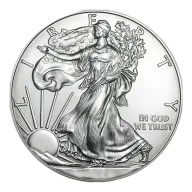
The obverse features Adolph A. Weinman's Walking Liberty design, adapted from his 1916 half dollar and consistently ranked among the most beautiful American coin designs. Lady Liberty strides toward the sun, draped in the American flag with her right hand extended. This design was retained when the coin underwent its first major revision in 2021, with the addition of Weinman's "AW" artist mark (present on the original 1916 design but omitted from the 1986 Silver Eagle).
The 2021 transition introduced a new reverse by Emily Damstra: an eagle landing on a branch in a naturalistic style, replacing John Mercanti's heraldic eagle that had served since 1986. Both Type 1 and Type 2 were produced during 2021, creating a natural collecting milestone. The Type 2 also introduced the Silver Eagle's first anti-counterfeiting measure: an edge variation where one reed is intentionally omitted, creating a small gap whose position changes annually.
Silver Eagles consistently command the highest premiums of any major sovereign silver coin. Typical premiums run 20-30% above spot under normal conditions and have spiked to 50-100% during demand surges (March 2020, early 2021). This premium reflects a combination of strong US collector crossover demand, periodic supply constraints (the Mint has rationed supply to authorized purchasers multiple times), and the US Mint's pricing structure to dealers. Buyers seeking maximum silver for their money should compare the Eagle's premium against alternatives like the 1oz Canadian Silver Maple Leaf or 1oz Austrian Silver Philharmonic, both of which typically trade at lower premiums.
Silver Eagle Technical Specifications
| Attribute | Value |
|---|---|
| Weight | 31.103g (1 troy ounce) |
| Diameter | 40.6mm |
| Thickness | 2.98mm |
| Purity | 999 fine silver (.999) |
| Face Value | $1 USD |
| Edge | Reeded |
| Composition | Pure silver (not alloyed) |
The Silver Eagle is produced only in a 1 oz denomination, unlike the Gold Eagle which comes in four sizes. Bullion coins are shipped to authorized purchasers in "monster boxes" of 500 coins (25 tubes of 20). Authorized purchasers must maintain a minimum net worth of $5 million and place orders of at least 25,000 coins.
From 2021 (Type 2 onward), each coin carries an anti-counterfeiting reeded edge variation: one reed is intentionally omitted, creating a small notch. The notch's position changes annually (roughly 6 o'clock on 2021 issues, shifted in subsequent years). This was the first time the US Mint applied this technique to the Silver Eagle series. Mint marks (P for Philadelphia, S for San Francisco, W for West Point) appear on proof and special editions to aid traceability.
Annual mintage has varied enormously, from a low of 4,672,051 (1995) to an all-time high of 47,000,000 (2015). Demand-driven production surges occurred in 2009 (28.8 million, recession demand), 2015 (47 million), and 2020 (31.3 million, COVID response). The 2009 vintage is the only year in which no proof or uncirculated versions were produced, with all capacity devoted to bullion.
Silver Eagle Tax Treatment by Country
The Silver Eagle's tax position varies significantly by market. Silver bullion is treated less favourably than gold in most jurisdictions, with purchase taxes applying where gold is exempt.
- United States: IRA-eligible at 999 purity (meeting the IRS 99.9% threshold for silver). Capital gains outside an IRA are taxed at the collectibles rate of up to 28%. State sales tax varies; approximately 35 states exempt investment bullion entirely. Five states have threshold-based exemptions: California ($2,000), Florida ($500), Louisiana ($1,000), Massachusetts ($1,000), and New York ($1,000).
- United Kingdom: Subject to 20% VAT. Silver does not receive the investment gold VAT exemption in the UK. This is a substantial cost that makes physical silver delivery expensive for UK buyers. The Silver Eagle is not UK legal tender, so it is also subject to CGT. UK buyers seeking CGT exemption on silver should consider the Silver Britannia, which is CGT-exempt as UK legal tender (though still subject to 20% VAT). Some UK dealers offer VAT-free vault storage as a workaround, but this requires forgoing physical possession.
- Canada: GST/HST-exempt for investment-grade silver at 99.9% purity or above. The Silver Eagle at 999 fine qualifies. Standard capital gains treatment (50% inclusion rate) applies.
- Australia: GST-free for investment-grade silver at 99.9% purity or above. The Silver Eagle at 999 fine meets this threshold. Capital gains tax applies with a 50% discount for assets held more than 12 months.
- New Zealand: GST-exempt for fine silver at 99.9% purity or above. The Silver Eagle at 999 fine qualifies. No formal capital gains tax.
- European Union: Silver is subject to VAT in most EU countries (rates from 17% to 27%). The investment gold directive does not cover silver. In Germany, dealers commonly use the margin scheme (Differenzbesteuerung) for silver coins, charging VAT only on the dealer's margin rather than the full price, which reduces effective VAT to roughly 7%.
- Singapore: Silver at 99.9% purity or above qualifies as Investment Precious Metals (IPM) and is GST-exempt. No capital gains tax.
- Hong Kong: No sales tax, import duty, or capital gains tax on silver bullion.
- South Africa: Silver bullion is subject to 15% VAT, including Silver Krugerrands despite their legal tender status.
From Defense Stockpile to 673 Million Coins
The Silver Eagle programme grew from a practical problem: the US government held a large Defense National Stockpile of silver and needed to sell it. Senator James A. McClure of Idaho, whose state had a significant silver mining industry, championed legislation to convert the stockpile into coins rather than dumping raw silver onto the market. The Liberty Coin Act (Public Law 99-61) was approved on 9 July 1985, and the first coins were struck at the San Francisco Mint on 29 October 1986, with public release following on 24 November.
The programme's commercial success was immediate and sustained. Over 5.3 million coins sold in the debut year. By the late 2000s, the Silver Eagle had become the benchmark silver bullion coin worldwide, with annual production routinely exceeding 30 million coins. The 2015 peak of 47 million coins set the all-time record.
Supply has not always kept pace with demand. During 2008-2010 and again in 2013-2015, demand exceeded the Mint's production capacity, forcing allocation programmes where authorized purchasers received rationed quantities. In 2009, the supply crunch was severe enough that no proof or uncirculated versions were produced at all, with every available blank devoted to bullion production. This remains the only year the series lacked proof and uncirculated editions.
April 2020 brought an unusual production event. COVID-19 shutdowns at the West Point Mint forced emergency production at the Philadelphia facility. Approximately 240,000 coins were struck between 8 and 20 April, later certified as "Emergency Issues" by grading services and commanding collector premiums.
The 2021 redesign was the most significant change in the series' history. The Type 1 reverse (Mercanti's heraldic eagle) was retired after 35 years of continuous use. Emily Damstra's naturalistic landing eagle replaced it, sculpted by Michael Gaudioso. Both types were produced during 2021, and the transition year has become a collecting focal point. Type 2 introduced the series' first anti-counterfeiting edge feature.
Privy mark variants debuted in 2024 (a star, 500,000 mintage) and continued in 2025 (an eagle, 500,000 mintage), adding new collectible dimensions to the bullion programme. The 1995-W Proof, available only in the 10th Anniversary set (30,125 pieces), commands prices above $3,800 and is the series' most valuable standard issue.
Silver Eagle vs Maple Leaf, Philharmonic, and Britannia
The 1oz Canadian Silver Maple Leaf at 999.9 purity (four nines, compared to the Eagle's three nines) is the Silver Eagle's most direct global competitor. The Maple Leaf features MintShield anti-tarnish technology and a micro-engraved laser security mark, both features the Silver Eagle lacks. Maple Leaf premiums are typically 5-10 percentage points lower than Silver Eagle premiums, making it the more cost-efficient choice for buyers who want maximum silver for their money. The Silver Eagle's premium advantage is its stronger brand recognition, particularly in the US, where it benefits from domestic collector demand and patriotic appeal. Outside North America, the premium gap is harder to justify on bullion merits alone.
The 1oz Austrian Silver Philharmonic at 999 fine carries consistently lower premiums than both the Eagle and the Maple Leaf, making it one of the most cost-effective sovereign silver coins available. Its EUR 1.50 face value is nominal. The Philharmonic has no anti-counterfeiting technology comparable to the Maple Leaf's MintShield or the Eagle's Type 2 edge variation. In European markets, the Philharmonic benefits from EU investment coin recognition and is often available under the German margin scheme at reduced effective VAT. For purely cost-driven silver buying, the Philharmonic frequently offers the best per-ounce value among sovereign coins.
The 1oz Silver Britannia at 999 fine is the comparison that matters most for UK buyers. Both carry 20% VAT in the UK, making the purchase cost equal on tax. The Britannia's decisive advantage is CGT exemption as UK legal tender, a benefit the Silver Eagle does not have. For UK investors, buying Silver Eagles instead of Britannias means paying the same VAT but giving up the CGT exemption on sale, plus paying higher premiums. The case for Eagles in the UK rests almost entirely on collector preference, not investment efficiency.
The 1oz Australian Silver Kangaroo at 999.9 purity offers annual design changes (like the Eagle's fixed-type approach, the Kangaroo's yearly variation provides mild collectible interest), micro-laser security features, and competitive premiums outside Australia. It is particularly strong in Asia-Pacific markets where the Perth Mint has established distribution.
American Silver Eagle Silver: frequently asked questions
-
American Silver Eagle prices move with the silver spot price, currently at $67.63. Dealers add a fabrication and distribution premium on top of spot, so the final price depends on which of the 41 dealers and 187 listings you're comparing. Use the table above to find the lowest premium available right now.
-
Every American Silver Eagle contains exactly one troy ounce (31.103 grams) of silver, struck at .999 fine (99.9% pure silver). The coin is produced in a single denomination and a single weight, so there is no need to check the size when buying bullion Eagles.
-
BullionFerret tracks 41 dealers listing 187 American Silver Eagle products with live premiums. Sort the comparison table by premium to see which dealer is cheapest right now. Premiums vary by quantity, so buying tubes of 20 or monster boxes of 500 often lowers the per-coin cost.
-
American Silver Eagles carry a higher premium for several reasons: they are legal tender issued by the US Mint, carry a government guarantee of weight and purity, and enjoy near-universal recognition among dealers worldwide. That recognisability makes them easier to resell, which buyers are willing to pay for. Generic rounds from private mints offer the same silver content at a lower cost but without the same liquidity.
-
Check the reeded edge carefully: coins from 2021 onwards (Type 2) have one reed deliberately omitted, creating a small gap that shifts position each year and is difficult to replicate. Weigh the coin at 31.103 grams and confirm the diameter is 40.6mm. High-definition engraving detail and a mint mark from Philadelphia (P), San Francisco (S), or West Point (W) are further indicators of an authentic issue.