1 listing Prices & premiums exclude tax to compare across countries
Filters
| Product | /oz | Premium | Price (ex. tax) | |
|---|---|---|---|---|

 Suisse Gold
Out of Stock
Suisse Gold
Out of Stock
|
$122.24 |
+83.43%
+98% inc.VAT
|
$393.22
€371 inc.VAT
|
View Deal |
Prices are fetched automatically and may not reflect current merchant prices. Currency conversions and tax treatment are approximate. Rankings are based solely on price. We are not a dealer and accept no responsibility for transactions with listed merchants. Past performance is not indicative of future results. This site does not provide investment advice. Full disclaimer
About the 100g UBS Silver Bar
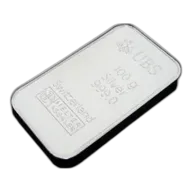
The 100g UBS Silver Bar
This bar contains 100 grams (3.215 troy ounces) of .999 fine silver. The 100g format is the metric counterpart to the 10 oz bar familiar in North America: close enough in weight that premiums are broadly comparable, and a practical entry point for buyers who think in grams rather than troy ounces. With a metal value of roughly $100, it is an affordable way to add meaningful silver weight in a single unit.
The case for the format is mostly about premium efficiency relative to flexibility. Smaller silver bars cost more per ounce: 1 oz bars typically run 8-15% over spot while bars in this weight class sit much closer to the 4-8% band that 10 oz bars occupy. A 100g bar therefore buys silver close to the cheapest rates available at retail scale without committing to kilo-sized purchases. European dealers in particular carry deep inventories of metric silver bars, since metric weights (100g, 250g, 500g, 1 kg) are the standard in European and Asian markets where 5 oz and 10 oz formats are not traditional.
On resale, the general rule for silver bars applies: bars from LBMA-accredited refiners command better buyback prices than generic bars, which typically sell at melt value only. Whatever the brand, a 100g bar is a standard trading size that any established dealer will buy, with spreads slightly wider than sovereign mint coins but narrower than oddball weights. Sealed bars in original packaging resell better than loose ones, so keep any packaging intact.
Tax on 100g Silver Bars by Country
Silver bars do not enjoy the near-universal tax exemption that investment gold does, so where you buy matters a great deal. At .999 fine, this bar meets the purity thresholds for the main exempting jurisdictions.
- United Kingdom: 20% VAT on new silver bullion, plus Capital Gains Tax on disposal since bars have no legal tender status. This double exposure makes silver bars the least tax-efficient silver form for UK buyers.
- European Union: Full national VAT applies to new silver, from 17% (Luxembourg) to 27% (Hungary), with most large markets at 19-21%. Margin-scheme pricing can reduce the effective rate on pre-owned bars in Germany and the Netherlands, but new bars attract the full rate.
- United States: State-dependent sales tax; roughly 35 states exempt bullion. Long-term gains are federally taxed at the collectibles rate of up to 28%.
- Canada: 0% GST/HST for silver at 99.9%+ purity in bar form.
- Australia: GST-free at 99.9%+ purity as investment-grade silver.
- New Zealand: GST-exempt at 99.9%+ purity.
- Singapore: 0% GST under the Investment Precious Metals scheme (silver at 99.9%+), with no capital gains tax. 100g is a common bar weight in the Singapore market.
- Hong Kong: No sales tax, no import duty, no capital gains tax.
For buyers in VAT countries, the tax difference between jurisdictions dwarfs any premium difference between brands, so compare prices on a like-for-like tax basis.
100g Silver Bar vs 10 oz, 1 oz, and Kilo Formats
The closest comparison is the 10 oz bar. At 100g versus 311g, the 10 oz bar is roughly three times the metal, and the two formats carry broadly comparable per-ounce premiums. Which suits you comes down to market and budget: 10 oz is the North American standard with the deepest dealer familiarity there, while 100g is the natural unit in European and Asian markets. A 100g bar also keeps the per-unit outlay around a third of a 10 oz purchase, which suits incremental buying.
Against 1 oz silver bars, the 100g format wins clearly on cost: the premium gap between 1 oz bars and bars in this weight class is the largest single saving available in the silver bar scale. The 1 oz format keeps maximum divisibility for buyers who expect to sell in small increments, but per ounce of silver acquired, it is the expensive way to stack.
Stepping up instead, the 1 kg bar is the international standard for retail silver and offers slightly lower premiums again, typically 3-6% over spot. The marginal saving from this weight class up to a kilo is real but smaller than the jump from 1 oz, and a kilo bar concentrates more value in a single unit that must be sold whole. For most buyers the choice between 100g and larger formats is a straightforward trade between premium efficiency and granularity.