1 listing
Filters

 Celtic Gold
Prices are fetched automatically and may not reflect current merchant prices. Currency conversions and tax treatment are approximate. Rankings are based solely on price. We are not a dealer and accept no responsibility for transactions with listed merchants. Past performance is not indicative of future results. This site does not provide investment advice. Full disclaimer
About the 10g B.H. Mayer Silver Bar
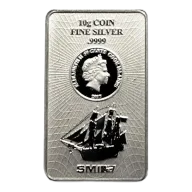
The 10g B.H. Mayer Silver Bar
This bar contains 10 grams (0.3215 troy oz) of .999 fine silver. Ten grams is a small weight by silver standards: small gram sizes like 1g, 5g, 10g, 50g, and 100g exist in silver but are far less common than they are in gold, where the gram system is a mainstream investment format. At roughly $10 of metal value at recent prices, 10g silver bars sit primarily in novelty and gift territory rather than serious accumulation, and that context shapes how a buyer should approach the purchase.
The economics follow directly from size. Minting, packaging, and distribution costs are largely fixed per bar regardless of how much silver is inside, so the smaller the bar, the larger those costs loom as a percentage of the price. The premium curve on silver bars runs from roughly 8-15% over spot at 1 oz down to 2-5% at 100 oz, and a 10g bar holds less than a third of an ounce, putting it at the expensive end of that spectrum on a percentage basis.
What the format does offer is a low absolute price point and easy gifting. A small minted bar arrives as a self-contained, branded object at a cost almost anyone can cover, which is precisely why mints keep producing the size. Buyers accumulating silver as an investment will get more metal for their money from 10 oz bars or other larger formats; buyers wanting a token of real silver at a small price are the natural audience here.
10g B.H. Mayer Silver Bar Specifications
| Attribute | Detail |
|---|---|
| Metal | Silver |
| Weight | 10 grams (0.3215 troy oz) |
| Purity | .999 fine silver |
| Form | Bar |
.999 is the standard fineness for retail silver bars. At this size, bars are produced as minted pieces, cut, stamped, and polished rather than cast, and small minted bars typically arrive in sealed packaging, which matters for resale: sealed bars in original packaging resell better than loose ones.
Verification is straightforward at this weight. The standard checks are precise weight against the 10-gram standard, dimension measurement, and the magnet slide test (silver is diamagnetic). Counterfeiting incentive is low for a bar holding around $10 of metal, and the common counterfeit approach for silver, a copper, lead, or zinc core under silver plating, shows up immediately as a weight or dimension mismatch on a piece this small. Silver tarnishes when exposed to sulphur compounds, so the bar should stay in its packaging in dry storage conditions.
10g Silver Bar Tax Treatment by Country
At .999 fineness the bar clears the purity thresholds that govern silver sales tax exemptions, though in threshold-based US states the low transaction value can matter.
- UK: 20% VAT on purchase. Bars have no legal tender status, so any gains are also within scope of Capital Gains Tax, although gains on a bar this size will sit far below the £3,000 annual allowance.
- US: No federal sales tax; most states exempt bullion, but several exempt only above a transaction threshold (for example $1,000 in New York and Massachusetts, $500 in Florida), which a single 10g silver bar will not reach. Buyers in threshold states pay sales tax on small purchases like this one.
- Canada: 0% GST/HST at 99.9%+ purity.
- Australia: GST-free as investment-grade silver, which requires at least 99.9% purity.
- New Zealand: GST-exempt at 99.9% silver purity.
- Singapore: 0% GST under the Investment Precious Metals scheme for qualifying silver at 99.9%+ purity; no capital gains tax.
- Hong Kong: no sales tax, no duties, no capital gains tax.
- EU: new silver attracts full national VAT, typically 17-27% depending on the country.
10g Silver vs 1 oz Bars and Coins
Against a 1 oz silver bar, the 10g bar loses on every investment measure. The 1 oz format already sits at the high-premium end of the bar scale at roughly 8-15% over spot, and fixed manufacturing costs weigh even more heavily on a bar holding less than a third of that metal. The 1 oz bar is also the more liquid unit; dealers trade it constantly, while small gram silver moves mainly as gifts.
Against a 1 oz sovereign silver coin such as a Britannia or Maple Leaf, the gap widens further. Sovereign coins carry higher absolute premiums than bars but bring legal tender status, universal dealer recognition, and, for UK buyers of UK coins, CGT exemption, none of which a small private-mint bar offers. A buyer choosing between one 1 oz coin and three 10g bars at a similar outlay gets more silver and a stronger resale market from the coin.
The honest comparison for a 10g silver bar is not against investment formats at all but against other small gifts. As a present or a first piece of silver, it delivers a genuine .999 fine bar at a minimal price, and the percentage premium is simply the cost of that accessibility. Buyers who find themselves purchasing several should switch formats: the per-ounce saving from consolidating into 1 oz bars or larger is immediate.
10g B.H. Mayer Silver Bar: frequently asked questions
-
B.H. Mayer is a private mint that produces this bar in 999 fine silver at a gross weight of 10g, giving it a silver content of 9.99 grams. It is a standard investment-grade bullion bar rather than a collectible, valued primarily for its metal content.
-
A 10g silver bar at 999 purity contains 9.99 grams of fine silver. The remaining 0.01 grams is trace alloy. At that weight, the bar holds approximately 0.321 troy ounces of silver, so its melt value moves directly with the silver spot price.