1 listing
Filters
| Product | /oz | Premium | Price | |
|---|---|---|---|---|

 Canadian PMX
Out of Stock
Canadian PMX
Out of Stock
|
$72.78 | +9.17% |
$2,339.85
CA$3,278
|
View Deal |
Prices are fetched automatically and may not reflect current merchant prices. Currency conversions and tax treatment are approximate. Rankings are based solely on price. We are not a dealer and accept no responsibility for transactions with listed merchants. Past performance is not indicative of future results. This site does not provide investment advice. Full disclaimer
About the 1 Kilo Beaver Bullion Silver Bar
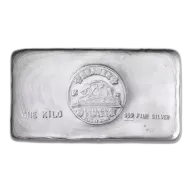
The 1 Kilo Beaver Bullion Silver Bar
A kilo silver bar sold under the Beaver Bullion name is, first and foremost, a play on the kilo format itself: 1,000 grams, or 32.15 troy ounces, the standard metric bullion weight and the international standard size for retail silver. Kilo bars carry premiums of roughly 3-6% over spot, among the lowest available for retail bullion alongside 100 oz bars. Switching from 1 oz units to a kilo bar saves approximately 6% on the silver value, which on a purchase in the $900-$1,000 range works out to $50-$70 kept in metal rather than premium.
Kilo buyers are optimising for the lowest cost per gram, not flexibility. The bar is an all-or-nothing sale; partial liquidation is not possible, so anyone who may need to raise small amounts of cash is better served holding 10 oz bars or smaller units. The marginal premium saving from 10 oz up to kilo is small, often under 1% per ounce, but it accumulates across large purchases, which is why serious stackers gravitate to the format.
Brand matters at resale for bars like this. Bars from recognised, LBMA-accredited refiners command better resale prices and tighter spreads, while bars from lesser-known producers typically sell at melt value with no brand premium recovered. A Beaver Bullion kilo bar should therefore be bought on price: if it is meaningfully cheaper per ounce than big-name alternatives, the discount compensates for selling at melt later; if the price is similar, the recognised refiner is the safer hold.
Tax Treatment of Kilo Silver Bars by Country
Silver bars do not enjoy the investment gold exemptions most countries offer, so the purchase jurisdiction drives the real cost of a kilo bar. Purity thresholds matter throughout; the figures below apply to bars meeting the standard .999 fineness for silver bars, so verify the fineness stamped on the specific bar.
- United States: no federal sales tax, and most states exempt bullion bars. A kilo bar's price clears the thresholds in partial-exemption states such as Florida ($500), New York and Massachusetts ($1,000), and California ($2,000). Long-term capital gains are taxed at the 28% collectibles rate. IRA-eligible silver must be 99.9%+ purity from accredited refiners.
- United Kingdom: 20% VAT on new silver bars, and no CGT exemption since bars are not legal tender. The larger the bar, the more the premium saving offsets the fixed VAT hit, but the double tax burden remains the UK silver bar problem.
- Canada: 0% GST/HST for silver refined to 99.9%+ purity in bar form.
- Australia: 0% GST for investment-grade silver at 99.9%+ purity from accredited sources; CGT applies with a 50% discount after a 12-month hold.
- New Zealand: GST-exempt at 99.9%+ silver purity; no formal capital gains tax.
- Singapore: GST-exempt under the Investment Precious Metals scheme for qualifying silver bars; no CGT. The kilo is the standard large format in Asian markets.
- Hong Kong: no sales tax, no import duty, no CGT.
- EU: full standard VAT on new silver bars at national rates (17-27%); margin scheme treatment may reduce the effective rate on second-hand bars in some countries.
Beaver Bullion Kilo Bar vs Branded and 100 oz Alternatives
The kilo silver bar market is crowded with LBMA-accredited names: PAMP Suisse, Valcambi, Heraeus, Umicore, Argor-Heraeus, the Royal Canadian Mint, and the Perth Mint all produce them, in both cast form (chunkier, often cheaper) and minted form (polished, serialised, sealed in assay cards). Against that field, a Beaver Bullion bar competes the way any lesser-known brand does: on purchase price. Accredited refiner bars are interchangeable globally and can be sold to dealers in any country without question; bars outside that circle remain sellable but trade at melt, and a buyer may want their own verification.
Verification on silver is at least straightforward. There is no tungsten-core problem as with gold, because no cheap metal approaches silver's density without being obviously wrong on weight; plated copper, lead, or zinc cores show up through weight and dimension mismatches, a magnet slide test, or specific gravity testing.
The other relevant comparison is format. The 100 oz silver bar is the traditional North American large format, roughly three kilo bars' worth of metal in one piece, with similar premiums; the kilo is the international standard and dominates in Europe, Asia, and Australia. Between them the choice is regional convention and transaction size. Below the kilo, 10 oz bars give up a little premium efficiency in exchange for much easier partial liquidation, which is the trade most retail stackers actually face.