1 listing Prices & premiums exclude tax to compare across countries
Filters
| Product | /oz | Premium | Price (ex. tax) | |
|---|---|---|---|---|

 Gold Bank
Out of Stock
Gold Bank
Out of Stock
|
$68.74 |
+4.20%
+25% inc.VAT
|
$2,210.02
£2,008 inc.VAT
|
View Deal |
Prices are fetched automatically and may not reflect current merchant prices. Currency conversions and tax treatment are approximate. Rankings are based solely on price. We are not a dealer and accept no responsibility for transactions with listed merchants. Past performance is not indicative of future results. This site does not provide investment advice. Full disclaimer
About the 1 Kilo Heimerle + Meule Silver Bar
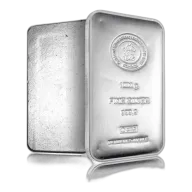
The 1 Kilo Heimerle + Meule Silver Bar
The 1 kilo Heimerle + Meule bar is a .9999 fine silver bar in the standard metric bullion weight. One kilogram is 32.1507 troy ounces, and the kilo is the international standard for large-format retail silver: the natural weight in Europe's metric markets, the dominant format in Asia, and the counterpart to the 100 oz bar tradition in North America. At current spot prices a silver kilo bar runs roughly $900-$1,000, with premiums of around 3-6%, among the lowest available for retail silver alongside 100 oz bars.
The .9999 fineness is worth noting: the standard purity for silver bars is .999, with four-nines bars produced by some refiners, so this bar sits at the higher purity standard. Either grade comfortably clears the tax-exemption thresholds in the jurisdictions that offer them.
Kilo buyers are optimising for the lowest cost per gram rather than flexibility. Moving from 1 oz bars to a kilo bar saves roughly 6% on the silver value, around $50-$70 on a ~$1,000 purchase, though the marginal saving over a 10 oz bar is small, often under 1% per ounce. The trade-off is the same as with any large bar: each kilo is an all-or-nothing sale, with no way to liquidate part of the position. For buyers accumulating in volume, kilo bars stack neatly and are more space-efficient per ounce than the same weight in smaller pieces.
Heimerle + Meule 1 Kilo Silver Bar Specifications
| Attribute | Value |
|---|---|
| Weight | 1 kilogram (1,000 g / 32.15 troy oz) |
| Purity | .9999 fine silver |
| Form | Bar |
| Manufacturer | Heimerle + Meule |
| Legal tender | No (private bar, no face value) |
A silver kilo bar measures approximately 114 x 57 x 13 mm, though exact dimensions vary by manufacturer, and weighs 1 kg (2.2 lbs). Silver's relatively low density of 10.49 g/cm3 makes the bar noticeably larger than the equivalent weight in gold, but it remains stackable in a home safe and compact relative to holding 32 individual ounces.
Storage considerations follow standard silver practice. Silver tarnishes in humid conditions, so bars should be kept below 50% relative humidity, with desiccant packets for basement or garage storage. Tarnish does not affect metal content, but clean bars present better at resale. For authentication, the usual large-bar checks apply: precise weight and dimension measurement, the magnet slide test (silver is diamagnetic), specific gravity, and sigma testing. There is no tungsten-core concern with silver, since tungsten is nearly twice as dense and would be obviously overweight in a correctly sized bar.
Tax Treatment of a 1 Kilo Silver Bar
As a silver bar with no legal tender status, the kilo bar follows standard silver bullion rules, and silver's tax position varies more by country than gold's.
- European Union: New silver bars attract full standard VAT at national rates, 19% in Germany and ranging roughly 17-27% across member states. The margin schemes available for some second-hand silver coins do not help with new bars from refiners.
- United Kingdom: 20% VAT on purchase and CGT liability on sale, making bars the least tax-efficient silver form for UK buyers despite the low premium.
- United States: No federal sales tax; around 35 states exempt bullion, and a roughly $1,000 kilo bar clears most threshold-based exemptions (Florida's $500, Louisiana's, Massachusetts' and New York's $1,000). Long-term gains are taxed at up to 28%. At .9999 the bar exceeds the IRS 99.9% fineness floor for IRA silver.
- Canada: GST/HST exempt as silver of at least 99.9% purity in bar form.
- Australia and New Zealand: GST-free in both at the 99.9% silver threshold, which .9999 exceeds.
- Singapore and Hong Kong: Singapore exempts qualifying investment silver from GST; Hong Kong levies no sales tax at all. Neither taxes capital gains, and the kilo is the standard large bar format across Asian markets.
Kilo Bars vs 10 oz, 100 oz, and Branded Alternatives
The kilo format faces competition from every major refiner: PAMP Suisse, Valcambi, the Royal Canadian Mint, Umicore, Heraeus, Argor-Heraeus, Asahi, Perth Mint, Nadir, and Geiger Edelmetalle all produce kilo silver bars, in both cast form (chunkier, often cheaper) and minted form (polished, serialised, in assay cards). Bars from LBMA-accredited refiners command the best buyback prices and tightest spreads; sealed bars in original packaging resell better than loose ones, and bars from lesser-known producers typically recover melt value only.
Against the 10 oz silver bar, the kilo saves a little on premium, often less than 1% per ounce, while tripling the size of each indivisible unit. For buyers who may want to sell in increments, the 10 oz format keeps more options open; for committed accumulators the kilo's lower cost per gram compounds across large purchases. Against the 100 oz silver bar, premiums are similar and the choice is largely regional: 100 oz is the traditional North American large bar, while the kilo is the international standard, particularly across Europe and Asia.
Kilo silver coins also exist, from the Perth Mint's Lunar, Koala, and Kookaburra ranges and from the Royal Mint, but they carry collector premiums above bar prices. For buyers at this weight whose goal is silver content rather than collectibility, the bar is the cost-efficient route.
1 Kilo Heimerle + Meule Silver Bar: frequently asked questions
-
The Heimerle + Meule 1kg bar is 999 fine silver (four-nines fine), containing 1 Kilo of pure silver. The 999.9 fineness is a step above the standard 999 bullion grade, meaning the bar carries only a trace of non-silver metal. It meets investment-grade purity requirements across major markets.
-
Silver does not use the karat system. Karat is a scale for gold purity only (24 karat = 100% gold). Silver is graded by millesimal fineness: 999 is standard bullion grade, 925 is sterling, and 999.9 (four-nines) is the highest commercial grade. The bullion equivalent of 24 karat gold is simply called fine silver.
-
Heimerle + Meule is a German precious metals refinery that produces silver bars in multiple sizes alongside other precious metal products. As with any bullion purchase, buyers can confirm a refiner's standing by checking whether the company appears on the LBMA (London Bullion Market Association) Good Delivery list, the global benchmark for wholesale bullion refiners.