1 listing
Filters
| Product | /oz | Premium | Price | |
|---|---|---|---|---|

 Monument Metals
Out of Stock
Monument Metals
Out of Stock
|
$64.14 | +3.12% | $2,062.32 | View Deal |
Prices are fetched automatically and may not reflect current merchant prices. Currency conversions and tax treatment are approximate. Rankings are based solely on price. We are not a dealer and accept no responsibility for transactions with listed merchants. Past performance is not indicative of future results. This site does not provide investment advice. Full disclaimer
About the 1 Kilo Istanbul Gold Refinery Silver Bar
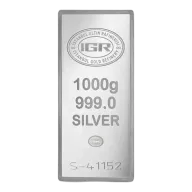
The 1 Kilo Istanbul Gold Refinery Silver Bar
This bar contains one kilogram of .999 fine silver, equal to 32.1507 troy ounces. The kilo is the standard metric bullion weight and the international standard size for retail silver, recognised across Europe, Asia and Australia. Buyers choosing 1 kilo silver bars are optimising for the lowest cost per gram rather than flexibility: premiums of roughly 3-6% over spot put kilo bars among the cheapest retail silver available, alongside 100 oz bars.
Kilo silver bars come in two styles. Cast bars are poured into moulds, look chunkier and often cost a little less; minted bars are polished, frequently serialised and sold in assay cards. Either way, a silver kilo bar measures approximately 114mm x 57mm x 13mm depending on the manufacturer and weighs 2.2 lbs, noticeably larger than the equivalent gold weight because silver is far less dense.
The trade-off for the low premium is divisibility. Each bar is a single unit worth roughly $900-$1,000 at recent spot prices, and partial liquidation is not possible; selling means parting with the whole kilo at once. For stackers accumulating serious weight that rarely matters, but anyone who may need to raise small amounts of cash is usually better served holding part of their position in smaller units. Storage is straightforward: kilo bars stack neatly and are more space-efficient per ounce than the same weight in 1 oz bars, though silver tarnishes in humid conditions, so dry storage with desiccant helps.
Tax Treatment for Kilo Silver Bars by Country
A kilo silver bar is a four-figure purchase in most currencies, so the tax regime where you buy has a meaningful cash impact.
- UK: New silver bars carry 20% VAT, and bars are liable for Capital Gains Tax on sale because they lack legal tender status. Kilo bars are popular with serious UK stackers despite this, since the low premium partly offsets the fixed VAT hit.
- US: Sales tax depends on the state; many exempt bullion entirely, others apply tax or exempt only above a threshold such as $1,000. Long-term capital gains are taxed at the collectibles rate of up to 28%. Silver at 99.9% purity from accredited refiners can be IRA-eligible.
- Canada: 0% GST/HST for silver refined to 99.9% or higher in bar form, which a .999 kilo bar meets.
- Australia: GST-free at 99.9% purity or higher as investment-grade silver.
- New Zealand: GST-exempt at 99.9% purity or higher; New Zealand has no formal capital gains tax.
- Singapore: 0% GST under the Investment Precious Metals scheme for qualifying silver of 99.9% purity or higher, and no capital gains tax. Kilo bars are particularly at home in Asian markets.
- Hong Kong: No sales tax, no import duty, no capital gains tax.
- EU: Full national VAT applies to new silver, typically 17-27% depending on the country.
Kilo Bars vs 10 oz and 100 oz Silver Bars
The kilo bar's closest rivals sit on either side of it on the weight scale. Against 10 oz silver bars, the kilo saves a little on premium, but the marginal saving from 10 oz to kilo is small, often under 1% per ounce. What the 10 oz bar offers in return is divisibility: three 10 oz bars can be sold one at a time, while a kilo is a single all-or-nothing transaction. The 10 oz format is the most popular silver bar size for exactly that balance.
Against the 100 oz bar, the comparison is mostly regional. A kilo is 32.15 oz, roughly one-third of a 100 oz bar, and premiums on the two formats are similar. The 100 oz bar is the traditional large silver format in North America, while the kilo is the international standard, dominant in Europe, Asia and Australia. A 100 oz bar weighs about 3.1 kg and ties up several thousand dollars in a single unit, so the kilo is the more manageable of the two for most buyers.
Compared with 1 oz silver bars at roughly 8-15% over spot, a kilo bar at 3-6% saves meaningful money on a sustained accumulation plan. The cost is liquidity granularity, and resale value depends on the refiner being recognised by dealers; bars from major refiners trade readily, while unrecognised brands tend to sell at melt value only.