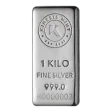
1 listing
Filters
| Product | /oz | Premium | Price | |
|---|---|---|---|---|

 BullionToGo
|
$81.18 |
+21.81%
+46% inc.VAT
|
$2,610.79
£2,348 inc.VAT
|
View Deal |
Prices are fetched automatically and may not reflect current merchant prices. Currency conversions and tax treatment are approximate. Rankings are based solely on price. We are not a dealer and accept no responsibility for transactions with listed merchants. Past performance is not indicative of future results. This site does not provide investment advice. Full disclaimer
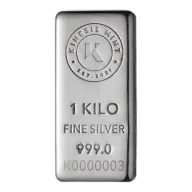
About the 1 Kilo Kinesis Silver Bar
The International Standard Silver Bar Weight
The 1 kilo Kinesis silver bar contains 1,000 grams of .999 fine silver, equal to 32.15 troy ounces. The kilogram is the standard metric bullion weight: every major refiner produces kilo bars, the format is recognised globally, and it dominates retail silver in Europe and Asia in the way the 100 oz bar dominates North America.
The economic case is cost per gram. Silver kilo bars carry premiums of roughly 3 to 6% over spot, among the lowest available in retail bullion alongside 100 oz bars. Switching from 1 oz pieces to a kilo bar saves around 6% on the silver value, roughly $50 to $70 on a purchase near $1,000 at recent spot prices. The marginal saving over a 10 oz bar is smaller, often under 1% per ounce, but it accumulates across a large position. Kilo buyers are optimising for the lowest cost of metal, not for flexibility.
That flexibility is the trade-off. A bar sells as a single unit, so partial liquidation is impossible, and a kilo represents a larger single transaction than a 10 oz bar when the time comes to sell. Resale also leans on brand recognition: bars from LBMA-accredited refiners enjoy ready dealer markets, while bars from less established producers may face wider buyback spreads or a verification step before purchase. As with any private bar, there is no face value and no legal tender status; the value is the metal and the stamp.
1 Kilo Silver Bar Specifications
| Attribute | Value |
|---|---|
| Fine silver content | 1 kg (32.15 troy oz) |
| Purity | .999 fine silver |
| Form | Rectangular bar |
| Typical dimensions (varies by maker) | Approximately 114 x 57 x 13 mm |
| Physical weight | 1 kg (2.2 lbs) |
| Face value | None; not legal tender |
Kilo silver bars come in two production styles across the market: cast bars, poured into moulds with a chunkier finish and usually the lower price, and minted bars, cut and polished, often serialised and packaged. Dimensions vary by manufacturer, and silver's relatively low density of 10.49 g/cm3 means a kilo of silver is noticeably larger than the same weight in gold.
Verification at this size relies on the standard toolkit for silver: precise weight on a calibrated scale, dimension checks against the maker's published specs, the magnet slide test that exploits silver's diamagnetic behaviour, specific gravity testing, or a sigma tester. There is no tungsten-core threat as with gold, since tungsten is nearly twice silver's density and would make a fake obviously overweight; plated base-metal cores are the realistic risk and are caught by weight and dimension mismatch. Storage needs dry conditions, ideally below 50% relative humidity with desiccant, because silver tarnishes when exposed to humid air and sulphur compounds. Multiple kilo bars stack neatly and store more efficiently per ounce than the same weight in coins.
Tax on Kilo Silver by Country
Silver is taxed far less kindly than gold in much of the world, and on a purchase the size of a kilo bar the difference is real money.
- United Kingdom: 20% VAT on new silver, and capital gains tax applies on disposal since bars have no legal tender status. UK stackers pay on both entry and exit; bonded or offshore vault storage defers the VAT only while the metal stays outside the UK.
- European Union: full local VAT rates of 17 to 27% by member state. The margin schemes available in Germany and the Netherlands cover pre-owned silver, not new refiner bars.
- United States: sales tax depends on the buyer's state; most exempt bullion, and the threshold states are generally cleared by a kilo-sized purchase. Gains are taxed at the collectibles rate of up to 28% for long-term holdings. IRA eligibility for silver requires 99.9% fineness plus accreditation requirements on the producer, so eligibility of any particular brand should be confirmed with the custodian.
- Canada: GST/HST exempt at the 99.9% federal purity threshold, which .999 silver exceeds.
- Australia and New Zealand: GST-free, with both countries setting the silver threshold at 99.9% purity.
- Singapore and Hong Kong: Singapore's Investment Precious Metals scheme exempts qualifying silver from GST, and Hong Kong levies no sales tax or import duty. The kilo is the standard retail format in both markets, making them the cheapest places in the world to take delivery of one.
1 Kilo Kinesis Silver Bar: frequently asked questions
-
The cheapest 1kg Kinesis silver bar we track is $2,610.79 from BullionToGo, currently around 21.8% over the $67.63 silver spot price. A kilogram bar carries a lower premium per ounce than smaller sizes, making it a common choice for buyers accumulating larger quantities.
-
Kinesis is the bullion brand of Kinesis Money, a private company that operates a gold and silver-backed digital currency platform. Physical bars carry the Kinesis brand and are private-mint products rather than sovereign or government-issued bullion.
-
Kinesis Money publishes that bullion held through its platform is physically allocated and stored in independently audited vaults. When you buy a physical Kinesis bar from a dealer and take delivery, it is simply a bar in your possession. Buyers who hold silver within the Kinesis platform (rather than taking delivery) should review Kinesis's published custody documentation and audit reports directly.